Department of Chemistry (DCH), University of Natural Resources and Life Sciences, Vienna, Austria.
Department of Biotechnology (DBT), University of Natural Resources and Life Sciences, Vienna, Austria.
Glycoconj J. 2024 Apr;41(2):151-162. doi: 10.1007/s10719-024-10148-9. Epub 2024 Apr 1.
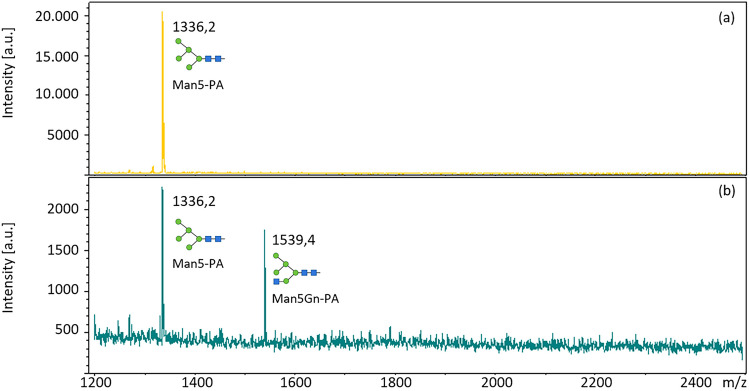
Molluscs are intermediate hosts for several parasites. The recognition processes, required to evade the host's immune response, depend on carbohydrates. Therefore, the investigation of mollusc glycosylation capacities is of high relevance to understand the interaction of parasites with their host. UDP-N-acetylglucosamine:α-1,3-D-mannoside β-1,2-N-acetylglucosaminyltransferase I (GnT-I) is the key enzyme for the biosynthesis of hybrid and complex type N-glycans catalysing the transfer of N-acetylglucosamine from UDP-N-acetylglucosamine to the α-1,3 Man antenna of ManGlcNAc. Thereby, the enzyme produces a suitable substrate for further enzymes, such as α-mannosidase II, GlcNAc-transferase II, galactosyltransferases or fucosyltransferases. The sequence of GnT- I from the Pacific oyster, Crassostrea gigas, was obtained by homology search using the corresponding human enzyme as the template. The obtained gene codes for a 445 amino acids long type II transmembrane glycoprotein and shared typical structural elements with enzymes from other species. The enzyme was expressed in insect cells and purified by immunoprecipitation using protein A/G-plus agarose beads linked to monoclonal His-tag antibodies. GnT-I activity was determined towards the substrates Man5-PA, MM-PA and GnM-PA. The enzyme displayed highest activity at pH 7.0 and 30 °C, using Man5-PA as the substrate. Divalent cations were indispensable for the enzyme, with highest activity at 40 mM Mn, while the addition of EDTA or Cu abolished the activity completely. The activity was also reduced by the addition of UDP, UTP or galactose. In this study we present the identification, expression and biochemical characterization of the first molluscan UDP-N-acetylglucosamine:α-1,3-D-mannoside β-1,2-N-acetylglucosaminyltransferase I, GnT-I, from the Pacific oyster Crassostrea gigas.
软体动物是几种寄生虫的中间宿主。为了逃避宿主的免疫反应,识别过程依赖于碳水化合物。因此,研究软体动物的糖基化能力对于理解寄生虫与宿主的相互作用具有重要意义。UDP-N-乙酰氨基葡萄糖:α-1,3-D-甘露糖苷β-1,2-N-乙酰氨基葡萄糖基转移酶 I (GnT-I) 是催化 UDP-N-乙酰氨基葡萄糖向甘露糖 GlcNAc 的α-1,3 甘露糖天线转移 N-乙酰氨基葡萄糖的生物合成中杂交和复合型 N-聚糖的关键酶。因此,该酶产生了适合进一步酶(如α-甘露糖苷酶 II、GlcNAc-转移酶 II、半乳糖基转移酶或岩藻糖基转移酶)的底物。使用相应的人酶作为模板,通过同源搜索获得太平洋牡蛎 Crassostrea gigas 的 GnT-I 序列。获得的基因编码一个 445 个氨基酸长的 II 型跨膜糖蛋白,与其他物种的酶具有典型的结构元件。该酶在昆虫细胞中表达,并使用与单克隆 His 标签抗体连接的蛋白 A/G-琼脂糖珠通过免疫沉淀进行纯化。使用 Man5-PA、MM-PA 和 GnM-PA 作为底物测定 GnT-I 的活性。该酶在 pH 7.0 和 30°C 下以 Man5-PA 作为底物显示出最高的活性。二价阳离子对该酶是必不可少的,在 40mM Mn 下活性最高,而添加 EDTA 或 Cu 则完全抑制了活性。UDP、UTP 或半乳糖的添加也降低了活性。本研究首次从太平洋牡蛎 Crassostrea gigas 中鉴定、表达和生化表征了第一个软体动物 UDP-N-乙酰氨基葡萄糖:α-1,3-D-甘露糖苷β-1,2-N-乙酰氨基葡萄糖基转移酶 I,GnT-I。