Harney Brendan L, Sacks-Davis Rachel, Agius Paul, van Santen Daniela K, Traeger Michael W, Wilkinson Anna L, Asselin Jason, Fairley Christopher K, Roth Norman, Bloch Mark, Matthews Gail V, Donovan Basil, Guy Rebecca, Stoové Mark, Hellard Margaret E, Doyle Joseph S
Disease Elimination Program, Burnet Institute, Melbourne, Victoria, Australia.
School of Public Health and Preventive Medicine, Monash University, Melbourne, Victoria, Australia.
Open Forum Infect Dis. 2024 Feb 19;11(4):ofae099. doi: 10.1093/ofid/ofae099. eCollection 2024 Apr.
In Australia, the incidence of hepatitis C virus (HCV) has declined among gay and bisexual men (GBM) with human immunodeficiency virus (HIV) since 2015 and is low among GBM using HIV preexposure prophylaxis (PrEP). However, ongoing HCV testing and treatment remains necessary to sustain this. To assess the potential utility of sexually transmissible infections (STIs) to inform HCV testing among GBM with HIV and GBM using PrEP, we examined the association between bacterial STI diagnoses and subsequent primary HCV infection.
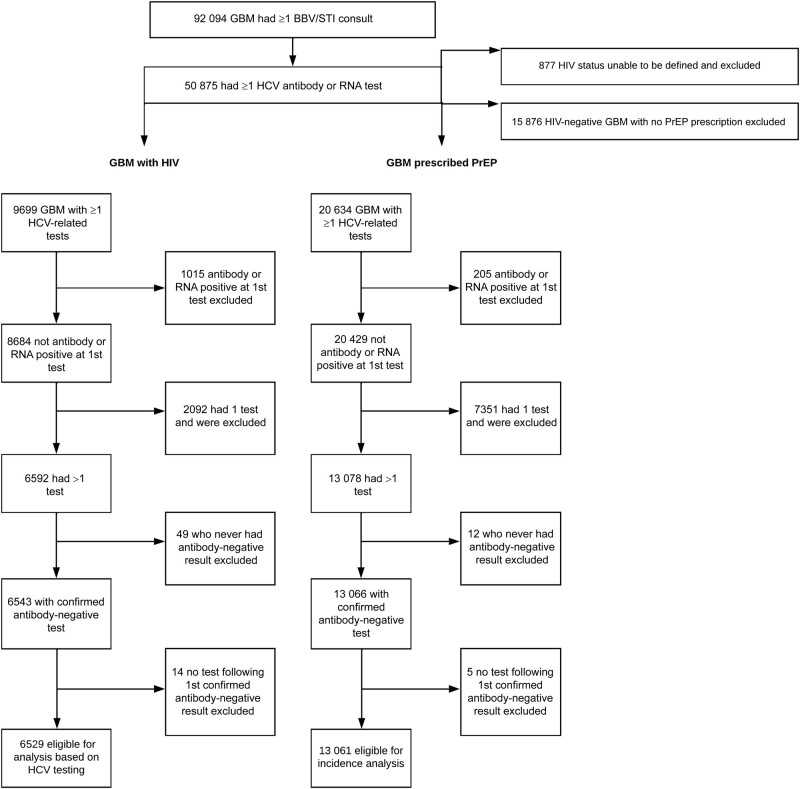
Data were from a national network of 46 clinics participating in the Australian Collaboration for Coordinated Enhanced Sentinel Surveillance. GBM included had ≥1 HCV antibody negative test result and ≥1 subsequent HCV antibody and/or RNA test. Discrete time survival analysis was used to estimate the association between a positive syphilis, rectal chlamydia, and rectal gonorrhea diagnosis in the previous 2 years and a primary HCV diagnosis, defined as a positive HCV antibody or RNA test result.
Among 6529 GBM with HIV, 92 (1.4%) had an incident HCV infection. A prior positive syphilis diagnosis was associated with an incident HCV diagnosis (adjusted hazard ratio, 1.99 [95% confidence interval, 1.11-3.58]). Among 13 061 GBM prescribed PrEP, 48 (0.4%) had an incident HCV diagnosis. Prior rectal chlamydia (adjusted hazard ratio, 2.75 [95% confidence interval, 1.42-5.32]) and rectal gonorrhea (2.54 [1.28-5.05]) diagnoses were associated with incident HCV.
Diagnoses of bacterial STIs in the past 2 years was associated with HCV incidence. These findings suggest that STIs might be useful for informing HCV testing decisions and guidelines for GBM with HIV and GBM using PrEP.
在澳大利亚,自2015年以来,感染人类免疫缺陷病毒(HIV)的男同性恋者和双性恋者(GBM)中丙型肝炎病毒(HCV)的发病率有所下降,在使用HIV暴露前预防(PrEP)的GBM中发病率较低。然而,持续进行HCV检测和治疗对于维持这一成果仍然必要。为了评估性传播感染(STIs)在为感染HIV的GBM和使用PrEP的GBM进行HCV检测时提供信息的潜在效用,我们研究了细菌性STI诊断与随后的原发性HCV感染之间的关联。
数据来自一个由46家诊所组成的全国性网络,这些诊所参与了澳大利亚协调强化哨点监测合作项目。纳入的GBM有≥1次HCV抗体阴性检测结果以及≥1次随后的HCV抗体和/或RNA检测。采用离散时间生存分析来估计前2年梅毒、直肠衣原体和直肠淋病诊断呈阳性与原发性HCV诊断之间的关联,原发性HCV诊断定义为HCV抗体或RNA检测结果呈阳性。
在6529名感染HIV的GBM中,92人(1.4%)发生了HCV感染。既往梅毒诊断呈阳性与HCV感染相关(调整后的风险比,1.99 [95%置信区间,1.11 - 3.58])。在13061名开具PrEP处方的GBM中,48人(0.4%)发生了HCV感染。既往直肠衣原体(调整后的风险比,2.75 [95%置信区间,1.42 - 5.32])和直肠淋病(2.54 [1.28 - 5.05])诊断与HCV感染相关。
过去2年的细菌性STI诊断与HCV发病率相关。这些发现表明,STIs可能有助于为感染HIV的GBM和使用PrEP的GBM的HCV检测决策及指南提供信息。