Division of Cardiology, Department of Internal Medicine Inha University College of Medicine Incheon South Korea.
Division of Cardiology, Department of Internal Medicine, Cardiovascular Imaging Center, Heart Vascular Stroke Institute, Samsung Medical Center Sungkyunkwan University School of Medicine Seoul Korea.
J Am Heart Assoc. 2024 Apr 16;13(8):e032929. doi: 10.1161/JAHA.123.032929. Epub 2024 Apr 2.
TRI-SCORE was recently developed in Europe as a risk model for predicting in-hospital death after isolated tricuspid valve surgery. We aimed to validate TRI-SCORE in an Asian population and investigate its value for predicting long-term outcomes.
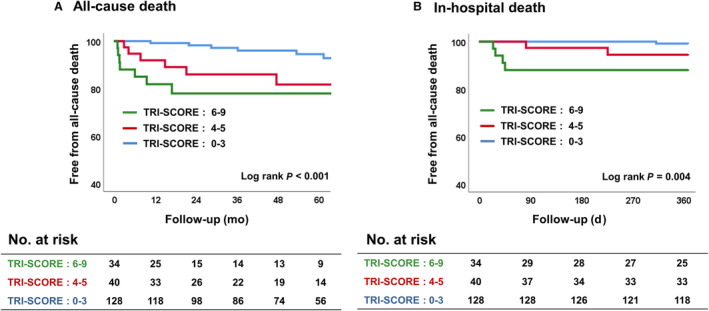
The TRI-SCORE was calculated for 202 patients (65±11 years, 61% women, 81% functional tricuspid regurgitation) who underwent isolated tricuspid valve surgery for severe tricuspid regurgitation at 2 Korean centers and was based on 8 parameters: age, New York Heart Association class, right-sided heart failure signs, furosemide daily dose, glomerular filtration rate, bilirubin, left ventricular ejection fraction, and moderate/severe right ventricular dysfunction. The primary outcome was all-cause death during follow-up; the secondary outcome was in-hospital death. During a median follow-up duration of 50 (interquartile range, 21-82) months after isolated tricuspid valve surgery, 23 (11.4%) patients experienced the primary outcome, and 7 (3.5%) patients experienced the secondary outcome. Observed all-cause death and in-hospital death increased by up to 50% in those with higher scores. Patients with the primary outcome had a higher TRI-SCORE (4.5±2.4 versus 2.9±2.1; =0.001) than those without. The TRI-SCORE showed a significant association with the primary outcome (concordance index, 0.77, cutoff value, 4) and in-hospital death (area under the curve, 0.84; cutoff value, 3). Using the Kaplan-Meier analysis, patients with a high TRI-SCORE exhibited a poor outcome for all-cause death at follow-up (log-rank <0.001) and in-hospital death (log-rank =0.004).
TRI-SCORE was validated in an Asian population and helped predict long-term outcomes after isolated tricuspid valve surgery.
TRI-SCORE 最近在欧洲被开发出来,作为预测孤立性三尖瓣手术后院内死亡的风险模型。我们旨在验证 TRI-SCORE 在亚洲人群中的适用性,并研究其对预测长期预后的价值。
我们为在韩国的 2 个中心接受孤立性三尖瓣手术治疗严重三尖瓣反流的 202 例患者(65±11 岁,61%为女性,81%为功能性三尖瓣反流)计算了 TRI-SCORE,该评分基于 8 个参数:年龄、纽约心脏协会分级、右侧心力衰竭体征、呋塞米日剂量、肾小球滤过率、胆红素、左心室射血分数和中重度右心室功能障碍。主要结局是随访期间的全因死亡;次要结局是院内死亡。在孤立性三尖瓣手术后中位随访时间为 50(四分位间距,21-82)个月期间,23(11.4%)例患者发生了主要结局,7(3.5%)例患者发生了次要结局。观察到,评分较高的患者的全因死亡和院内死亡增加了高达 50%。发生主要结局的患者的 TRI-SCORE 较高(4.5±2.4 比 2.9±2.1;=0.001)。TRI-SCORE 与主要结局(一致性指数,0.77,临界值,4)和院内死亡(曲线下面积,0.84;临界值,3)有显著关联。使用 Kaplan-Meier 分析,高 TRI-SCORE 患者在随访期间的全因死亡(对数秩检验<0.001)和院内死亡(对数秩检验=0.004)的预后较差。
TRI-SCORE 在亚洲人群中得到验证,有助于预测孤立性三尖瓣手术后的长期预后。