
伊朗扎格罗斯森林中栎木炭疽病病原菌 Biscogniauxia mediterranea 和 Obolarina persica 的潜在分布。
Potential distribution of Biscogniauxia mediterranea and Obolarina persica causal agents of oak charcoal disease in Iran's Zagros forests.
机构信息
Kohgiluyeh va Boyer-Ahmad Agricultural and Natural Resources Research and Education Center, Yasuj, Iran.
National center of genetic resources, Agricultural Research Education and Extention Organization, Tehran, Iran.
出版信息
Sci Rep. 2024 Apr 2;14(1):7784. doi: 10.1038/s41598-024-57298-2.
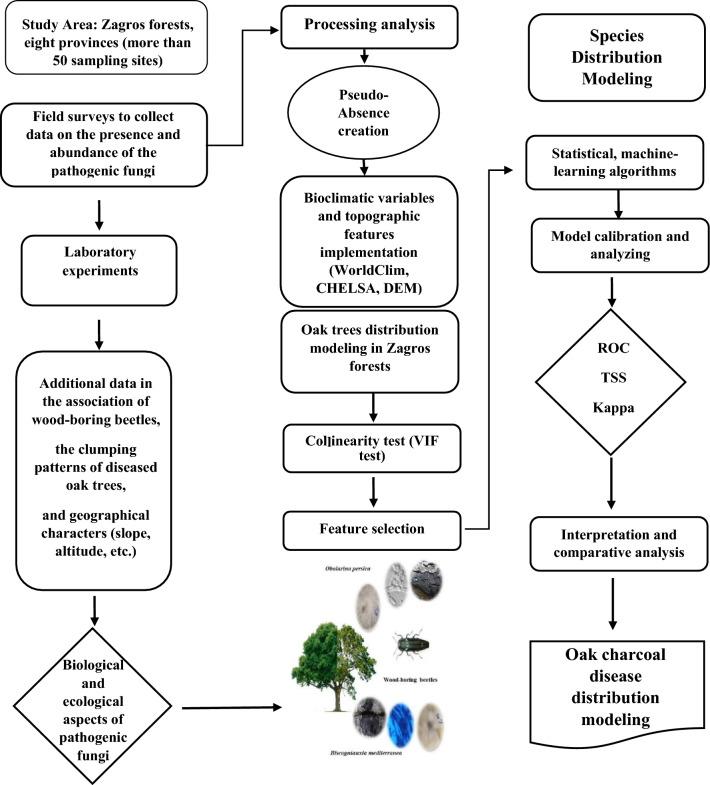
In Iran, native oak species are under threat from episodes of Charcoal Disease, a decline syndrome driven by abiotic stressors (e.g. drought, elevated temperature) and biotic components, Biscogniauxia mediterranea (De Not.) Kuntze and Obolarina persica (M. Mirabolfathy). The outbreak is still ongoing and the country's largest ever recorded. Still, the factors driving its' epidemiology in time and space are poorly known and such knowledge is urgently needed to develop strategies to counteract the adverse effects. In this study, we developed a generic framework based on experimental, machine-learning algorithms and spatial analyses for landscape-level prediction of oak charcoal disease outbreaks. Extensive field surveys were conducted during 2013-2015 in eight provinces (more than 50 unique counties) in the Zagros ecoregion. Pathogenic fungi were isolated and characterized through morphological and molecular approaches, and their pathogenicity was assessed under controlled water stress regimes in the greenhouse. Further, we evaluated a set of 29 bioclimatic, environmental, and host layers in modeling for disease incidence data using four well-known machine learning algorithms including the Generalized Linear Model, Gradient Boosting Model, Random Forest model (RF), and Multivariate Adaptive Regression Splines implemented in MaxEnt software. Model validation statistics [Area Under the Curve (AUC), True Skill Statistics (TSS)], and Kappa index were used to evaluate the accuracy of each model. Models with a TSS above 0.65 were used to prepare an ensemble model. The results showed that among the different climate variables, precipitation and temperature (Bio18, Bio7, Bio8, and bio9) in the case of O. persica and similarly, gsl (growing season length TREELIM, highlighting the warming climate and the endophytic/pathogenic nature of the fungus) and precipitation in case of B. mediterranea are the most important influencing variables in disease modeling, while near-surface wind speed (sfcwind) is the least important variant. The RF algorithm generates the most robust predictions (ROC of 0.95; TSS of 0.77 and 0.79 for MP and OP, respectively). Theoretical analysis shows that the ensemble model (ROC of 0.95 and 0.96; TSS = 0.79 and 0.81 for MP and OP, respectively), can efficiently be used in the prediction of the charcoal disease spatiotemporal distribution. The oak mortality varied ranging from 2 to 14%. Wood-boring beetles association with diseased trees was determined at 20%. Results showed that water deficiency is a crucial component of the oak decline phenomenon in Iran. The Northern Zagros forests (Ilam, Lorestan, and Kermanshah provinces) along with the southern Zagros forests (Fars and Kohgilouyeh va-Boyer Ahmad provinces) among others are the most endangered areas of potential future pandemics of charcoal disease. Our findings will significantly improve our understanding of the current situation of the disease to pave the way against pathogenic agents in Iran.
在伊朗,本土栎树物种受到木炭病的威胁,这是一种由非生物胁迫(如干旱、高温)和生物成分(如 Biscogniauxia mediterranea 和 Obolarina persica)驱动的衰退综合征。疫情仍在持续,是伊朗有记录以来最大的一次。尽管如此,其时空流行病学的驱动因素仍知之甚少,迫切需要这些知识来制定策略以应对不利影响。在这项研究中,我们开发了一个基于实验、机器学习算法和空间分析的通用框架,用于预测栎木炭病的爆发。在扎格罗斯生态区的八个省(50 多个独特的县)进行了广泛的实地调查。通过形态学和分子方法分离和鉴定了致病真菌,并在温室中进行了受控水分胁迫条件下的致病性评估。此外,我们在 29 种生物气候、环境和宿主层中评估了一组模型,用于使用四种著名的机器学习算法(包括广义线性模型、梯度提升模型、随机森林模型(RF)和多元自适应回归样条在 MaxEnt 软件中)对疾病发病率数据进行建模。使用曲线下面积(AUC)、真技能统计(TSS)和 Kappa 指数来评估每个模型的准确性。TSS 高于 0.65 的模型用于制备集成模型。结果表明,在不同的气候变量中,对于 O. persica 来说,降水和温度(Bio18、Bio7、Bio8 和 bio9),以及对于 B. mediterranea 来说,gsl(生长季节长度 TREELIM,突出了气候变暖以及真菌的内生/致病性质)和降水是疾病建模中最重要的影响变量,而近地表风速(sfcwind)是最不重要的变量。RF 算法生成最稳健的预测(ROC 为 0.95;对于 MP 和 OP,TSS 分别为 0.77 和 0.79)。理论分析表明,集成模型(ROC 为 0.95 和 0.96;TSS 分别为 0.79 和 0.81)可有效地用于预测木炭病的时空分布。栎树死亡率从 2%到 14%不等。与患病树木相关的蛀木甲虫的比例为 20%。结果表明,水分不足是伊朗栎树衰退现象的一个关键组成部分。北方扎格罗斯森林(伊拉姆、洛雷斯坦和克尔曼沙赫省)以及南方扎格罗斯森林(法尔斯和科吉卢耶-巴赫亚尔阿哈迈德省)等地区是未来木炭病潜在大流行的最危险地区。我们的研究结果将显著提高我们对该疾病现状的认识,为伊朗对抗致病因子铺平道路。




 Zotero 插件