Department of Medical and Translational Biology, Umeå University, SE-901 87, Umeå, Sweden.
Department of Clinical Sciences, Otorhinolaryngology, Umeå University, SE-901 87, Umeå, Sweden.
Eur J Med Res. 2024 Apr 3;29(1):216. doi: 10.1186/s40001-024-01812-9.
Desmin is a major cytoskeletal protein considered ubiquitous in mature muscle fibers. However, we earlier reported that a subgroup of muscle fibers in the soft palate of healthy subjects and obstructive sleep apnea patients (OSA) lacked immunoexpression for desmin. This raised the question of whether these fibers also lack messenger ribonucleic acid (mRNA) for desmin and can be considered a novel fiber phenotype. Moreover, some fibers in the OSA patients had an abnormal distribution and aggregates of desmin. Thus, the aim of the study was to investigate if these desmin protein abnormalities are also reflected in the expression of desmin mRNA in an upper airway muscle of healthy subjects and OSA patients.
Muscle biopsies from the musculus uvulae in the soft palate were obtained from ten healthy male subjects and six male patients with OSA. Overnight sleep apnea registrations were done for all participants. Immunohistochemistry, in-situ hybridization, and reverse transcription-quantitative polymerase chain reaction (RT-qPCR) techniques were used to evaluate the presence of desmin protein and its mRNA.
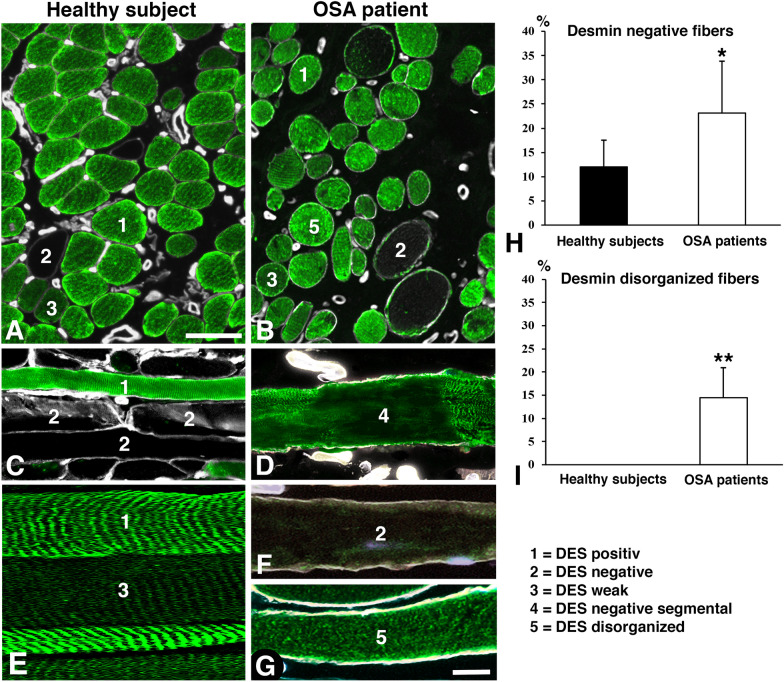
Our findings demonstrated that a group of muscle fibers lacked expression for desmin mRNA and desmin protein in healthy individuals and OSA patients (12.0 ± 5.6% vs. 23.1 ± 10.8%, p = 0.03). A subpopulation of these fibers displayed a weak subsarcolemmal rim of desmin accompanied by a few scattered mRNA dots in the cytoplasm. The muscles of OSA patients also differed from healthy subjects by exhibiting muscle fibers with reorganized or accumulated aggregates of desmin protein (14.5 ± 6.5%). In these abnormal fibers, the density of mRNA was generally low or concentrated in specific regions. The overall quantification of desmin mRNA by RT-qPCR was significantly upregulated in OSA patients compared to healthy subjects (p = 0.01).
Our study shows evidence that muscle fibers in the human soft palate lack both mRNA and protein for desmin. This indicates a novel cytoskeletal structure and challenges the ubiquity of desmin in muscle fibers. Moreover, the observation of reorganized or accumulated aggregates of desmin mRNA and desmin protein in OSA patients suggests a disturbance in the transcription and translation process in the fibers of the patients.
结蛋白是一种主要的细胞骨架蛋白,被认为在成熟的肌肉纤维中普遍存在。然而,我们之前的报告显示,健康受试者和阻塞性睡眠呼吸暂停患者(OSA)的软腭中的一组肌肉纤维缺乏结蛋白的免疫表达。这就提出了一个问题,即这些纤维是否也缺乏结蛋白的信使核糖核酸(mRNA),并可以被视为一种新型的纤维表型。此外,OSA 患者的一些纤维表现出结蛋白分布异常和聚集。因此,本研究的目的是研究在健康受试者和 OSA 患者的上气道肌肉中,这种结蛋白蛋白异常是否也反映在结蛋白 mRNA 的表达上。
从十名健康男性受试者和六名男性 OSA 患者的软腭悬雍垂肌肉中获得肌肉活检。所有参与者都进行了过夜睡眠呼吸暂停记录。采用免疫组织化学、原位杂交和反转录定量聚合酶链反应(RT-qPCR)技术评估结蛋白蛋白及其 mRNA 的存在。
我们的研究结果表明,一组肌肉纤维在健康个体和 OSA 患者中缺乏结蛋白 mRNA 和结蛋白表达(12.0±5.6%比 23.1±10.8%,p=0.03)。这些纤维的一个亚群表现出微弱的肌膜下结蛋白边缘,伴有细胞质中少数散在的 mRNA 斑点。OSA 患者的肌肉也与健康受试者不同,表现为肌纤维结蛋白重新组织或聚集(14.5±6.5%)。在这些异常纤维中,mRNA 的密度通常较低或集中在特定区域。与健康受试者相比,OSA 患者的结蛋白 mRNA 的总体定量通过 RT-qPCR 明显上调(p=0.01)。
我们的研究表明,人类软腭的肌肉纤维缺乏结蛋白的 mRNA 和蛋白。这表明存在一种新型的细胞骨架结构,并对结蛋白在肌肉纤维中的普遍性提出了挑战。此外,在 OSA 患者中观察到结蛋白 mRNA 和结蛋白蛋白的重新组织或聚集,表明患者纤维中的转录和翻译过程受到干扰。