BRAC (Formerly: Bangladesh Rural Advancement Committee), Dhaka, Bangladesh.
State Key Laboratory of Ophthalmology, Zhongshan Ophthalmic Center, Sun Yat-sen University, Guangzhou, China.
PLoS One. 2024 Apr 3;19(4):e0296115. doi: 10.1371/journal.pone.0296115. eCollection 2024.
Presbyopia, the leading cause of vision impairment globally, is common during working years. However, no trials have assessed presbyopia's impact on income.
In April 2017, we conducted a census among 59 Bangladesh villages to identify persons aged 35 to 65 years with presbyopia (presenting distance vision > = 6/12 bilaterally and correctable inability to see 6/13 at 40 cm with both eyes), who never had owned glasses. Participants were randomized (1:1) to receive immediate free reading glasses (intervention) or glasses delivered 8 months later (control). Visual demand of different jobs was stratified into three levels. Outcomes were between-group differences in the 8 month change in: self-reported monthly income (primary) and Near Vision Related Quality of Life (NVRQOL, secondary).
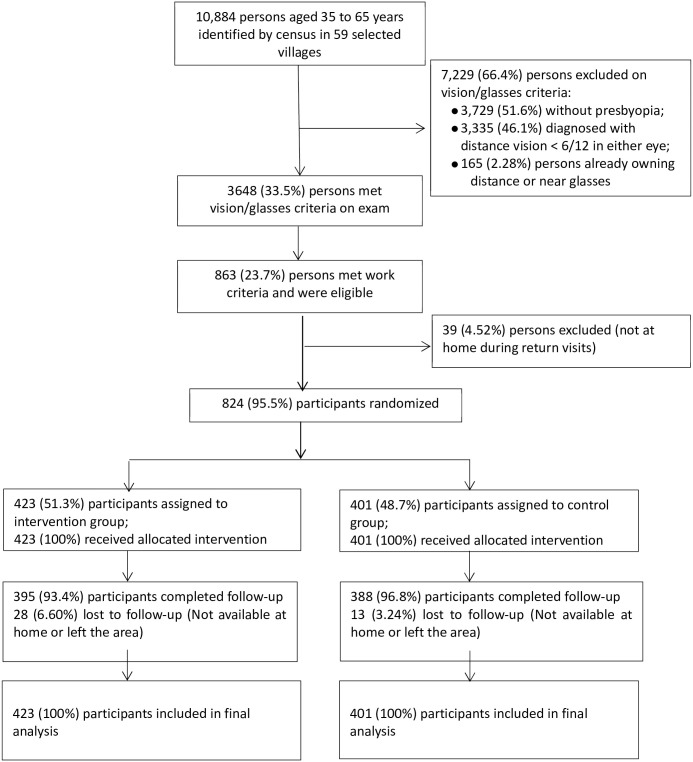
Among 10,884 census participants, 3,655 (33.6%) met vision criteria and 863 (23.6%) comprised a sample enriched for near vision-intensive jobs, but 39 (4.52%) could not be reached. All participants allocated to intervention (n = 423, 51.3%) and control (n = 401, 48.7%) received the appropriate intervention, and follow-up was available for 93.4% and 96.8% respectively. Groups were similar at baseline in all characteristics: mean age was 47 years, 50% were male, 35% literate, and about half engaged in "most near vision-intensive" occupations. Glasses wear at 8-month follow-up was 88.3% and 7.81% in intervention and control respectively. At baseline, both the intervention and control groups had a self-reported median monthly income of US$35.3. At endline, the median income for the intervention group was US$47.1 compared with US$35.3 for control, a difference of 33.4%. Predictors of greater income increase in multivariate models included intervention group allocation (OR 1.45, 95% CI 1.12, 1.88, P = 0.005), male sex (OR 2.41, 95% CI 1.84, 3.16, P <0.001), and not engaging in income-producing work at baseline (OR 2.35, 95% CI 1.69, 3.26, P<0.001).
Provision of reading glasses increases income in near vision-intensive occupations, and may facilitate return to work for those currently unemployed.
远视是全球导致视力损害的主要原因,在工作年龄中很常见。然而,尚无试验评估远视对收入的影响。
2017 年 4 月,我们对孟加拉国的 59 个村庄进行了普查,以确定 35 至 65 岁之间患有远视(双眼远距视力> = 6/12 且双眼矫正后无法看到 40 厘米处的 6/13)但从未戴过眼镜的人群。参与者被随机(1:1)分为接受即时免费阅读眼镜(干预组)或 8 个月后提供眼镜(对照组)。不同工作的视觉需求分为三个层次。主要结局是 8 个月时两组间自报告月收入(一级结局)和近视力相关生活质量(二级结局)的变化。
在 10884 名普查参与者中,有 3655 名(33.6%)符合视力标准,863 名(23.6%)构成了近视力密集型工作的样本富集,但有 39 名(4.52%)无法联系。所有分配到干预组(n = 423,51.3%)和对照组(n = 401,48.7%)的参与者均接受了适当的干预,分别有 93.4%和 96.8%的参与者获得了随访。两组在基线时的所有特征均相似:平均年龄为 47 岁,50%为男性,35%识字,约一半从事“最需要近视力”的职业。8 个月随访时,干预组和对照组的眼镜佩戴率分别为 88.3%和 7.81%。在基线时,干预组和对照组的自报告月收入中位数均为 35.3 美元。在终点时,干预组的收入中位数为 47.1 美元,而对照组为 35.3 美元,差异为 33.4%。多元模型预测收入增加的因素包括干预组分配(比值比 1.45,95%置信区间 1.12,1.88,P = 0.005)、男性(比值比 2.41,95%置信区间 1.84,3.16,P<0.001)和基线时不从事有收入工作(比值比 2.35,95%置信区间 1.69,3.26,P<0.001)。
提供阅读眼镜可增加近视力密集型职业的收入,并可能促进目前失业者重返工作岗位。