Women's College Hospital, Toronto, Ontario, Canada
Edwin S.H. Leong Centre for Healthy Children, University of Toronto, Toronto, Ontario, Canada.
BMJ Open. 2024 Apr 3;14(4):e078833. doi: 10.1136/bmjopen-2023-078833.
The community-based, longitudinal, Canadian HIV Women's Sexual and Reproductive Health Cohort Study (CHIWOS) explored the experiences of women with HIV in Canada over the past decade. CHIWOS' high-impact publications document significant gaps in the provision of healthcare to women with HIV. We used concept mapping to analyse and present a summary of CHIWOS findings on women's experiences navigating these gaps.
Concept mapping procedures were performed in two steps between June 2019 and March 2021. First, two reviewers (AY and PM) independently reviewed CHIWOS manuscripts and conference abstracts written before 1 August 2019 to identify main themes and generate individual concept maps. Next, the preliminary results were presented to national experts, including women with HIV, to consolidate findings into visuals summarising the experiences and care gaps of women with HIV in CHIWOS.
British Columbia, Ontario and Quebec, Canada.
A total of 18 individual CHIWOS team members participated in this study including six lead investigators of CHIWOS and 12 community researchers.
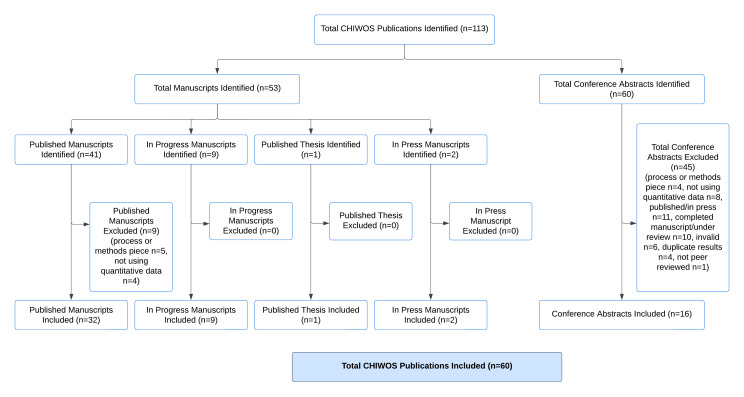
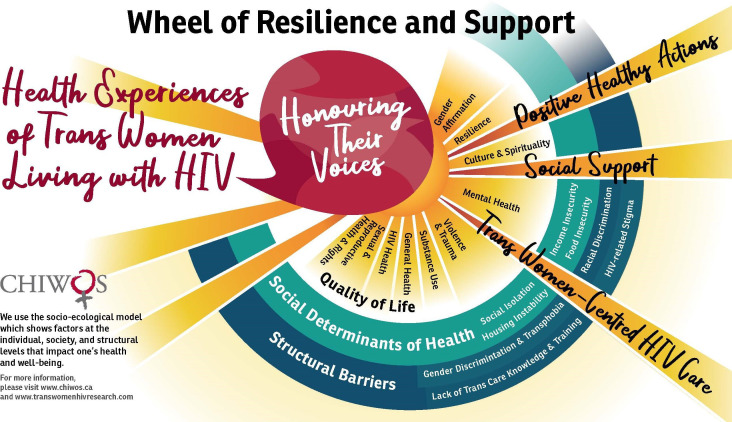
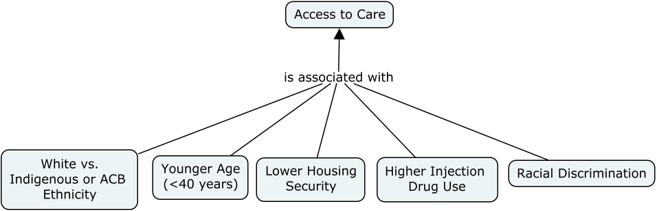
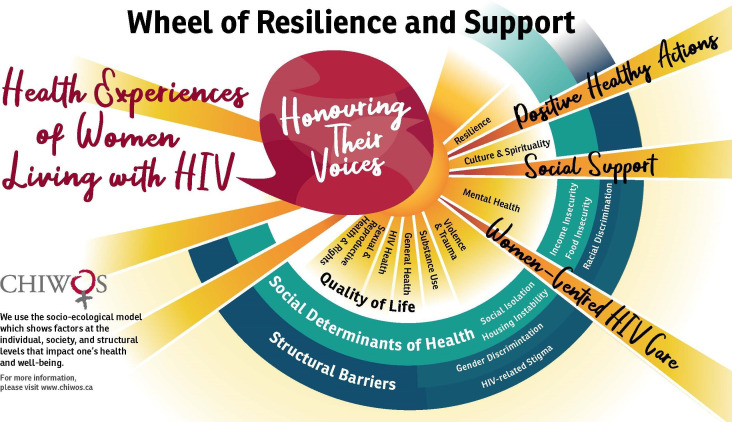
Overall, a total of 60 peer-reviewed manuscripts and conference abstracts met the inclusion criteria. Using concept mapping, themes were generated and structured through online meetings. In total, six composite concept maps were co-developed: quality of life, HIV care, psychosocial and mental health, sexual health, reproductive health, and trans women's health. Two summary diagrams were created encompassing the concept map themes, one for all women and one specific to trans women with HIV. Through our analysis, resilience, social support, positive healthy actions and women-centred HIV care were highlighted as strengths leading to well-being for women with HIV.
Concept mapping resulted in a composite summary of 60 peer-reviewed CHIWOS publications. This activity allows for priority setting to optimise care and well-being for women with HIV.
基于社区的、纵向的加拿大艾滋病毒女性性健康和生殖健康队列研究(CHIWOS)探讨了过去十年加拿大艾滋病毒女性的经历。CHIWOS 的高影响力出版物记录了艾滋病毒女性获得医疗保健方面的重大差距。我们使用概念映射来分析和呈现 CHIWOS 关于女性在解决这些差距方面的经验的研究结果摘要。
概念映射程序在 2019 年 6 月至 2021 年 3 月之间分两步进行。首先,两名评审员(AY 和 PM)独立审查了 2019 年 8 月 1 日之前撰写的 CHIWOS 手稿和会议摘要,以确定主要主题并生成个人概念图。接下来,将初步结果提交给包括艾滋病毒女性在内的国家专家,以将研究结果整合到总结艾滋病毒女性在 CHIWOS 中的经验和护理差距的视觉效果中。
加拿大不列颠哥伦比亚省、安大略省和魁北克省。
共有 18 名 CHIWOS 团队成员参加了这项研究,包括 CHIWOS 的六位首席研究员和 12 位社区研究人员。
共有 60 篇同行评审的手稿和会议摘要符合纳入标准。使用概念映射,通过在线会议生成和构建主题。总共开发了六张综合概念图:生活质量、艾滋病毒护理、心理社会和心理健康、性健康、生殖健康和跨性别女性健康。创建了两张涵盖概念图主题的总结图,一张适用于所有女性,一张适用于感染艾滋病毒的跨性别女性。通过我们的分析,韧性、社会支持、积极的健康行为和以女性为中心的艾滋病毒护理被强调为导致艾滋病毒女性健康和幸福的优势。
概念映射产生了 60 篇经过同行评审的 CHIWOS 出版物的综合摘要。这项活动可以优先考虑为艾滋病毒女性优化护理和福祉。