Economics Department, University of Texas at Austin, Austin, TX, United States of America.
Population Wellbeing Initiative, University of Texas at Austin, Austin, TX, United States of America.
PLoS One. 2024 Apr 4;19(4):e0298190. doi: 10.1371/journal.pone.0298190. eCollection 2024.
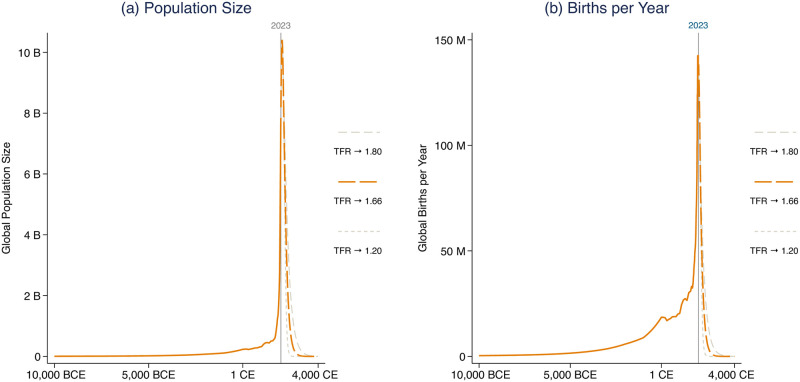
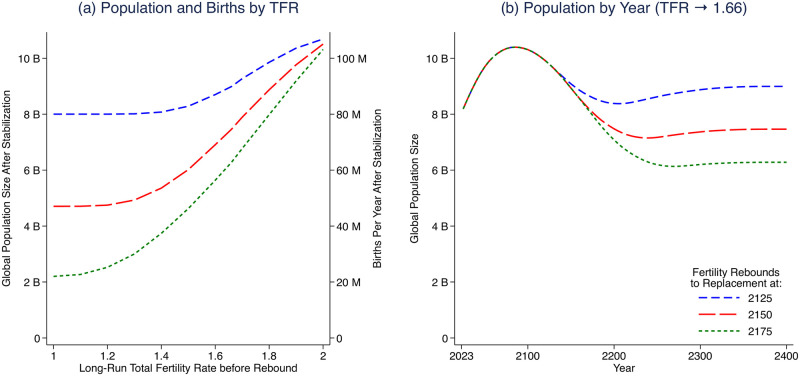
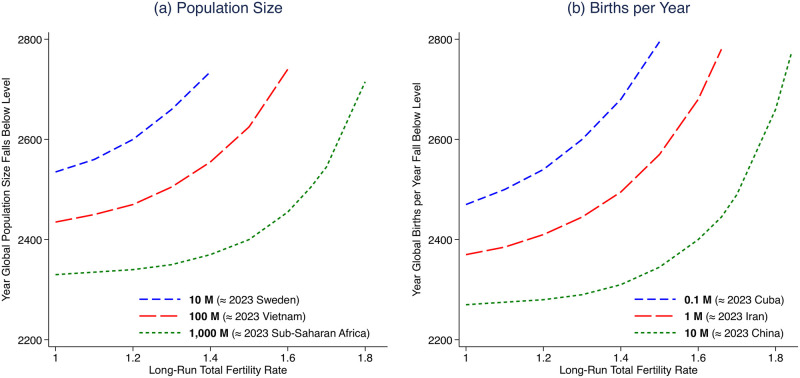
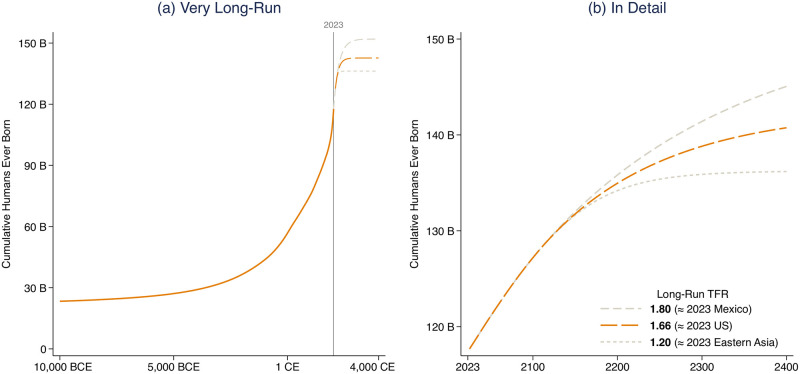
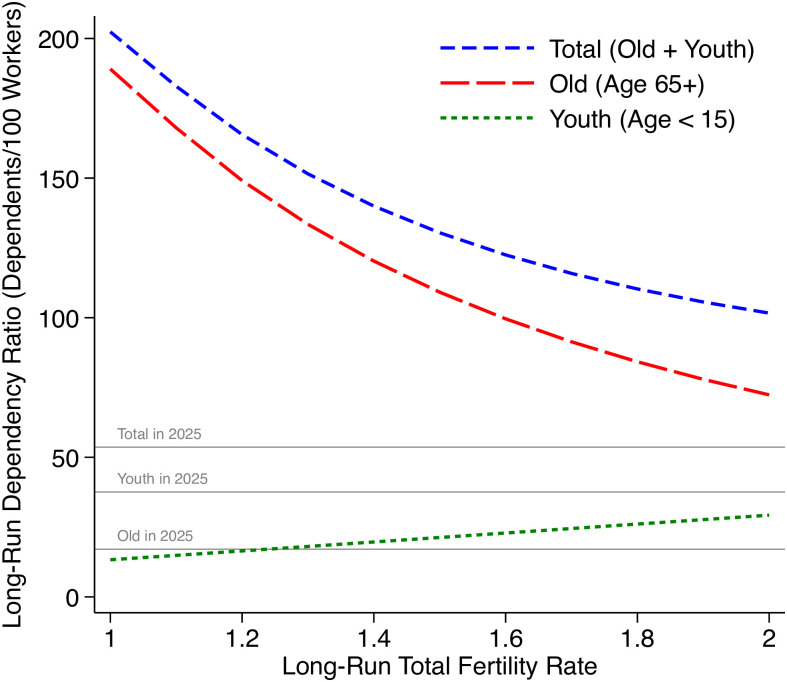
The size of the human population is projected to peak in the 21st century. But quantitative projections past 2100 are rare, and none quantify the possibility of a rebound from low fertility to replacement-level fertility. Moreover, the most recent long-term deterministic projections were published a decade ago; since then there has been further global fertility decline. Here we provide updated long-term cohort-component population projections and extend the set of scenarios in the literature to include scenarios in which future fertility (a) stays below replacement or (b) recovers and increases. We also characterize old-age dependency ratios. We show that any stable, long-run size of the world population would persistently depend on when an increase towards replacement fertility begins. Without such an increase, the 400-year span when more than 2 billion people were alive would be a brief spike in history. Indeed, four-fifths of all births-past, present, and future-would have already happened.
预计 21 世纪人类人口数量将达到峰值。但 2100 年以后的定量预测很少,也没有预测低生育率是否有可能反弹到更替生育率。此外,最近的长期确定性预测是在十年前发布的;自那时以来,全球生育率进一步下降。在这里,我们提供了更新的长期队列成分人口预测,并在文献中的情景集扩展到包括以下情景:(a)未来生育率保持在更替水平以下,或(b)恢复并增加。我们还描述了老年抚养比。我们表明,世界人口的任何稳定的长期规模都将持续取决于达到更替生育率的时间。如果没有这样的增长,那么 20 多亿人在世的 400 年跨度将是历史上的一个短暂峰值。事实上,过去、现在和未来的五分之四的出生人口已经发生了。