School of Pharmacy, Guangxi University of Chinese Medicine, Nanning, 530200, China.
Key Laboratory of TCM Neuro-metabolism and Immunopharmacology of Guangxi Education Department, Guangxi University of Chinese Medicine, Nanning, 530200, China.
BMC Complement Med Ther. 2024 Apr 4;24(1):144. doi: 10.1186/s12906-024-04403-7.
Mitochondrial dysfunction is one of the distinctive features of neurons in patients with Alzheimer's disease (AD). Intraneuronal autophagosomes selectively phagocytose and degrade the damaged mitochondria, mitigating neuronal damage in AD. Panax notoginseng saponins (PNS) can effectively reduce oxidative stress and mitochondrial damage in the brain of animals with AD, but their exact mechanism of action is unknown.
Senescence-accelerated mouse prone 8 (SAMP8) mice with age-related AD were treated with PNS for 8 weeks. The effects of PNS on learning and memory abilities, cerebral oxidative stress status, and hippocampus ultrastructure of mice were observed. Moreover, changes of the PTEN-induced putative kinase 1 (PINK1)-Parkin, which regulates ubiquitin-dependent mitophagy, and the recruit of downstream autophagy receptors were investigated.
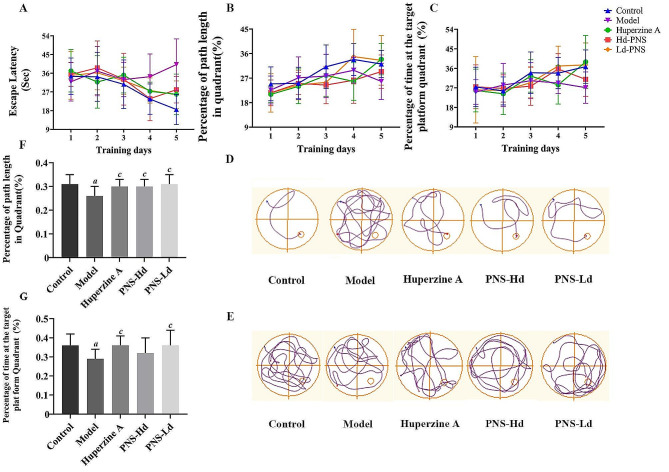
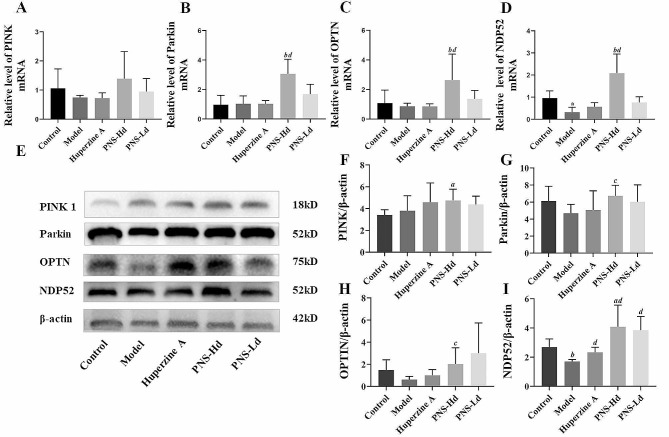
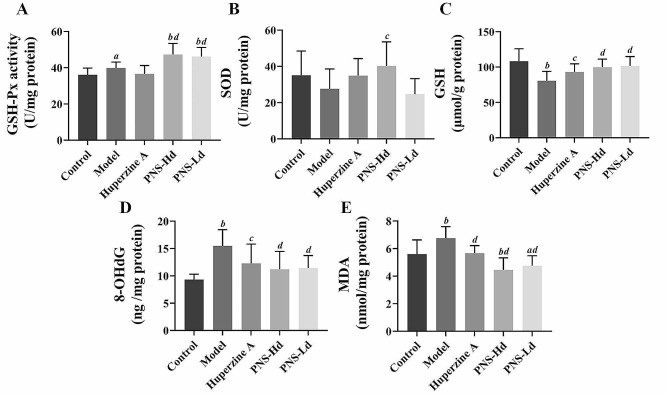
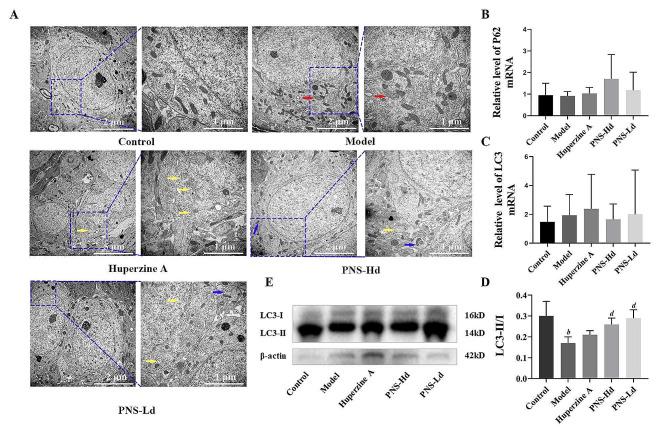
PNS attenuated cognitive dysfunction in SAMP8 mice in the Morris water maze test. PNS also enhanced glutathione peroxidase and superoxide dismutase activities, and increased glutathione levels by 25.92% and 45.55% while inhibiting 8-hydroxydeoxyguanosine by 27.74% and the malondialdehyde production by 34.02% in the brains of SAMP8 mice. Our observation revealed the promotion of mitophagy, which was accompanied by an increase in microtubule-associated protein 1 light chain 3 (LC3) mRNA and 70.00% increase of LC3-II/I protein ratio in the brain tissues of PNS-treated mice. PNS treatment increased Parkin mRNA and protein expression by 62.80% and 43.80%, while increasing the mRNA transcription and protein expression of mitophagic receptors such as optineurin, and nuclear dot protein 52.
PNS enhanced the PINK1/Parkin pathway and facilitated mitophagy in the hippocampus, thereby preventing cerebral oxidative stress in SAMP8 mice. This may be a mechanism contributing to the cognition-improvement effect of PNS.
线粒体功能障碍是阿尔茨海默病(AD)患者神经元的特征之一。细胞内自噬体选择性地吞噬和降解受损的线粒体,减轻 AD 中的神经元损伤。三七总皂苷(PNS)可有效减少 AD 动物大脑中的氧化应激和线粒体损伤,但具体作用机制尚不清楚。
用 PNS 处理衰老加速小鼠易感 8 型(SAMP8)小鼠 8 周,观察 PNS 对小鼠学习记忆能力、大脑氧化应激状态和海马超微结构的影响。此外,还研究了调节泛素依赖性线粒体自噬的 PTEN 诱导的假定激酶 1(PINK1)-Parkin 的变化以及下游自噬受体的募集情况。
PNS 可改善 SAMP8 小鼠在 Morris 水迷宫测试中的认知功能障碍。PNS 还增强了谷胱甘肽过氧化物酶和超氧化物歧化酶的活性,使 SAMP8 小鼠大脑中的谷胱甘肽水平分别增加了 25.92%和 45.55%,同时使 8-羟基脱氧鸟苷减少了 27.74%,使丙二醛生成减少了 34.02%。我们的观察结果表明,PNS 促进了线粒体自噬,这伴随着大脑组织中微管相关蛋白 1 轻链 3(LC3)mRNA 的增加和 LC3-II/I 蛋白比的增加,增加了 70.00%。PNS 治疗使 Parkin mRNA 和蛋白表达增加了 62.80%和 43.80%,同时增加了线粒体自噬受体如视神经萎缩蛋白和核点蛋白 52 的 mRNA 转录和蛋白表达。
PNS 增强了 PINK1/Parkin 通路,促进了 SAMP8 小鼠海马体中的线粒体自噬,从而防止了 SAMP8 小鼠大脑中的氧化应激。这可能是 PNS 改善认知的作用机制。