Goult Jonathan D, Van Daniel C L, Taylor Yasmin V, Inns Patrick G, Kaminska Renata, Vesely Martin, Kleanthous Colin, Paci Emanuele
Department of Biochemistry, University of Oxford, Oxford OX1 3QU, UK.
Astbury Centre for Structural Molecular Biology, University of Leeds, Leeds LS2 9JT, UK.
PNAS Nexus. 2024 Mar 27;3(4):pgae124. doi: 10.1093/pnasnexus/pgae124. eCollection 2024 Apr.
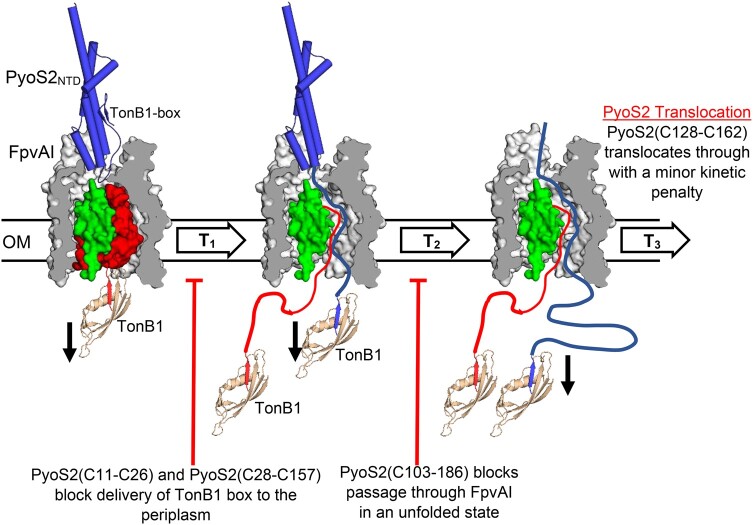
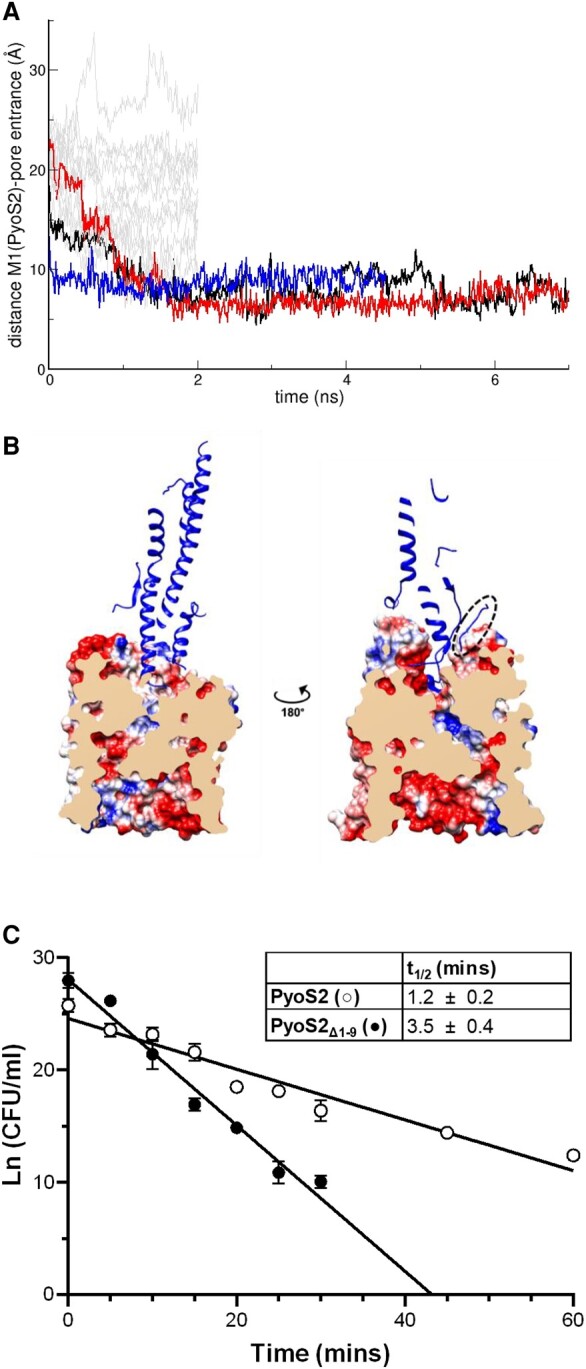
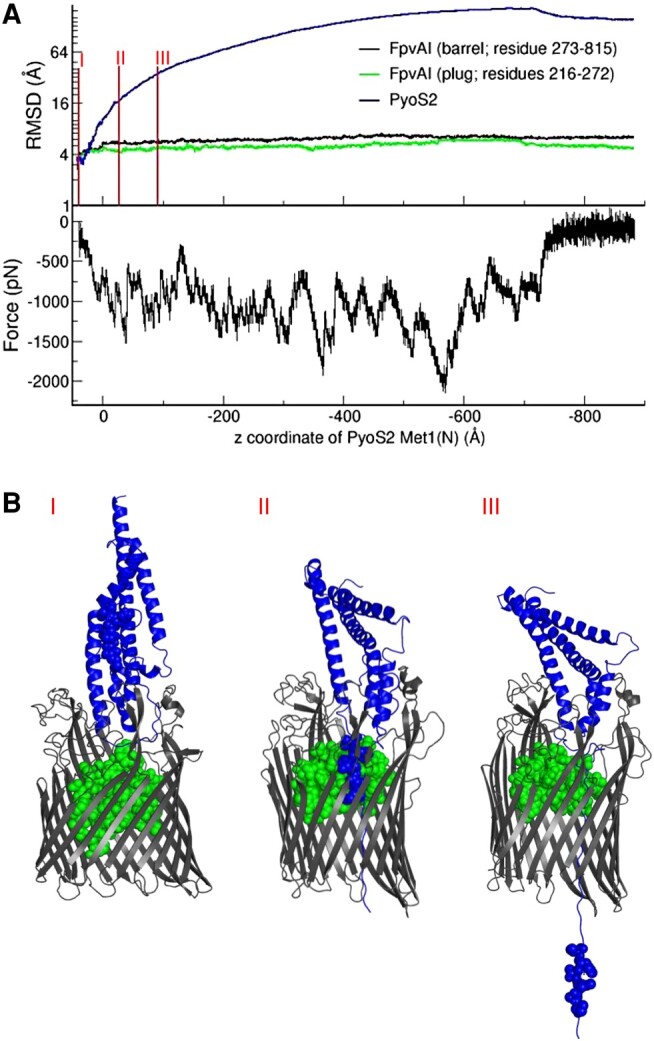
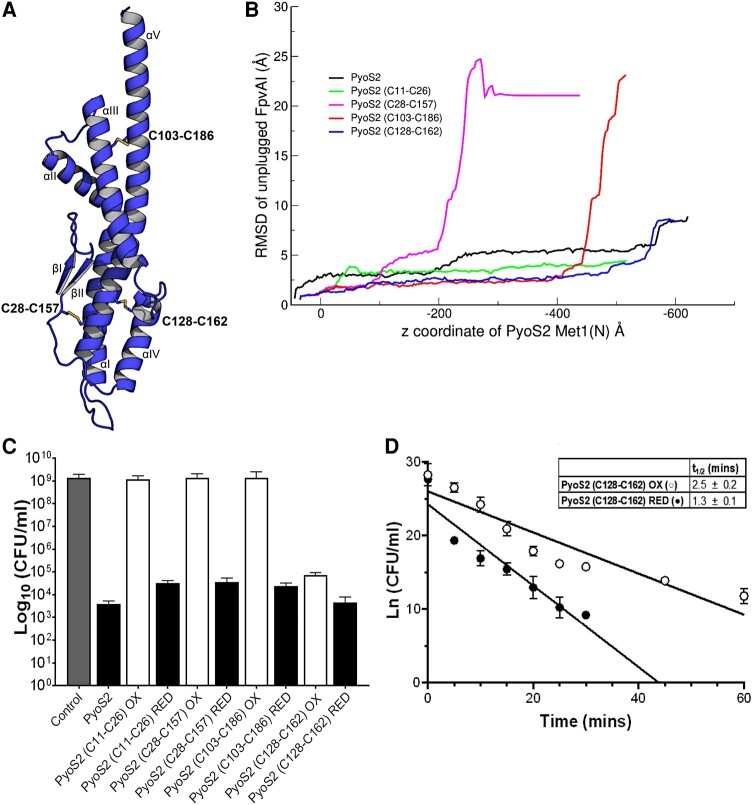
TonB-dependent transporters (TBDTs) mediate energized transport of essential nutrients into gram-negative bacteria. TBDTs are increasingly being exploited for the delivery of antibiotics to drug-resistant bacteria. While much is known about ground state complexes of TBDTs, few details have emerged about the transport process itself. In this study, we exploit bacteriocin parasitization of a TBDT to probe the mechanics of transport. Previous work has shown that the N-terminal domain of -specific bacteriocin pyocin S2 (PyoS2) is imported through the pyoverdine receptor FpvAI. PyoS2 transport follows the opening of a proton-motive force-dependent pore through FpvAI and the delivery of its own TonB box that engages TonB. We use molecular models and simulations to formulate a complete translocation pathway for PyoS2 that we validate using protein engineering and cytotoxicity measurements. We show that following partial removal of the FpvAI plug domain which occludes the channel, the pyocin's N-terminus enters the channel by electrostatic steering and ratchets to the periplasm. Application of force, mimicking that exerted by TonB, leads to unraveling of PyoS2 as it squeezes through the channel. Remarkably, while some parts of PyoS2 must unfold, complete unfolding is not required for transport, a result we confirmed by disulfide bond engineering. Moreover, the section of the FpvAI plug that remains embedded in the channel appears to serve as a buttress against which PyoS2 is pushed to destabilize the domain. Our study reveals the limits of structural deformation that accompanies import through a TBDT and the role the TBDT itself plays in accommodating transport.
依赖TonB的转运蛋白(TBDTs)介导必需营养物质向革兰氏阴性菌的能量驱动转运。TBDTs越来越多地被用于将抗生素递送至耐药细菌。虽然对TBDTs的基态复合物了解很多,但关于转运过程本身的细节却很少。在本研究中,我们利用TBDT的细菌素寄生作用来探究转运机制。先前的工作表明,特异性细菌素绿脓菌素S2(PyoS2)的N端结构域通过铁载体受体FpvAI导入。PyoS2的转运遵循通过FpvAI打开的质子动力势依赖性孔道以及其自身与TonB结合的TonB框的递送。我们使用分子模型和模拟来制定PyoS2的完整转运途径,并通过蛋白质工程和细胞毒性测量进行验证。我们表明,在部分去除堵塞通道的FpvAI堵塞结构域后,绿脓菌素的N端通过静电引导进入通道并棘轮式转运至周质。模拟TonB施加的力导致PyoS2在挤过通道时解折叠。值得注意的是,虽然PyoS2的某些部分必须解折叠,但转运并不需要完全解折叠,我们通过二硫键工程证实了这一结果。此外,仍嵌入通道中的FpvAI堵塞结构域部分似乎起到了支撑作用,PyoS2被推向该支撑以破坏该结构域的稳定性。我们的研究揭示了通过TBDT进行导入时伴随的结构变形的限度以及TBDT本身在适应转运中所起的作用。