Protein Homeostasis Laboratory, Department of Life Sciences, School of Natural Sciences, Shiv Nadar Institution of Eminence, Delhi-NCR, Gautam Buddha Nagar, Greater Noida, Uttar Pradesh 201314, India.
Chemical and Systems Biology Unit, CSIR-Institute of Genomics and Integrative Biology, New Delhi 110025, India.
G3 (Bethesda). 2024 Jun 5;14(6). doi: 10.1093/g3journal/jkae075.
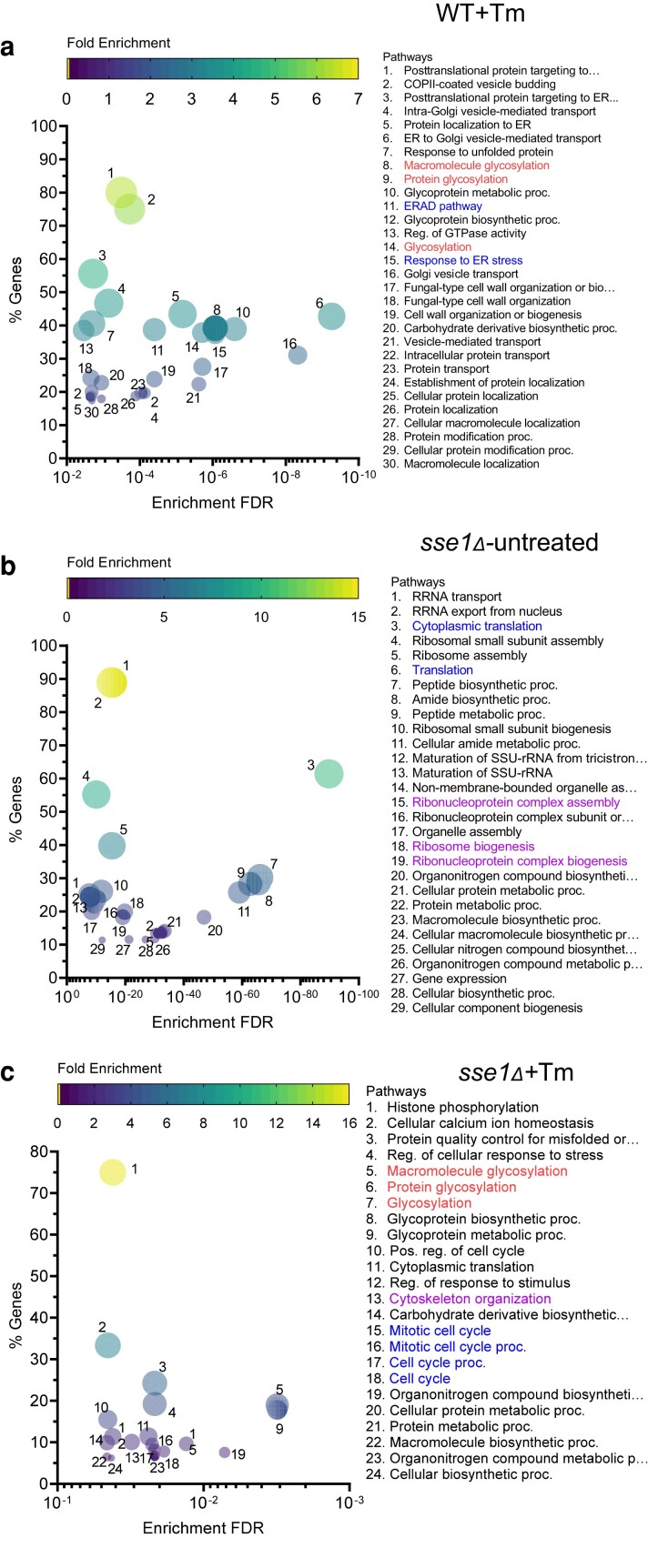
Sse1 is a cytosolic Hsp110 molecular chaperone of yeast, Saccharomyces cerevisiae. Its multifaceted roles in cellular protein homeostasis as a nucleotide exchange factor (NEF), as a protein-disaggregase and as a chaperone linked to protein synthesis (CLIPS) are well documented. In the current study, we show that SSE1 genetically interacts with IRE1 and HAC1, the endoplasmic reticulum-unfolded protein response (ER-UPR) sensors implicating its role in ER protein homeostasis. Interestingly, the absence of this chaperone imparts unusual resistance to tunicamycin-induced ER stress which depends on the intact Ire1-Hac1 mediated ER-UPR signaling. Furthermore, cells lacking SSE1 show inefficient ER-stress-responsive reorganization of translating ribosomes from polysomes to monosomes that drive uninterrupted protein translation during tunicamycin stress. In consequence, the sse1Δ strain shows prominently faster reversal from ER-UPR activated state indicating quicker restoration of homeostasis, in comparison to the wild-type (WT) cells. Importantly, Sse1 plays a critical role in controlling the ER-stress-mediated cell division arrest, which is escaped in sse1Δ strain during chronic tunicamycin stress. Accordingly, sse1Δ strain shows significantly higher cell viability in comparison to WT yeast imparting the stark fitness following short-term as well as long-term tunicamycin stress. These data, all together, suggest that cytosolic chaperone Sse1 is an important modulator of ER stress response in yeast and it controls stress-induced cell division arrest and cell death during overwhelming ER stress induced by tunicamycin.
Sse1 是酵母 Saccharomyces cerevisiae 的细胞质 Hsp110 分子伴侣。它作为核苷酸交换因子 (NEF)、蛋白解聚酶和与蛋白合成相关的伴侣 (CLIPS) 在细胞蛋白稳态中的多方面作用已有详细记录。在当前研究中,我们表明 SSE1 与内质网未折叠蛋白反应 (ER-UPR) 传感器 Ire1 和 Hac1 在遗传上相互作用,这表明其在 ER 蛋白稳态中的作用。有趣的是,这种伴侣的缺失赋予了对衣霉素诱导的 ER 应激的异常抗性,这依赖于完整的 Ire1-Hac1 介导的 ER-UPR 信号。此外,缺乏这种伴侣的细胞显示出从多核糖体到单核糖体的翻译核糖体在 ER 应激反应中重组的效率低下,这会在衣霉素应激期间驱动不间断的蛋白翻译。因此,sse1Δ 菌株在从 ER-UPR 激活状态的恢复中表现出明显更快的逆转,表明与野生型 (WT) 细胞相比,稳态更快地恢复。重要的是,Sse1 在控制 ER 应激介导的细胞分裂停滞中起着关键作用,在慢性衣霉素应激期间,sse1Δ 菌株逃脱了这种作用。因此,与 WT 酵母相比,sse1Δ 菌株在细胞活力方面表现出明显更高的存活率,这在短期和长期衣霉素应激后赋予了明显的适应性。所有这些数据表明,细胞质伴侣 Sse1 是酵母 ER 应激反应的重要调节剂,它控制应激诱导的细胞分裂停滞和衣霉素诱导的压倒性 ER 应激期间的细胞死亡。