Department of Mathematical Sciences, KAIST, Daejeon, 34141, Republic of Korea; Biomedical Mathematics Group, Pioneer Research Center for Mathematical and Computational Sciences, Institute for Basic Science, Daejeon, 34126, Republic of Korea.
Department of Psychiatry, Korea University College of Medicine, Seoul, 02841, Republic of Korea; Chronobiology Institute, Korea University, Seoul, 02841, Republic of Korea.
EBioMedicine. 2024 May;103:105094. doi: 10.1016/j.ebiom.2024.105094. Epub 2024 Apr 4.
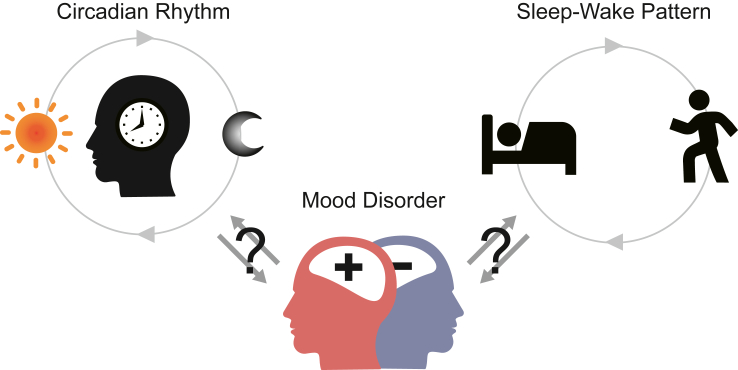
Sleep and circadian rhythm disruptions are common in patients with mood disorders. The intricate relationship between these disruptions and mood has been investigated, but their causal dynamics remain unknown.
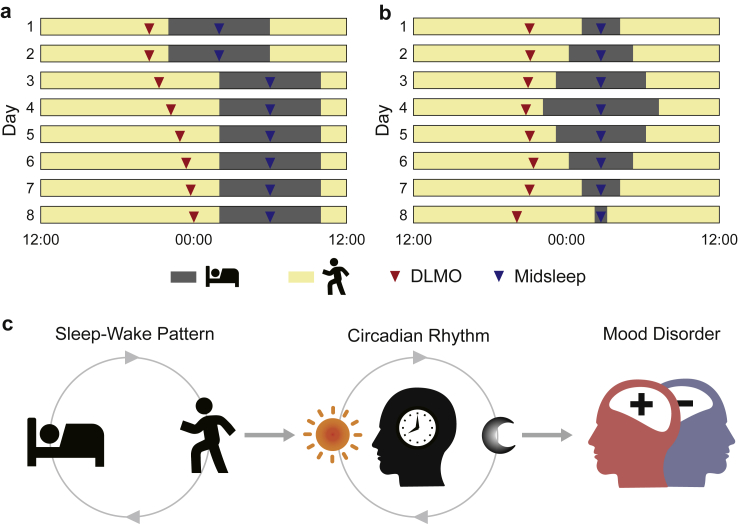
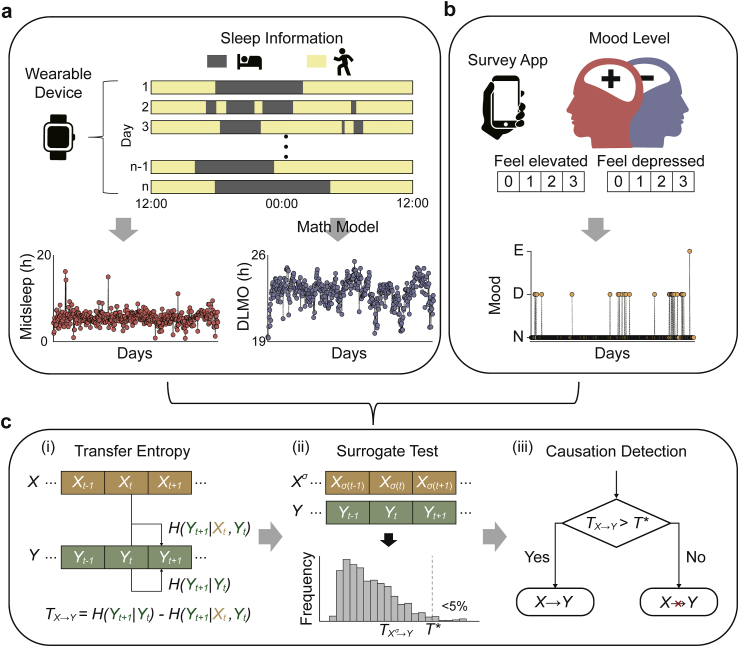
We analysed data from 139 patients (76 female, mean age = 23.5 ± 3.64 years) with mood disorders who participated in a prospective observational study in South Korea. The patients wore wearable devices to monitor sleep and engaged in smartphone-delivered ecological momentary assessment of mood symptoms. Using a mathematical model, we estimated their daily circadian phase based on sleep data. Subsequently, we obtained daily time series for sleep/circadian phase estimates and mood symptoms spanning >40,000 days. We analysed the causal relationship between the time series using transfer entropy, a non-linear causal inference method.
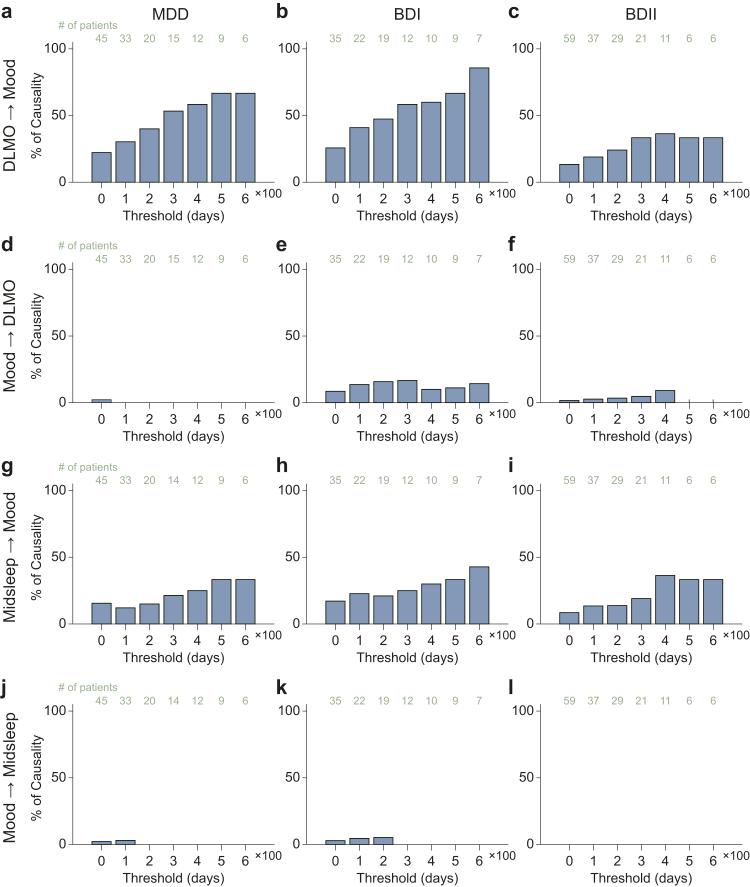
The transfer entropy analysis suggested causality from circadian phase disturbance to mood symptoms in both patients with MDD (n = 45) and BD type I (n = 35), as 66.7% and 85.7% of the patients with a large dataset (>600 days) showed causality, but not in patients with BD type II (n = 59). Surprisingly, no causal relationship was suggested between sleep phase disturbances and mood symptoms.
Our findings suggest that in patients with mood disorders, circadian phase disturbances directly precede mood symptoms. This underscores the potential of targeting circadian rhythms in digital medicine, such as sleep or light exposure interventions, to restore circadian phase and thereby manage mood disorders effectively.
Institute for Basic Science, the Human Frontiers Science Program Organization, the National Research Foundation of Korea, and the Ministry of Health & Welfare of South Korea.
睡眠和昼夜节律紊乱在情绪障碍患者中很常见。这些紊乱与情绪之间的复杂关系已经得到了研究,但它们的因果动态仍然未知。
我们分析了来自韩国一项前瞻性观察研究的 139 名情绪障碍患者(76 名女性,平均年龄 23.5 ± 3.64 岁)的数据。这些患者佩戴可穿戴设备来监测睡眠,并通过智能手机进行情绪症状的生态瞬时评估。我们使用数学模型根据睡眠数据估计他们的日常昼夜节律相位。随后,我们获得了跨越 >40000 天的睡眠/昼夜节律相位估计和情绪症状的每日时间序列。我们使用传递熵(一种非线性因果推断方法)分析了时间序列之间的因果关系。
传递熵分析表明,在 MDD(n=45)和 BD I 型(n=35)患者中,昼夜节律相位紊乱与情绪症状之间存在因果关系,在具有较大数据集(>600 天)的 66.7%和 85.7%的患者中表现出因果关系,但在 BD II 型(n=59)患者中没有。令人惊讶的是,睡眠相位紊乱与情绪症状之间没有表现出因果关系。
我们的研究结果表明,在情绪障碍患者中,昼夜节律相位紊乱直接导致情绪症状。这强调了在数字医学中靶向昼夜节律的潜力,例如睡眠或光照干预,以恢复昼夜节律相位,从而有效地治疗情绪障碍。
基础科学研究所、人类前沿科学计划组织、韩国国家研究基金会和韩国保健福利部。