Department of Clinical Sciences, Lund University, Malmö, Sweden
Department of Clinical Physiology, Skånes universitetssjukhus Malmö, Malmö, Sweden.
Heart. 2024 May 23;110(12):831-837. doi: 10.1136/heartjnl-2023-323681.
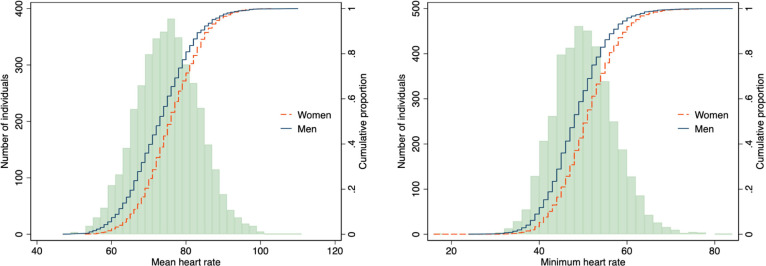
Elevated heart rate (HR) predicts cardiovascular disease and mortality, but there are no established normal limits for ambulatory HR. We used data from the Swedish CArdioPulmonary Imaging Study to determine reference ranges for ambulatory HR in a middle-aged population. We also studied clinical correlates of ambulatory HR.
A 24-hour ECG was registered in 5809 atrial fibrillation-free individuals, aged 50-65 years. A healthy subset (n=3942) was used to establish reference values (excluding persons with beta-blockers, cardiovascular disease, hypertension, heart failure, anaemia, diabetes, sleep apnoea or chronic obstructive pulmonary disease).Minimum HR was defined as the lowest 1-minute HR. Reference ranges are reported as means±SDs and 2.5th-97.5th percentiles. Clinical correlates of ambulatory HR were analysed with multivariable linear regression.
The average mean and minimum HRs were 73±9 and 48±7 beats per minute (bpm) in men and 76±8 and 51±7 bpm in women; the reference range for mean ambulatory HR was 57-90 bpm in men and 61-92 bpm in women. Average daytime and night-time HRs are also reported. Clinical correlates, including age, sex, height, body mass index, physical activity, smoking, alcohol intake, diabetes, hypertension, haemoglobin level, use of beta-blockers, estimated glomerular filtration rate, per cent of predicted forced expiratory volume in 1 s and coronary artery calcium score, explained <15% of the interindividual differences in HR.
Ambulatory HR varies widely in healthy middle-aged individuals, a finding with relevance for the management of patients with a perception of tachycardia. Differences in ambulatory HR between individuals are largely independent of common clinical correlates.
心率(HR)升高可预测心血管疾病和死亡率,但尚无静息 HR 的既定正常范围。我们使用来自瑞典心肺成像研究的数据,确定了中年人群静息 HR 的参考范围。我们还研究了静息 HR 的临床相关性。
在 5809 例无房颤的个体中记录了 24 小时心电图,年龄在 50-65 岁之间。使用健康亚组(n=3942)来确定参考值(排除使用β受体阻滞剂、心血管疾病、高血压、心力衰竭、贫血、糖尿病、睡眠呼吸暂停或慢性阻塞性肺疾病的个体)。最低 HR 定义为最低 1 分钟 HR。参考范围以平均值±SD 和 2.5-97.5 百分位数报告。使用多变量线性回归分析静息 HR 的临床相关性。
男性平均 HR 和最低 HR 分别为 73±9 次/分和 48±7 次/分,女性分别为 76±8 次/分和 51±7 次/分;男性静息 HR 的参考范围为 57-90 次/分,女性为 61-92 次/分。还报告了平均日间和夜间 HR。包括年龄、性别、身高、体重指数、体力活动、吸烟、饮酒、糖尿病、高血压、血红蛋白水平、β受体阻滞剂使用、估计肾小球滤过率、预计 1 秒用力呼气量的百分比和冠状动脉钙评分在内的临床相关性解释了 HR 个体差异的<15%。
在健康的中年个体中,静息 HR 差异很大,这一发现与对感知心动过速患者的管理有关。个体之间静息 HR 的差异在很大程度上独立于常见的临床相关性。