Department of Pharmaceutics, School of Pharmacy (K.C.B.Y., N.I.), Department of Chemistry (A.M., B.P.Z., M.F.B.), and Department of Medicinal Chemistry (A.N.), University of Washington, Seattle, Washington.
Department of Pharmaceutics, School of Pharmacy (K.C.B.Y., N.I.), Department of Chemistry (A.M., B.P.Z., M.F.B.), and Department of Medicinal Chemistry (A.N.), University of Washington, Seattle, Washington
Mol Pharmacol. 2024 May 17;105(6):395-410. doi: 10.1124/molpharm.124.000878.
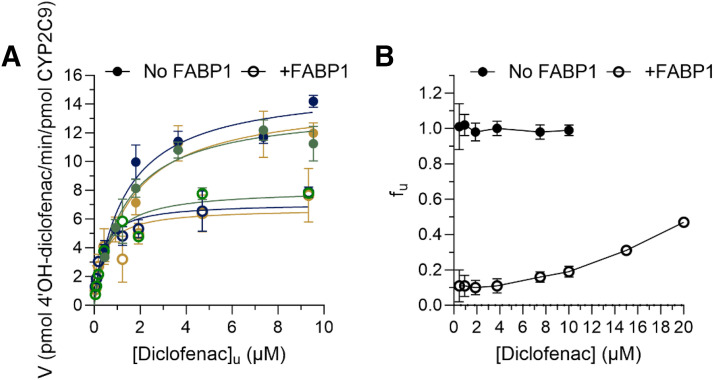
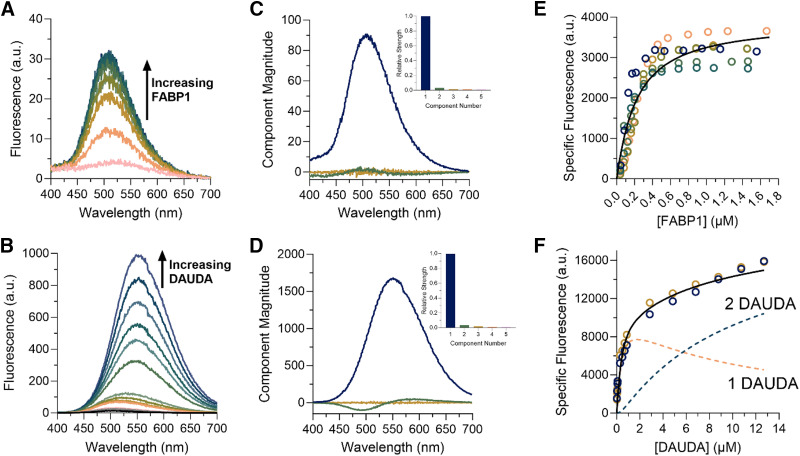
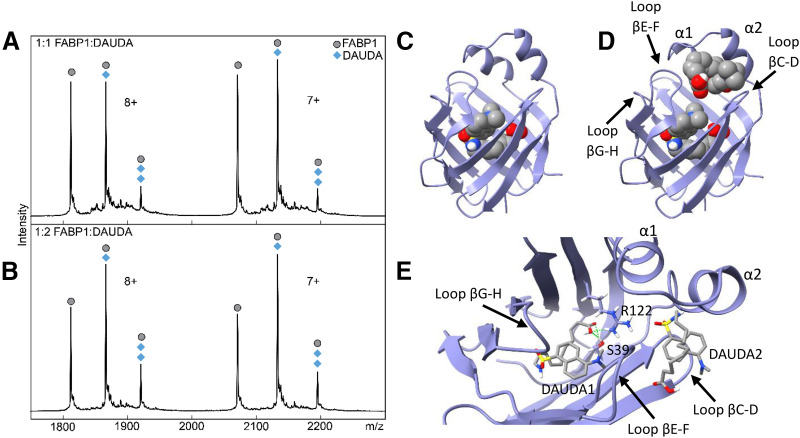
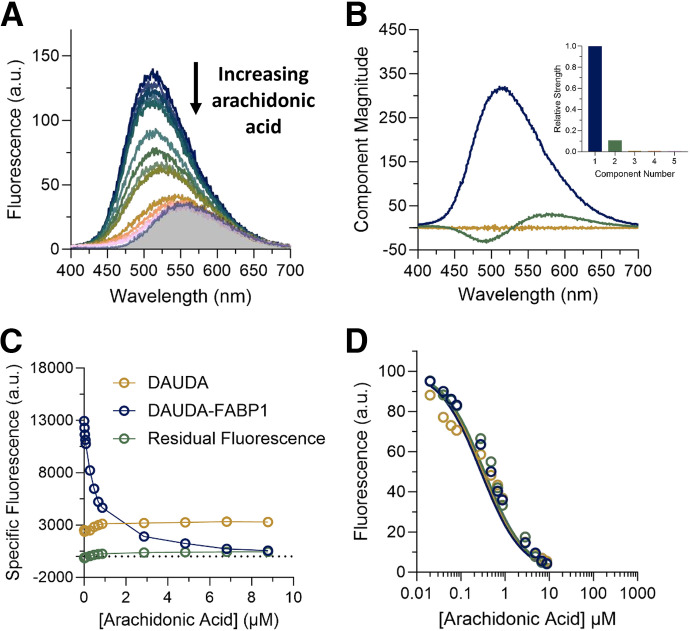
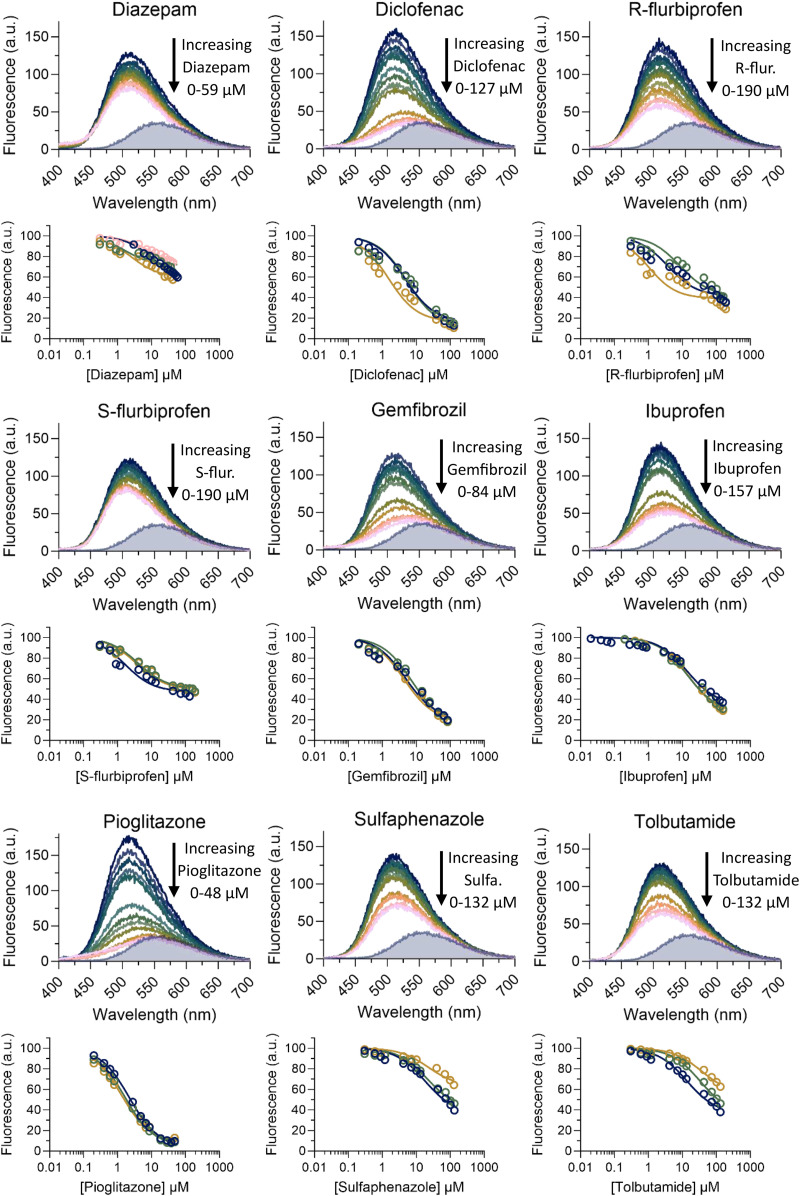
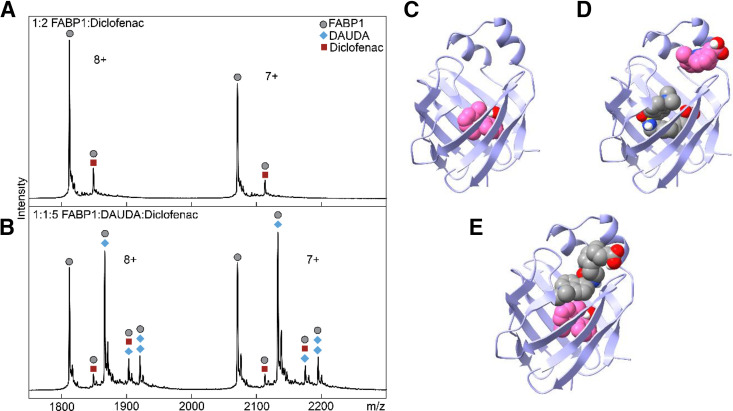
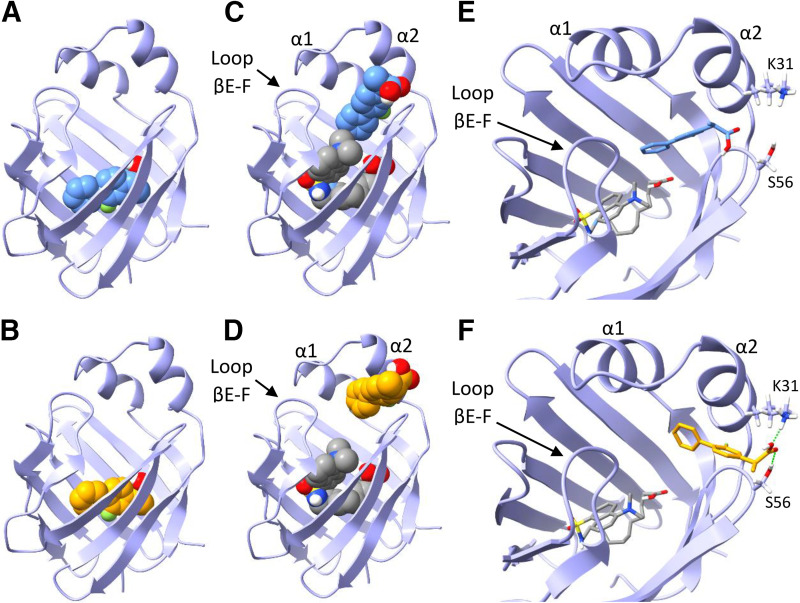
Liver fatty acid binding protein 1 (FABP1) binds diverse endogenous lipids and is highly expressed in the human liver. Binding to FABP1 alters the metabolism and homeostasis of endogenous lipids in the liver. Drugs have also been shown to bind to rat FABP1, but limited data are available for human FABP1 (hFABP1). FABP1 has a large binding pocket, and up to two fatty acids can bind to FABP1 simultaneously. We hypothesized that drug binding to hFABP1 results in formation of ternary complexes and that FABP1 binding alters drug metabolism. To test these hypotheses, native protein mass spectrometry (MS) and fluorescent 11-(dansylamino)undecanoic acid (DAUDA) displacement assays were used to characterize drug binding to hFABP1, and diclofenac oxidation by cytochrome P450 2C9 (CYP2C9) was studied in the presence and absence of hFABP1. DAUDA binding to hFABP1 involved high (K = 0.2 M) and low (K > 10 M) affinity binding sites. Nine drugs bound to hFABP1 with equilibrium dissociation constant (K) values ranging from 1 to 20 M. None of the tested drugs completely displaced DAUDA from hFABP1, and fluorescence spectra showed evidence of ternary complex formation. Formation of DAUDA-hFABP1-diclofenac ternary complex was verified with native MS. Docking predicted diclofenac binding in the portal region of FABP1 with DAUDA in the binding cavity. The catalytic rate constant of diclofenac hydroxylation by CYP2C9 was decreased by ∼50% ( < 0.01) in the presence of FABP1. Together, these results suggest that drugs form ternary complexes with hFABP1 and that hFABP1 binding in the liver will alter drug metabolism and clearance. SIGNIFICANCE STATEMENT: Many commonly prescribed drugs bind fatty acid binding protein 1 (FABP1), forming ternary complexes with FABP1 and the fluorescent fatty acid 11-(dansylamino)undecanoic acid. These findings suggest that drugs will bind to apo-FABP1 and fatty acid-bound FABP1 in the human liver. The high expression of FABP1 in the liver, together with drug binding to FABP1, may alter drug disposition processes in vivo.
肝脂肪酸结合蛋白 1(FABP1)结合多种内源性脂质,在人体肝脏中高度表达。与 FABP1 结合可改变肝脏内源性脂质的代谢和稳态。已证实药物也与大鼠 FABP1 结合,但关于人 FABP1(hFABP1)的数据有限。FABP1 具有较大的结合口袋,最多可以同时结合两种脂肪酸。我们假设药物与 hFABP1 结合会形成三元复合物,并且 FABP1 结合会改变药物代谢。为了验证这些假设,使用天然蛋白质谱(MS)和荧光 11-(丹磺酰基氨基)十一烷酸(DAUDA)置换实验来表征药物与 hFABP1 的结合,并在存在和不存在 hFABP1 的情况下研究了环氧化酶 P450 2C9(CYP2C9)对双氯芬酸的氧化作用。DAUDA 与 hFABP1 的结合涉及高(K = 0.2 M)和低(K > 10 M)亲和力结合位点。九种药物与 hFABP1 的平衡解离常数(K)值范围为 1 至 20 M。测试的药物均未完全从 hFABP1 上置换 DAUDA,荧光光谱显示存在三元复合物形成的证据。使用天然 MS 验证了 DAUDA-hFABP1-双氯芬酸三元复合物的形成。对接预测双氯芬酸在 FABP1 的门户区域结合,DAUDA 在结合腔中结合。CYP2C9 对双氯芬酸羟化的催化速率常数在 FABP1 存在下降低了约 50%(<0.01)。这些结果表明,药物与 hFABP1 形成三元复合物,肝脏中 hFABP1 的结合将改变药物代谢和清除。意义声明:许多常用的处方药与脂肪酸结合蛋白 1(FABP1)结合,与 FABP1 和荧光脂肪酸 11-(丹磺酰基氨基)十一烷酸形成三元复合物。这些发现表明,药物将与 apo-FABP1 和脂肪酸结合的 FABP1 结合在人体肝脏中。FABP1 在肝脏中的高表达,加上药物与 FABP1 的结合,可能会改变体内药物处置过程。