Department of Public Health Sciences, Stockholm University, Albanovägen 12, Hus 4, plan 5, 106 91, Stockholm, Sweden.
Epidemiology, Population Studies and Infrastructures (EPI@LUND), Lund University, Lund, Sweden.
BMC Womens Health. 2024 Apr 5;24(1):221. doi: 10.1186/s12905-024-03028-9.
Polycystic ovary syndrome (PCOS) has previously been associated with several comorbidities that may have shared genetic, epigenetic, developmental or environmental origins. PCOS may be influenced by prenatal androgen excess, poor intrauterine or childhood environmental factors, childhood obesity and learned health risk behaviors. We analyzed the association between PCOS and several relevant comorbidities while adjusting for early-life biological and socioeconomic conditions, also investigating the extent to which the association is affected by familial risk factors.
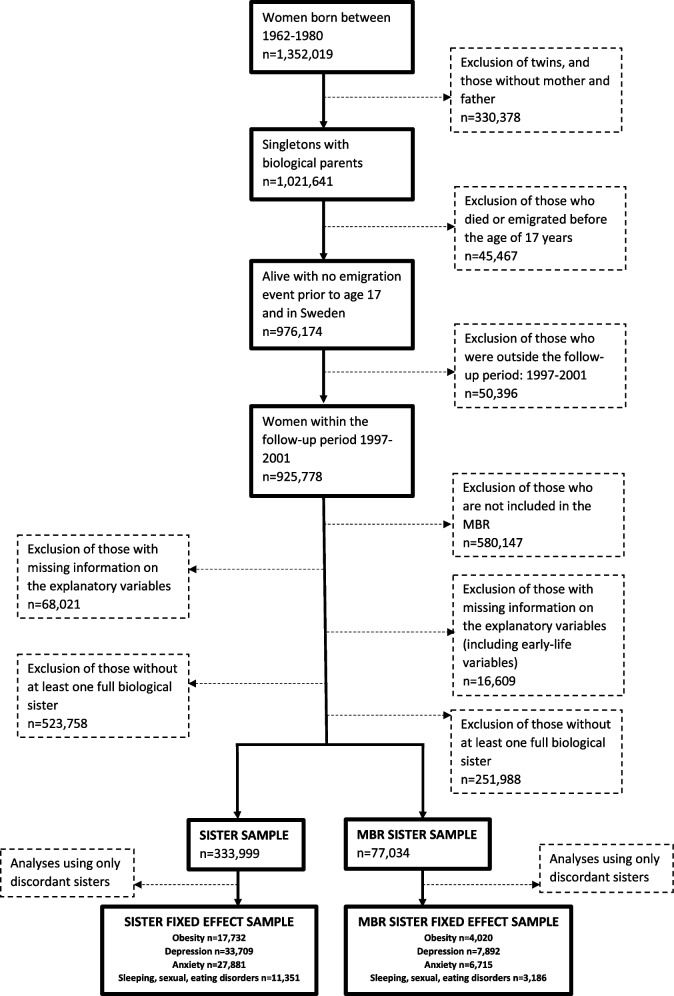
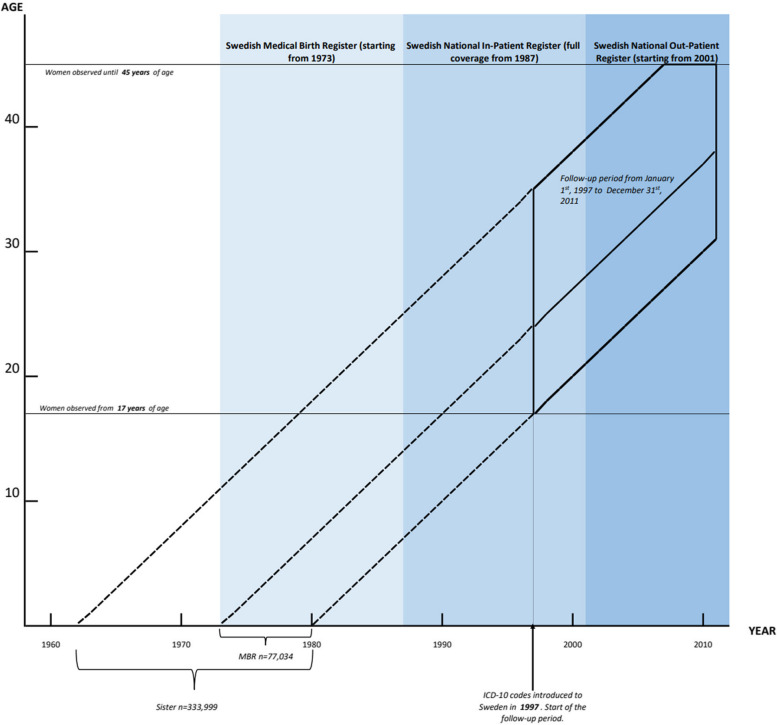
This total-population register-based cohort study included 333,999 full sisters, born between 1962 and 1980. PCOS and comorbidity diagnoses were measured at age 17-45 years through national hospital register data from 1997 to 2011, and complemented with information on the study subjects´ early-life and social characteristics. In the main analysis, sister fixed effects (FE) models were used to control for all time-invariant factors that are shared among sisters, thereby testing whether the association between PCOS and examined comorbidities is influenced by unobserved familial environmental, social or genetic factors.
Three thousand five hundred seventy women in the Sister sample were diagnosed with PCOS, of whom 14% had obesity, 8% had depression, 7% had anxiety and 4% experienced sleeping, sexual and eating disorders (SSE). Having PCOS increased the odds of obesity nearly 6-fold (adjusted OR (aOR): 5.9 [95% CI:5.4-6.5]). This association was attenuated in models accounting for unobserved characteristics shared between full sisters, but remained considerable in size (Sister FE: aOR: 4.5 [95% CI: 3.6-5.6]). For depression (Sister FE: aOR: 1.4 [95% CI: 1.2-1.8]) and anxiety (Sister FE: aOR: 1.5 [95% CI: 1.2-1.8), there was a small decrease in the aORs when controlling for factors shared between sisters. Being diagnosed with SSE disorders yielded a 2.4 aOR (95% CI:2.0-2.6) when controlling for a comprehensive set of individual-level confounders, which only decreased slightly when controlling for factors at the family level such as shared genes or parenting style. Accounting for differences between sisters in observed early-life circumstances influenced the estimated associations marginally.
Having been diagnosed with PCOS is associated with a markedly increased risk of obesity and sleeping, sexual and eating disorders, also after accounting for factors shared between sisters and early-life conditions.
多囊卵巢综合征(PCOS)先前与多种合并症相关,这些合并症可能具有共同的遗传、表观遗传、发育或环境起源。PCOS 可能受到产前雄激素过多、宫内或儿童期环境因素差、儿童肥胖和习得的健康风险行为的影响。我们分析了 PCOS 与几种相关合并症之间的关联,同时调整了生命早期的生物和社会经济状况,并调查了家族风险因素对关联的影响程度。
本全人群基于登记的队列研究纳入了 333999 名全姐妹,出生于 1962 年至 1980 年之间。通过 1997 年至 2011 年的国家医院登记数据,在 17-45 岁时测量 PCOS 和合并症诊断,并通过研究对象的生命早期和社会特征信息进行补充。在主要分析中,姐妹固定效应(FE)模型用于控制姐妹之间共有的所有时不变因素,从而检验 PCOS 和所检查的合并症之间的关联是否受到未观察到的家族环境、社会或遗传因素的影响。
在姐妹样本中,有 3570 名女性被诊断患有 PCOS,其中 14%患有肥胖症,8%患有抑郁症,7%患有焦虑症,4%患有睡眠、性和饮食障碍(SSE)。患有 PCOS 使肥胖症的几率增加近 6 倍(调整后的比值比(aOR):5.9 [95%CI:5.4-6.5])。当考虑到全姐妹之间共有的未观察到的特征时,这种关联减弱,但仍然相当大(姐妹 FE:aOR:4.5 [95%CI:3.6-5.6])。对于抑郁症(姐妹 FE:aOR:1.4 [95%CI:1.2-1.8])和焦虑症(姐妹 FE:aOR:1.5 [95%CI:1.2-1.8]),当控制姐妹之间共有的因素时,aOR 略有下降。当控制个体层面混杂因素的综合集时,被诊断为 SSE 障碍的几率为 2.4 aOR(95%CI:2.0-2.6),当控制家庭层面的因素(如共同基因或育儿风格)时,该几率仅略有下降。考虑到姐妹之间观察到的生命早期环境差异对估计的关联有一定影响。
在考虑到姐妹之间共享的因素和生命早期状况后,被诊断患有 PCOS 与肥胖症和睡眠、性和饮食障碍的风险显著增加相关。