Larsson Susanna, Holmgren Sandra, Jenndahl Lachmi, Ulfenborg Benjamin, Strehl Raimund, Synnergren Jane, Ghosheh Nidal
Systems Biology Research Center, School of Bioscience, University of Skövde, SE-541 28 Skövde, Sweden.
VERIGRAFT, Arvid Wallgrens Backe 20, SE-413 46 Gothenburg, Sweden.
ACS Omega. 2024 Mar 19;9(13):14805-14817. doi: 10.1021/acsomega.3c07098. eCollection 2024 Apr 2.
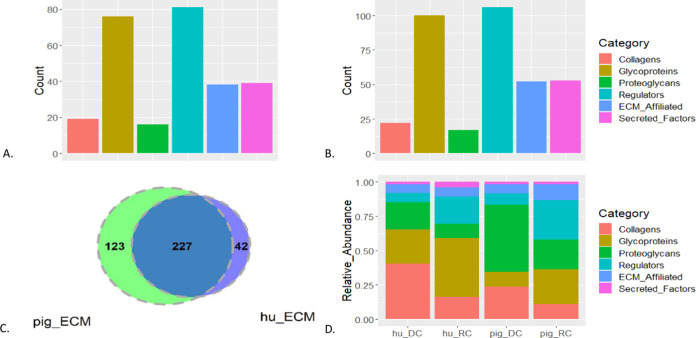
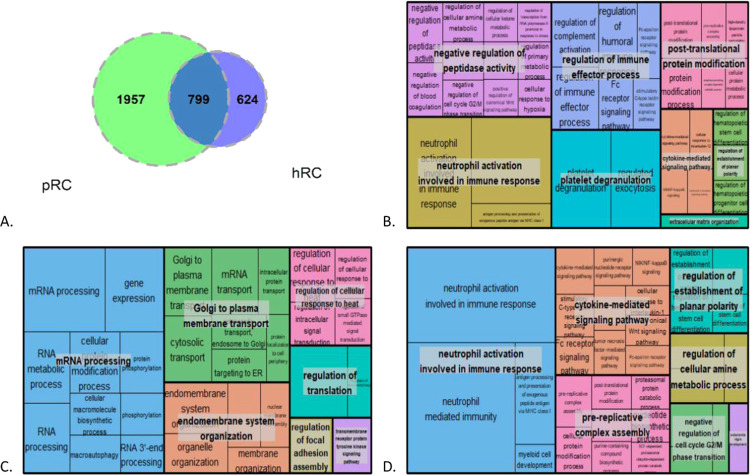
Vascular diseases are the largest cause of death globally and impose a major global burden on healthcare. The gold standard for treating vascular diseases is the transplantation of autologous veins, if applicable. Alternative treatments still suffer from shortcomings, including low patency, lack of growth potential, the need for repeated intervention, and a substantial risk of developing infections. The use of a vascular ECM scaffold reconditioned with the patient's own cells has shown successful results in preclinical and clinical studies. In this study, we have compared the proteomes of personalized tissue-engineered veins of humans and pigs. By applying tandem mass tag (TMT) labeling LC/MS-MS, we have investigated the proteome of decellularized (DC) veins from humans and pigs and reconditioned (RC) DC veins produced through perfusion with the patient's whole blood in STEEN solution, applying the same technology as used in the preclinical studies. The results revealed high similarity between the proteomes of human and pig DC and RC veins, including the ECM texture after decellularization and reconditioning. In addition, functional enrichment analysis showed similarities in signaling pathways and biological processes involved in the immune system response. Furthermore, the classification of proteins involved in immune response activity that were detected in human and pig RC veins revealed proteins that evoke immunogenic responses, which may lead to graft rejection, thrombosis, and inflammation. However, the results from this study imply the initiation of wound healing rather than an immunogenic response, as both systems share the same processes, and no immunogenic response was reported in the preclinical and clinical studies. Finally, our study assessed the application of STEEN solution in tissue engineering and identified proteins that may be useful for the prediction of successful transplantations.
血管疾病是全球最大的死亡原因,给全球医疗保健带来了重大负担。治疗血管疾病的金标准是在适用的情况下移植自体静脉。替代治疗仍然存在缺点,包括通畅率低、缺乏生长潜力、需要反复干预以及发生感染的重大风险。使用经患者自身细胞修复的血管细胞外基质支架在临床前和临床研究中已显示出成功的结果。在本研究中,我们比较了人和猪的个性化组织工程静脉的蛋白质组。通过应用串联质量标签(TMT)标记液相色谱/质谱联用技术,我们研究了人和猪的去细胞(DC)静脉以及通过在STEEN溶液中用患者全血灌注产生的修复(RC)DC静脉的蛋白质组,采用了与临床前研究相同的技术。结果显示人和猪的DC和RC静脉的蛋白质组之间具有高度相似性,包括去细胞化和修复后的细胞外基质结构。此外,功能富集分析显示在免疫系统反应所涉及的信号通路和生物学过程方面存在相似性。此外,在人和猪的RC静脉中检测到的参与免疫反应活性的蛋白质分类揭示了引发免疫原性反应的蛋白质,这可能导致移植物排斥、血栓形成和炎症。然而,本研究的结果表明启动了伤口愈合而非免疫原性反应,因为两个系统具有相同的过程,并且在临床前和临床研究中均未报告免疫原性反应。最后,我们的研究评估了STEEN溶液在组织工程中的应用,并鉴定了可能有助于预测成功移植的蛋白质。