Tapia-Castillo Alejandra, Carvajal Cristian A, Pérez Jorge A, Sandoval Alejandra, Allende Fidel, Solari Sandra, Fardella Carlos E
Department of Endocrinology, School of Medicine, Pontificia Universidad Católica de Chile, Santiago 8330077, Chile.
Centro Traslacional de Endocrinología UC (CETREN-UC), Santiago 8330033, Chile.
J Endocr Soc. 2024 Mar 15;8(6):bvae051. doi: 10.1210/jendso/bvae051. eCollection 2024 Apr 6.
A large proportion of patients with low-renin hypertension (LRH) correspond to primary aldosteronism (PA). However, some of these subjects have low to normal aldosterone. Since low renin is driven by excessive mineralocorticoids or glucocorticoids acting on mineralocorticoid receptors (MRs), we hypothesize that a low-cortisone condition, associated classically with 11βHSD2 deficiency, is a proxy of chronic MR activation by cortisol, which can also lead to low renin, elevated blood pressure, and renal and vascular alterations.
To evaluate low cortisone as a predictor of low renin activity and its association with parameters of kidney and vascular damage.
A cross-sectional study was carried out in 206 adult subjects. The subjects were classified according to low plasma renin activity (<1 ng/mL × hours) and low cortisone (<25th percentile).
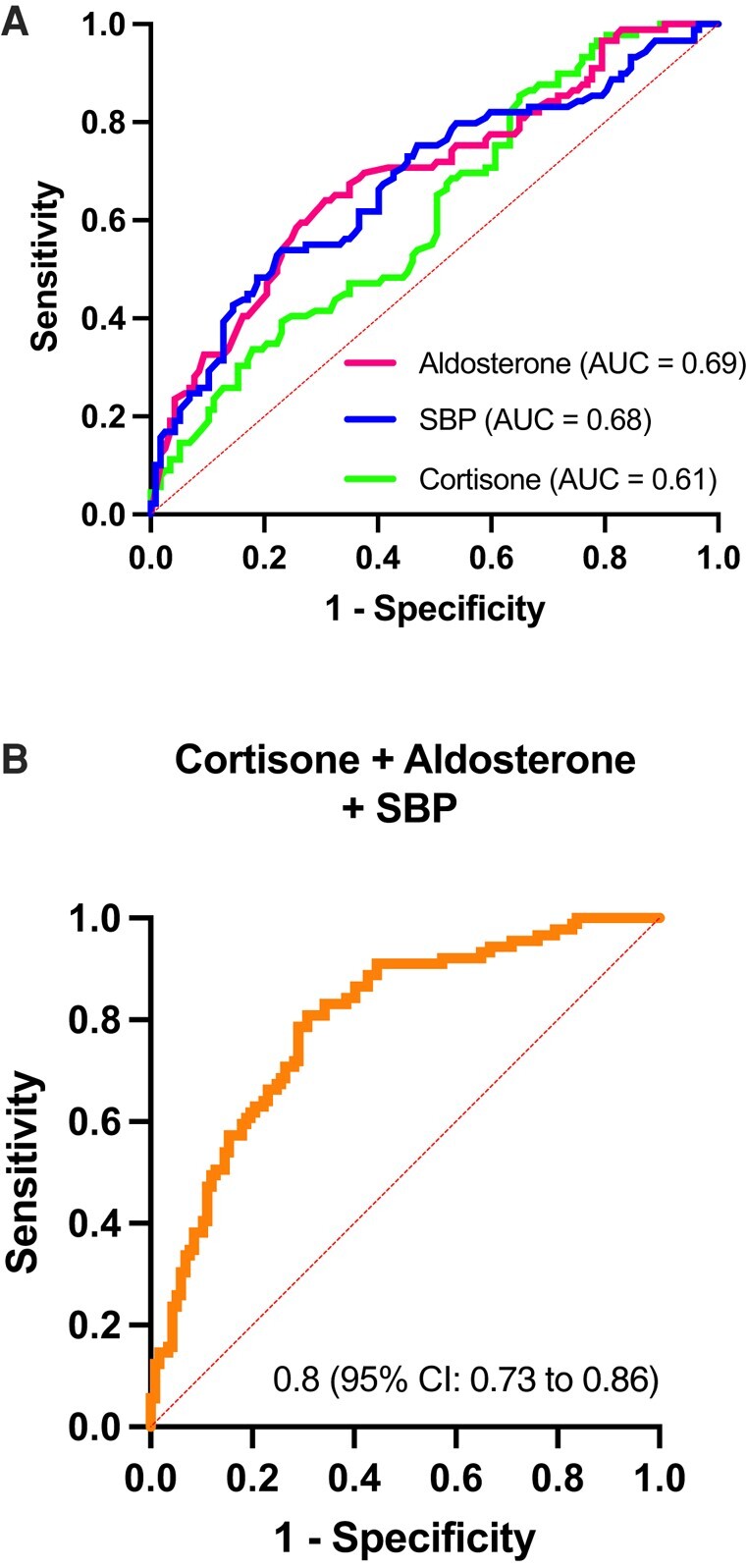
Plasma renin activity was associated with aldosterone (r = 0.36; < .001) and cortisone (r = 0.22; = .001). A binary logistic regression analysis showed that serum cortisone per ug/dL increase predicted the low-renin phenotype (OR 0.4, 95% CI 0.21-0.78). The receiver operating characteristic curves for cortisone showed an area under the curve of 0.6 to discriminate subjects with low renin activity from controls. The low-cortisone subjects showed higher albuminuria and PAI-1 and lower sodium excretion. The association study also showed that urinary cortisone was correlated with blood pressure and serum potassium ( < .05).
This is the first study showing that low cortisone is a predictor of a low-renin condition. Low cortisone also predicted surrogate markers of vascular and renal damage. Since the aldosterone to renin ratio is used in the screening of PA, low cortisone values should be considered additionally to avoid false positives in the aldosterone-renin ratio calculation.
很大一部分低肾素性高血压(LRH)患者符合原发性醛固酮增多症(PA)。然而,这些患者中有一些醛固酮水平较低至正常。由于低肾素是由过量的盐皮质激素或糖皮质激素作用于盐皮质激素受体(MRs)所致,我们推测,一种通常与11βHSD2缺乏相关的低可的松状态,是皮质醇慢性激活MR的一种替代指标,这也可导致低肾素、血压升高以及肾脏和血管改变。
评估低可的松作为低肾素活性预测指标及其与肾脏和血管损伤参数的关联。
对206名成年受试者进行了一项横断面研究。根据低血浆肾素活性(<1 ng/mL×小时)和低可的松(<第25百分位数)对受试者进行分类。
血浆肾素活性与醛固酮(r = 0.36;<0.001)和可的松(r = 0.22;=0.001)相关。二元逻辑回归分析显示,每微克/分升可的松水平升高可预测低肾素表型(比值比0.4,95%可信区间0.21 - 0.78)。可的松的受试者工作特征曲线显示曲线下面积为0.6,以区分低肾素活性受试者与对照组。低可的松受试者的蛋白尿和PAI - 1水平较高,钠排泄较低。关联研究还显示尿可的松与血压和血清钾相关(<0.05)。
这是第一项表明低可的松是低肾素状态预测指标的研究。低可的松还可预测血管和肾脏损伤的替代标志物。由于醛固酮与肾素比值用于PA的筛查,因此应额外考虑低可的松值,以避免醛固酮 - 肾素比值计算中的假阳性。