Department of Nuclear Medicine, Tongji Hospital, Tongji Medical College, Huazhong University of Science and Technology, 1095 Jiefang Ave, Wuhan, 430030, China.
Department of Chemistry, Johannes Gutenberg University, 55131, Mainz, Germany.
Eur J Nucl Med Mol Imaging. 2024 Jul;51(9):2744-2757. doi: 10.1007/s00259-024-06704-y. Epub 2024 Apr 8.
Radiopharmaceutical therapies targeting fibroblast activation protein (FAP) have shown promising efficacy against many tumor types. But radiopharmaceuticals alone in most cases are insufficient to completely eradicate tumor cells, which can partially be attributed to the protective interplay between tumor cells and cancer-associated fibroblasts (CAFs). The C-X-C chemokine receptor type 4/C-X-C motif chemokine 12 (CXCR4/CXCL12) interaction plays an important role in orchestrating tumor cells and CAFs. We hereby investigated the feasibility and efficacy of [Lu]Lu-DOTAGA.(SA.FAPi), a FAP-targeting radiopharmaceutical, in combination with AMD3100, a CXCR4 antagonist, in a preclinical murine model of triple-negative breast cancer (TNBC).
Public database was first interrogated to reveal the correlation between CAFs' scores and the prognosis of TNBC patients, as well as the expression levels of FAP and CXCR4 in normal tissues and tumors. In vitro therapeutic efficacy regarding cell proliferation, migration, and colony formation was assessed in BALB/3T3 fibroblasts and 4T1 murine breast cancer cells. In vivo therapeutic efficacy was longitudinally monitored using serial F-FDG, [F]AlF-NOTA-FAPI-04, and [Ga]Ga-DOTA-Pentixafor PET/CT scans and validated using tumor sections through immunohistochemical staining of Ki-67, α-SMA, CXCR4, and CXCL12. Intratumoral abundance of myeloid-derived suppressive cells (MDSCs) was analyzed using flow cytometry in accordance with the PET/CT schedules. Treatment toxicity was evaluated by examining major organs including heart, lung, liver, kidney, and spleen.
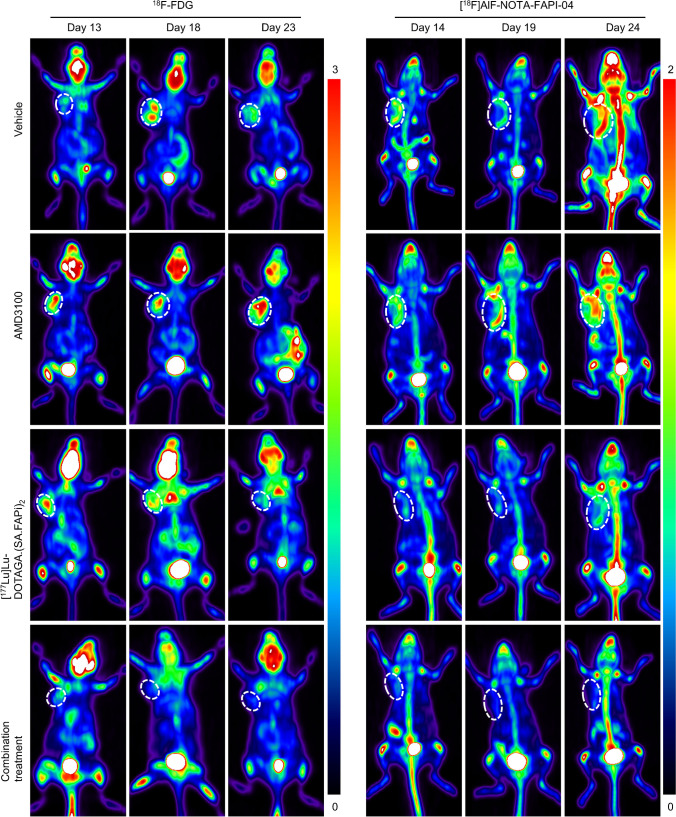
CAFs' scores negatively correlated with the survival of TNBC patients (p < 0.05). The expression of CXCR4 and FAP was both significantly higher in tumors than in normal tissues. The combination of [Lu]Lu-DOTAGA.(SA.FAPi) and AMD3100 significantly suppressed cell proliferation, migration, and colony formation in cell culture, and exhibited synergistic effects in 4T1 tumor models along with a decreased number of MDSCs. PET/CT imaging revealed lowest tumor accumulation of F-FDG and [F]AlF-NOTA-FAPI-04 on day 13 and day 14 after treatment started, both of which gradually increased at later time points. A similar trend was observed in the IHC staining of Ki-67, α-SMA, and CXCL12.
The combination of [Lu]Lu-DOTAGA.(SA.FAPi) and AMD3100 is a feasible treatment against TNBC with minimal toxicity in main organs.
针对成纤维细胞激活蛋白(FAP)的放射性药物疗法已显示出对多种肿瘤类型的有希望的疗效。但在大多数情况下,单独使用放射性药物不足以完全根除肿瘤细胞,这在一定程度上归因于肿瘤细胞和癌相关成纤维细胞(CAF)之间的保护性相互作用。C-X-C 趋化因子受体 4/C-X-C 基序趋化因子 12(CXCR4/CXCL12)相互作用在协调肿瘤细胞和 CAF 方面起着重要作用。我们在此研究了 FAP 靶向放射性药物[Lu]Lu-DOTAGA(SA.FAPi)与 CXCR4 拮抗剂 AMD3100 联合在三阴性乳腺癌(TNBC)的临床前小鼠模型中的可行性和疗效。
首先在公共数据库中进行查询,以揭示 CAF 评分与 TNBC 患者预后之间的相关性,以及正常组织和肿瘤中 FAP 和 CXCR4 的表达水平。在 BALB/3T3 成纤维细胞和 4T1 小鼠乳腺癌细胞中评估细胞增殖、迁移和集落形成的体外治疗效果。使用连续的 F-FDG、[F]AlF-NOTA-FAPI-04 和 [Ga]Ga-DOTA-Pentixafor PET/CT 扫描进行纵向监测体内治疗效果,并通过 Ki-67、α-SMA、CXCR4 和 CXCL12 的免疫组织化学染色验证肿瘤切片。根据 PET/CT 时间表,使用流式细胞术分析肿瘤内髓系抑制细胞(MDSC)的丰度。通过检查包括心脏、肺、肝、肾和脾在内的主要器官来评估治疗毒性。
CAF 评分与 TNBC 患者的生存呈负相关(p<0.05)。与正常组织相比,肿瘤中 CXCR4 和 FAP 的表达均明显升高。[Lu]Lu-DOTAGA(SA.FAPi)和 AMD3100 的联合使用显著抑制了细胞培养中的细胞增殖、迁移和集落形成,并在 4T1 肿瘤模型中表现出协同作用,同时 MDSC 数量减少。PET/CT 成像显示在治疗开始后第 13 天和第 14 天,F-FDG 和 [F]AlF-NOTA-FAPI-04 的肿瘤累积量最低,随后在后续时间点逐渐增加。Ki-67、α-SMA 和 CXCL12 的 IHC 染色也观察到类似的趋势。
[Lu]Lu-DOTAGA(SA.FAPi)和 AMD3100 的联合治疗是一种针对 TNBC 的可行治疗方法,对主要器官的毒性最小。