G.K. Skryabin Institute of Biochemistry and Physiology of Microorganisms, RAS, Federal Research Center "Pushchino Scientific Center for Biological Research of the Russian Academy of Sciences", Pushchino, 142290, Russia.
Belozersky Institute of Physico-Chemical Biology, Lomonosov Moscow State University, Leninskie Gory 1/40, Moscow, 119234, Russia.
Microb Cell Fact. 2024 Apr 9;23(1):105. doi: 10.1186/s12934-024-02385-2.
Pregnenolone and progesterone are the life-important steroid hormones regulating essential vital functions in mammals, and widely used in different fields of medicine. Microbiological production of these compounds from sterols is based on the use of recombinant strains expressing the enzyme system cholesterol hydroxylase/C20-C22 lyase (CH/L) of mammalian steroidogenesis. However, the efficiency of the known recombinant strains is still low. New recombinant strains and combination approaches are now needed to produce these steroid hormones.
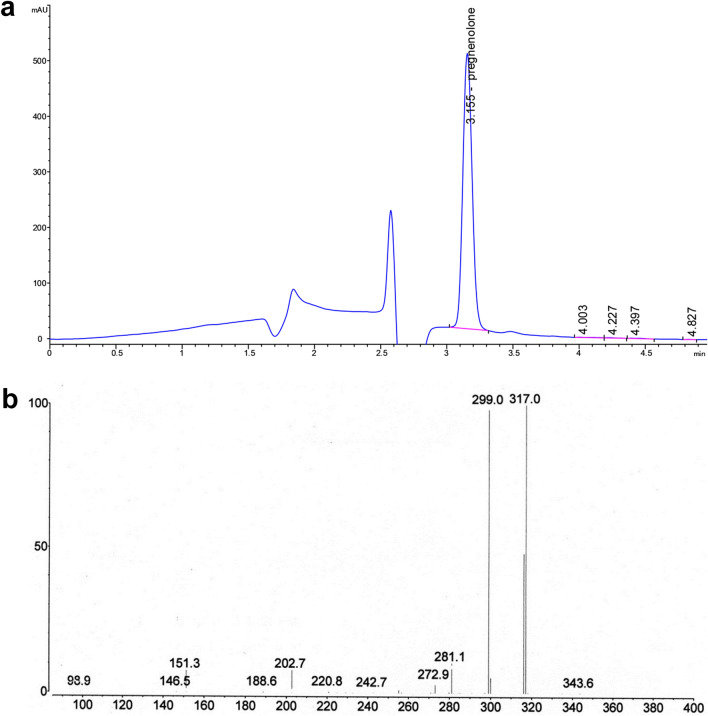
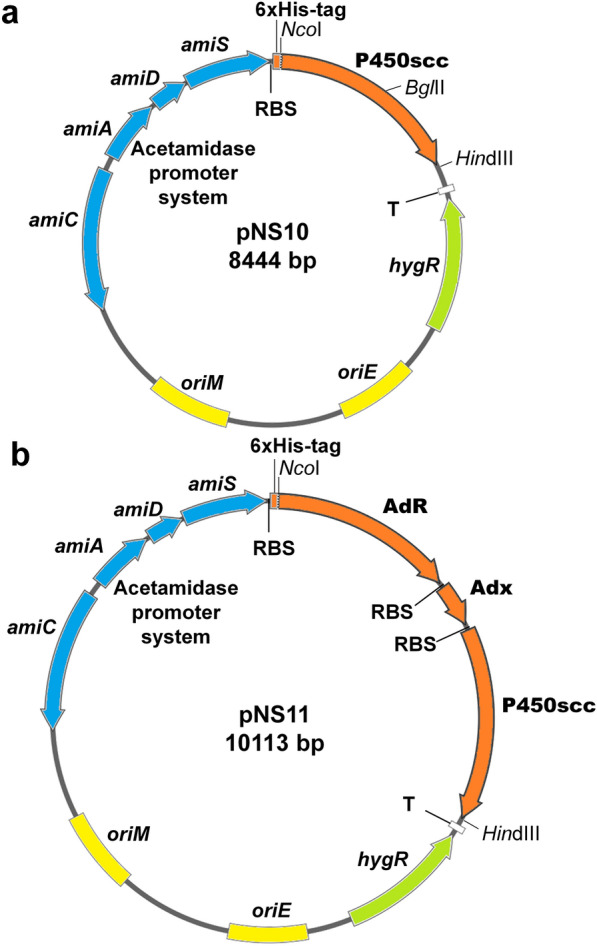
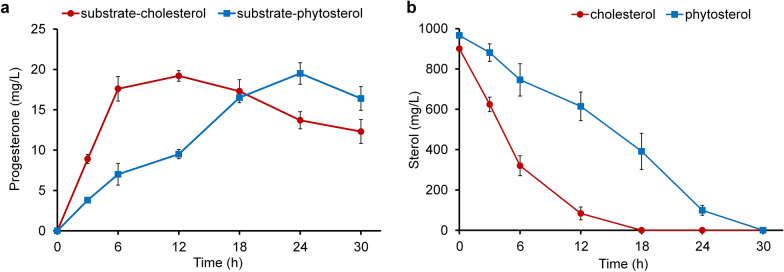
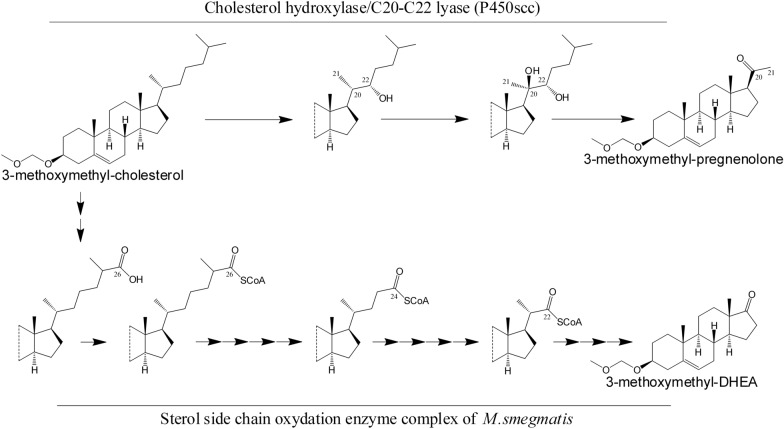
Based on Mycolicibacterium smegmatis, a recombinant strain was created that expresses the steroidogenesis system (CYP11A1, adrenodoxin reductase, adrenodoxin) of the bovine adrenal cortex. The recombinant strain transformed cholesterol and phytosterol to form progesterone among the metabolites. When 3-methoxymethyl ethers of sterols were applied as bioconversion substrates, the corresponding 3-ethers of pregnenolone and dehydroepiandrosterone (DHEA) were identified as major metabolites. Under optimized conditions, the recombinant strain produced 85.2 ± 4.7 mol % 3-methoxymethyl-pregnenolone within 48 h, while production of 3-substituted DHEA was not detected. After the 3-methoxymethyl function was deprotected by acid hydrolysis, crystalline pregnenolone was isolated in high purity (over 98%, w/w). The structures of steroids were confirmed using TLC, HPLC, MS and H- and C-NMR analyses.
The use of mycolicybacteria as a microbial platform for the expression of systems at the initial stage of mammalian steroidogenesis ensures the production of valuable steroid hormones-progesterone and pregnenolone from cholesterol. Selective production of pregnenolone from cholesterol is ensured by the use of 3-substituted cholesterol as a substrate and optimization of the conditions for its bioconversion. The results open the prospects for the generation of the new microbial biocatalysts capable of effectively producing value-added steroid hormones.
孕烯醇酮和孕酮是调节哺乳动物基本生命功能的重要甾体激素,广泛应用于医学的不同领域。微生物从甾体中生产这些化合物是基于使用表达哺乳动物甾体生物合成中胆固醇羟化酶/C20-C22 裂解酶(CH/L)酶系统的重组菌株。然而,已知重组菌株的效率仍然很低。现在需要新的重组菌株和组合方法来生产这些甾体激素。
基于耻垢分枝杆菌,创建了一个表达牛肾上腺皮质甾体生物合成系统(CYP11A1、肾上腺皮质还原酶、肾上腺质)的重组菌株。该重组菌株将胆固醇和植物甾醇转化为代谢物中的孕酮。当将甾醇的 3-甲氧基甲基醚用作生物转化底物时,鉴定出相应的孕烯醇酮和脱氢表雄酮(DHEA)的 3-醚作为主要代谢物。在优化条件下,重组菌株在 48 小时内产生了 85.2±4.7 mol%的 3-甲氧基甲基孕烯醇酮,而未检测到 3-取代的 DHEA 的产生。3-甲氧基甲基功能经酸水解脱保护后,可分离得到高纯度(超过 98%,w/w)的结晶孕烯醇酮。使用 TLC、HPLC、MS 和 H-和 C-NMR 分析确认了类固醇的结构。
使用分枝杆菌作为哺乳动物甾体生物合成初始阶段的表达系统的微生物平台,确保了从胆固醇生产有价值的甾体激素-孕酮和孕烯醇酮。使用 3-取代胆固醇作为底物并优化其生物转化条件,确保了从胆固醇选择性生产孕烯醇酮。这些结果为生成能够有效生产高附加值甾体激素的新型微生物生物催化剂开辟了前景。