Kattimani Vivekanand, Alekhya Donipudi Lakshmi Durga, Pathralapati Sahithi, Sojin Shilpa Susan, Patel Shikha, Prabhakar Chinmayi, Dixit Heena
Sibar Institute of Dental Sciences, Guntur, Andhra Pradesh, India.
GSL Dental College and Hospital, Rajahmundry, Andhra Pradesh, India.
J Pharm Bioallied Sci. 2024 Feb;16(Suppl 1):S637-S640. doi: 10.4103/jpbs.jpbs_908_23. Epub 2024 Feb 29.
Almost 70% of women residing in urban areas and 48% of women in rural areas use sanitary napkins in India. According to menstrual health alliance India (MHAI), single sanitary pad will take about 500-800 years to decompose as the plastic used in manufacturing is nonbiodegradable and causes severe noxious effects contributing to global warming through the production of planet warming fuels which eventually have severe impact on environment sustainability. Hence, the study was undertaken to contribute the evidence for the "Clean and Green India".
To know the perception and practice of disposal of sanitary napkins among young college-going females in India.
A cross-sectional study was conducted throughout the country employing a self-administered questionnaire using a survey link sent through social media. Data collected were analyzed and interpreted using SPSS version 20.0.
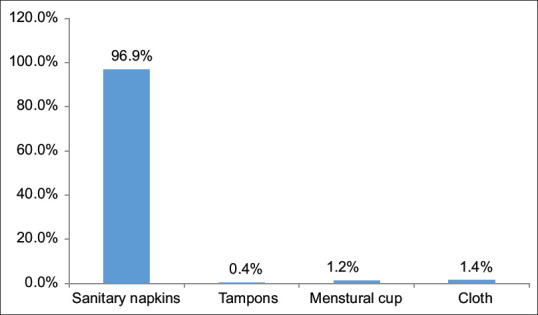
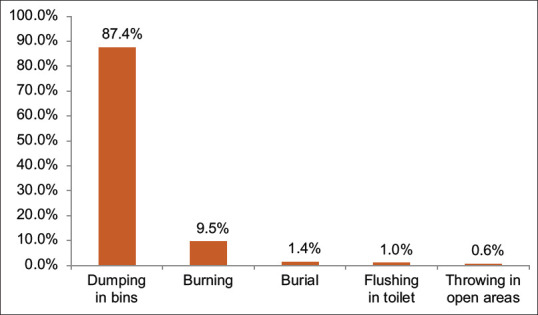
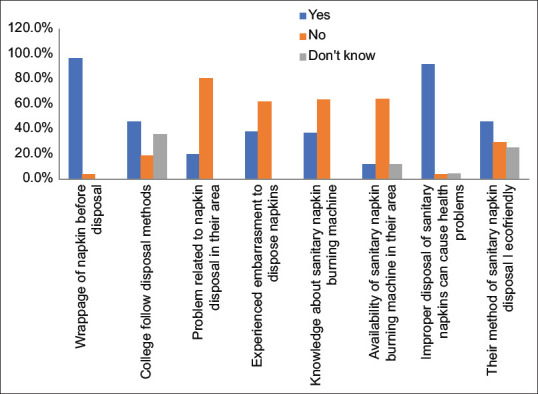
The study population comprised 484 young college girls with a mean age of 20.92 ± 1.86 years and 96.9% of them are using sanitary napkins as menstrual absorbent aids. The most common method employed for the disposal of sanitary napkins was dumping them in the bin (87.4%). About 63.2% of them had no knowledge about sanitary napkin-burning machines. Around 92% think that improper disposal of sanitary napkins can cause health problems.
The findings from the study revealed that a significant number of women were practicing noneco-friendly disposal methods and menstrual hygiene aids which are a bane to the ecosystem. Study warrants the education and training of females to achieve a green and clean sustainable India.
在印度,近70%的城市女性和48%的农村女性使用卫生巾。据印度月经健康联盟(MHAI)称,单个卫生巾大约需要500 - 800年才能分解,因为制造过程中使用的塑料不可生物降解,会产生严重的有害影响,通过产生导致全球变暖的燃料对全球变暖造成影响,最终对环境可持续性产生严重影响。因此,开展这项研究是为“清洁与绿色印度”提供证据。
了解印度年轻女大学生对卫生巾处理的认知和做法。
在全国范围内进行了一项横断面研究,通过社交媒体发送调查链接,采用自填式问卷。收集的数据使用SPSS 20.0版本进行分析和解释。
研究人群包括484名年轻女大学生,平均年龄为20.92 ± 1.86岁,其中96.9%的人使用卫生巾作为经期吸收辅助用品。处理卫生巾最常用的方法是将它们扔进垃圾桶(87.4%)。约63.2%的人不了解卫生巾焚烧机。约92%的人认为不当处理卫生巾会导致健康问题。
该研究结果显示,相当数量的女性采用不环保的处理方法和经期卫生用品,这对生态系统有害。该研究有必要对女性进行教育和培训,以实现绿色、清洁的可持续印度。