
甲苯会改变基底外侧杏仁核神经元的内在兴奋性和兴奋性突触传递。
Toluene alters the intrinsic excitability and excitatory synaptic transmission of basolateral amygdala neurons.
作者信息
Braunscheidel Kevin, Okas Michael, Woodward John J
机构信息
Department of Neuroscience, Medical University of South Carolina, Charleston, SC, United States.
出版信息
Front Neurosci. 2024 Feb 26;18:1366216. doi: 10.3389/fnins.2024.1366216. eCollection 2024.
INTRODUCTION
Inhalant abuse is an important health issue especially among children and adolescents who often encounter these agents in the home. Research into the neurobiological targets of inhalants has lagged behind that of other drugs such as alcohol and psychostimulants. However, studies from our lab and others have begun to reveal how inhalants such as the organic solvent toluene affect neurons in key addiction related areas of the brain including the ventral tegmental area, nucleus accumbens and medial prefrontal cortex. In the present study, we extend these findings and examine the effect of toluene on electrophysiological responses of pyramidal neurons in the basolateral amygdala BLA, a region important for generating emotional and reward based information needed to guide future behavior.
METHODS
Whole-cell patch-clamp electrophysiology recordings of BLA pyramidal neurons in rat brain slices were used to assess toluene effects on intrinsic excitability and excitatory glutamatergic synaptic transmission.
RESULTS
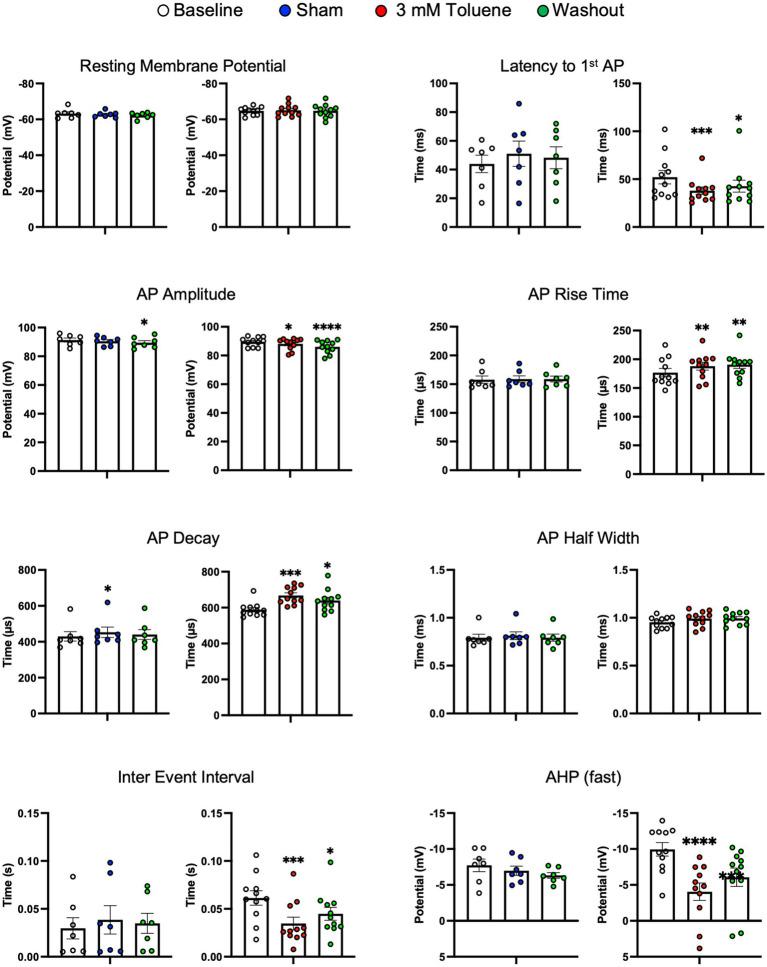
Acute application of 3 mM but not 0.3 mM toluene produced a small but significant (~20%) increase in current-evoked action potential (AP) firing that reversed following washout of the toluene containing solution. The change in firing during exposure to 3 mM toluene was accompanied by selective changes in AP parameters including reduced latency to first spike, increased AP rise time and decay and a reduction in the fast after-hyperpolization. To examine whether toluene also affects excitatory synaptic signaling, we expressed channelrhodopsin-2 in medial prefrontal cortex neurons and elicited synaptic currents in BLA neurons via light pulses. Toluene (3 mM) reduced light-evoked AMPA-mediated synaptic currents while a lower concentration (0.3 mM) had no effect. The toluene-induced reduction in AMPA-mediated BLA synaptic currents was prevented by the cannabinoid receptor-1 antagonist AM281.
DISCUSSION
These findings are the first to demonstrate effects of acute toluene on BLA pyramidal neurons and add to existing findings showing that abused inhalants such as toluene have significant effects on neurons in brain regions involved in natural and drug induced reward.
引言
吸入剂滥用是一个重要的健康问题,尤其是在儿童和青少年中,他们经常在家中接触到这些制剂。对吸入剂神经生物学靶点的研究落后于对酒精和精神兴奋剂等其他药物的研究。然而,我们实验室和其他机构的研究已经开始揭示诸如有机溶剂甲苯等吸入剂如何影响大脑中与成瘾相关的关键区域的神经元,这些区域包括腹侧被盖区、伏隔核和内侧前额叶皮质。在本研究中,我们扩展了这些发现,并研究了甲苯对基底外侧杏仁核(BLA)锥体细胞电生理反应的影响,BLA是一个对产生指导未来行为所需的基于情绪和奖励的信息很重要的区域。
方法
使用大鼠脑片上BLA锥体细胞的全细胞膜片钳电生理记录来评估甲苯对内在兴奋性和兴奋性谷氨酸能突触传递的影响。
结果
急性应用3 mM而非0.3 mM甲苯会使电流诱发动作电位(AP)发放出现小但显著(约20%)的增加,在洗去含甲苯溶液后这种增加会逆转。在暴露于3 mM甲苯期间发放的变化伴随着AP参数的选择性变化,包括首次动作电位潜伏期缩短、动作电位上升时间和衰减增加以及快速超极化后电位减小。为了研究甲苯是否也影响兴奋性突触信号传导,我们在内侧前额叶皮质神经元中表达了通道视紫红质-2,并通过光脉冲在BLA神经元中引发突触电流。甲苯(3 mM)降低了光诱发的AMPA介导的突触电流,而较低浓度(0.3 mM)则没有影响。大麻素受体-1拮抗剂AM281可阻止甲苯诱导的AMPA介导的BLA突触电流减少。
讨论
这些发现首次证明了急性甲苯对BLA锥体细胞的影响,并补充了现有研究结果,表明诸如甲苯等滥用吸入剂对参与自然和药物诱导奖励的脑区神经元有显著影响。


 Zotero 插件