
基于代谢相关基因的胃腺癌分子亚型构建及预后模型
Molecular subtype construction and prognosis model for stomach adenocarcinoma characterized by metabolism-related genes.
作者信息
Sun Jie, Wang Yuanyuan, Zhang Kai, Shi Sijia, Gao Xinxin, Jia Xianghao, Cong Bicong, Zheng Chunning
机构信息
Department of Gastrointestinal Surgery, Shandong Provincial Third Hospital, Jinan, 250031, China.
Department of Oncology and Hematology, Second Affiliated Hospital of Shandong University of Traditional Chinese Medicine, Jinan, 250001, China.
出版信息
Heliyon. 2024 Mar 19;10(7):e28413. doi: 10.1016/j.heliyon.2024.e28413. eCollection 2024 Apr 15.
BACKGROUND
Metabolic reprogramming is implicated in cancer progression. However, the impact of metabolism-associated genes in stomach adenocarcinomas (STAD) has not been thoroughly reviewed. Herein, we characterized metabolic transcription-correlated STAD subtypes and evaluated a metabolic RiskScore for evaluation survival.
METHOD
Genes related to metabolism were gathered from previous study and metabolic subtypes were screened using ConsensusClusterPlus in TCGA-STAD and GSE66229 dataset. The ssGSEA, MCP-Count, ESTIMATE and CIBERSORT determined the immune infiltration. A RiskScore model was established using the WGCNA and LASSO Cox regression in the TCGA-STAD queue and verified in the GSE66229 datasets. RT-qPCR was employed to measure the mRNA expressions of genes in the model.
RESULT
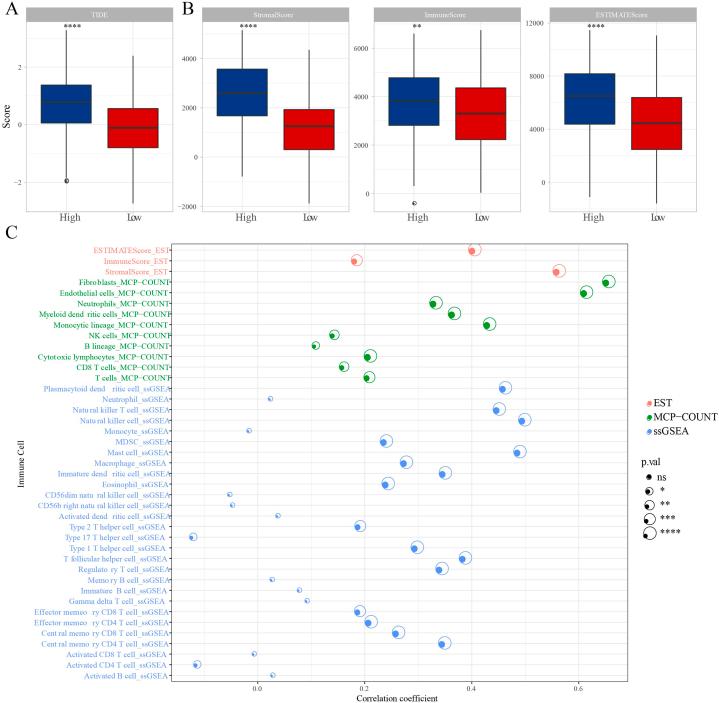
Two metabolism-related subtypes (C1 and C2) of STAD were constructed on account of the expression profiles of 113 prognostic metabolism genes with different immune outcomes and apparently distinct metabolic characteristic. The overall survival (OS) of C2 subtype was shorter than that of C1 subtype. Four metabolism-associated genes in turquoise model, which closely associated with C2 subtype, were employed to build the RiskScore (MATN3, OSBPL1A, SERPINE1, CPNE8) in TCGA-train dataset. Patients developed a poorer prognosis if they had a high RiskScore than having a low RiskScore. The promising effect of RiskScore was verified in the TCGA-test, TCGA-STAD and GSE66229 datasets. The prediction reliability of the RiskScore was validated by time-dependent receiver operating characteristic curve (ROC) and nomogram. Moreover, samples with high RiskScore had an enhanced immune status and TIDE score. Moreover, MATN3, OSBPL1A, SERPINE1 and CPNE8 mRNA levels were all elevated in SGC7901 cells. Inhibition of OSBPL1A decreased SGC7901 cells invasion numbers.
CONCLUSION
This work provided a new perspective into heterogeneity in metabolism and its association with immune escape in STAD. RiskScore was considered to be a strong prognostic label that could help individualize the treatment of STAD patients.
背景
代谢重编程与癌症进展有关。然而,代谢相关基因在胃腺癌(STAD)中的影响尚未得到全面综述。在此,我们对代谢转录相关的STAD亚型进行了特征描述,并评估了一个代谢风险评分以评估生存情况。
方法
从先前的研究中收集与代谢相关的基因,并使用ConsensusClusterPlus在TCGA-STAD和GSE66229数据集中筛选代谢亚型。通过单样本基因集富集分析(ssGSEA)、MCP-Count、ESTIMATE和CIBERSORT确定免疫浸润情况。在TCGA-STAD队列中使用加权基因共表达网络分析(WGCNA)和套索Cox回归建立风险评分模型,并在GSE66229数据集中进行验证。采用逆转录定量聚合酶链反应(RT-qPCR)测量模型中基因的mRNA表达。
结果
基于113个预后代谢基因的表达谱构建了两种与代谢相关的STAD亚型(C1和C2),它们具有不同的免疫结果和明显不同的代谢特征。C2亚型的总生存期(OS)短于C1亚型。在蓝绿色模块中与C2亚型密切相关的四个代谢相关基因被用于在TCGA训练数据集中构建风险评分(MATN3、OSBPL1A、SERPINE1、CPNE8)。风险评分高的患者预后比风险评分低的患者差。风险评分的良好效果在TCGA测试、TCGA-STAD和GSE66229数据集中得到验证。风险评分的预测可靠性通过时间依赖的受试者工作特征曲线(ROC)和列线图进行验证。此外,风险评分高的样本具有增强的免疫状态和肿瘤免疫逃逸评分(TIDE)。此外,MATN3、OSBPL1A、SERPINE1和CPNE 8的mRNA水平在SGC7901细胞中均升高。抑制OSBPL1A可减少SGC7901细胞的侵袭数量。
结论
这项工作为STAD中代谢异质性及其与免疫逃逸的关联提供了新的视角。风险评分被认为是一个强大的预后指标,有助于对STAD患者进行个体化治疗。


 Zotero 插件