Department of Medicine, Division of Cardiology, Wilf Family Cardiovascular Research Institute, Einstein - Mount Sinai Diabetes Research Center (ES-DRC), Einstein Institute for Aging Research, Albert Einstein College of Medicine, New York, NY, USA.
Department of Molecular Pharmacology, Einstein Institute for Neuroimmunology and Inflammation (INI), Fleischer Institute for Diabetes and Metabolism (FIDAM), Albert Einstein College of Medicine, New York, NY, USA.
Cardiovasc Diabetol. 2024 Apr 10;23(1):125. doi: 10.1186/s12933-024-02218-x.
Hypertension and chronic kidney disease (CKD) pose significant public health challenges, sharing intertwined pathophysiological mechanisms. Prediabetes is recognized as a precursor to diabetes and is often accompanied by cardiovascular comorbidities such as hypertension, elevating the risk of pre-frailty and frailty. Albuminuria is a hallmark of organ damage in hypertension amplifying the risk of pre-frailty, frailty, and cognitive decline in older adults. We explored the association between albuminuria and cognitive impairment in frail older adults with prediabetes and CKD, assessing cognitive levels based on estimated glomerular filtration rate (eGFR).
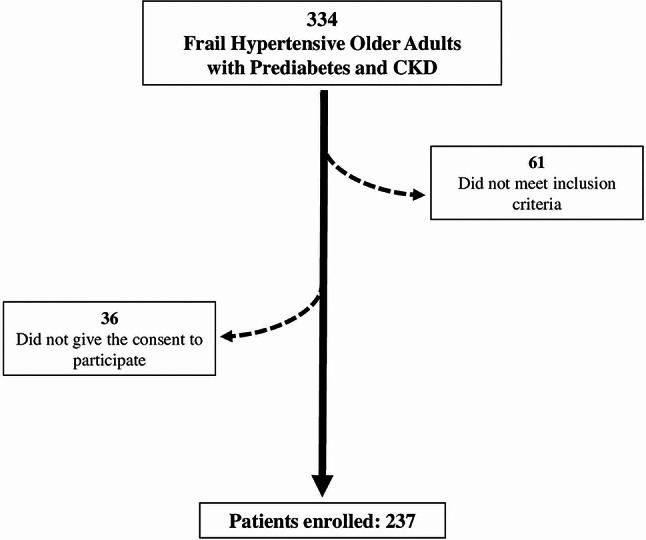
We conducted a study involving consecutive frail older patients with hypertension recruited from March 2021 to March 2023 at the ASL (local health unit of the Italian Ministry of Health) of Avellino, Italy, followed up after three months. Inclusion criteria comprised age over 65 years, prior diagnosis of hypertension without secondary causes, prediabetes, frailty status, Montreal Cognitive Assessment (MoCA) score < 26, and CKD with eGFR > 15 ml/min.
237 patients completed the study. We examined the association between albuminuria and MoCA Score, revealing a significant inverse correlation (r: 0.8846; p < 0.0001). Subsequently, we compared MoCA Score based on eGFR, observing a significant difference (p < 0.0001). These findings were further supported by a multivariable regression analysis, with albuminuria as the dependent variable.
Our study represents the pioneering effort to establish a significant correlation between albuminuria and eGFR with cognitive function in frail hypertensive older adults afflicted with prediabetes and CKD.
高血压和慢性肾脏病(CKD)共同存在错综复杂的病理生理机制,对公共健康构成重大挑战。糖尿病前期被认为是糖尿病的前兆,常伴有心血管合并症,如高血压,增加了衰弱前期和衰弱的风险。白蛋白尿是高血压导致器官损伤的标志,增加了衰弱前期、衰弱和老年人认知能力下降的风险。我们探讨了白蛋白尿与患有糖尿病前期和 CKD 的衰弱老年高血压患者认知障碍之间的关联,根据估算肾小球滤过率(eGFR)评估认知水平。
我们进行了一项研究,纳入了 2021 年 3 月至 2023 年 3 月期间意大利阿韦利诺 ASL(意大利卫生部地方卫生单位)连续招募的衰弱老年高血压患者,随访三个月。纳入标准包括年龄超过 65 岁、无继发性病因的高血压既往诊断、糖尿病前期、衰弱状态、蒙特利尔认知评估(MoCA)评分<26 分以及 eGFR>15 ml/min 的 CKD。
237 名患者完成了研究。我们检查了白蛋白尿与 MoCA 评分之间的关联,发现两者呈显著负相关(r:0.8846;p<0.0001)。随后,我们根据 eGFR 比较了 MoCA 评分,观察到显著差异(p<0.0001)。白蛋白尿作为因变量的多变量回归分析进一步支持了这些发现。
我们的研究首次确立了白蛋白尿与 eGFR 与患有糖尿病前期和 CKD 的衰弱老年高血压患者认知功能之间的显著相关性。