Wallace Zachary S, Katz Guy, Hernandez-Barco Yasmin G, Baker Matthew C
Division of Rheumatology, Allergy, and Immunology, Massachusetts General Hospital, Boston, MA, USA.
Harvard Medical School, Harvard University, Boston, MA, USA.
Rheumatol Adv Pract. 2024 Apr 10;8(2):rkae020. doi: 10.1093/rap/rkae020. eCollection 2024.
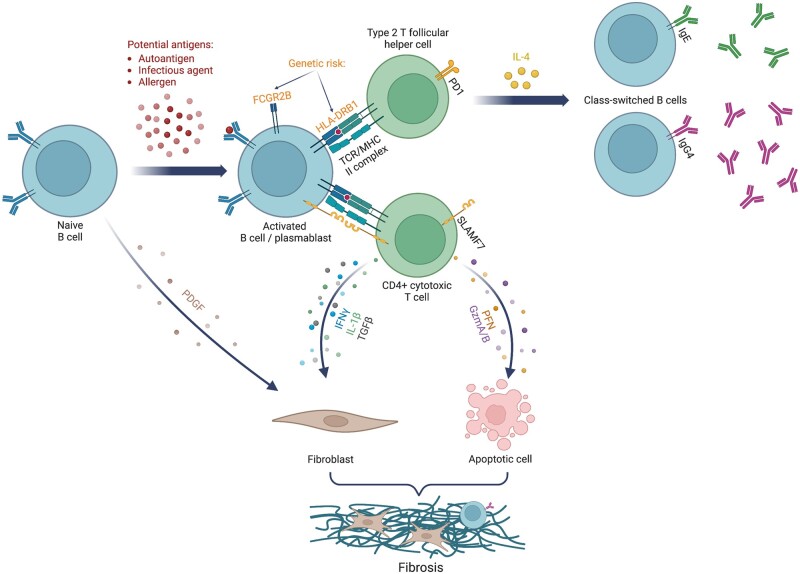
IgG4-related disease (IgG4-RD) is an increasingly recognized cause of fibroinflammatory lesions in patients of diverse racial and ethnic backgrounds and is associated with an increased risk of death. The aetiology of IgG4-RD is incompletely understood, but evidence to date suggests that B and T cells are important players in pathogenesis, both of which are key targets of ongoing drug development programmes. The diagnosis of IgG4-RD requires clinicopathological correlation because there is no highly specific or sensitive test. Glucocorticoids are highly effective, but their use is limited by toxicity, highlighting the need for studies investigating the efficacy of glucocorticoid-sparing agents. B cell-targeted therapies, particularly rituximab, have demonstrated benefit, but no randomized clinical trials have evaluated their efficacy. If untreated or under-treated, IgG4-RD can cause irreversible organ damage, hence close monitoring and consideration for long-term immunosuppression is warranted in certain cases.
IgG4相关疾病(IgG4-RD)是不同种族和民族背景患者中纤维炎性病变越来越常见的病因,且与死亡风险增加相关。IgG4-RD的病因尚未完全明确,但迄今为止的证据表明,B细胞和T细胞在发病机制中起重要作用,二者均为正在进行的药物研发项目的关键靶点。IgG4-RD的诊断需要临床病理相关性,因为尚无高度特异或敏感的检测方法。糖皮质激素非常有效,但其使用受到毒性限制,这凸显了研究糖皮质激素节省剂疗效的必要性。针对B细胞的疗法,尤其是利妥昔单抗,已显示出益处,但尚无随机临床试验评估其疗效。如果不治疗或治疗不足,IgG4-RD可导致不可逆的器官损害,因此在某些情况下有必要进行密切监测并考虑长期免疫抑制治疗。