
超越预测:揭示 μ 阿片受体和大麻素受体以及免疫介质在评估 SARS-CoV-2 感染严重程度方面的预后能力。
Beyond prediction: unveiling the prognostic power of μ-opioid and cannabinoid receptors, alongside immune mediators, in assessing the severity of SARS-CoV-2 infection.
机构信息
Department of Biochemistry, School of Medicine, Iran University of Medical Sciences, Tehran, Iran.
Department of Virology, School of Public Health, Tehran University of Medical Sciences, Tehran, P.O. Box: 1417613151, Iran.
出版信息
BMC Infect Dis. 2024 Apr 12;24(1):398. doi: 10.1186/s12879-024-09280-6.
BACKGROUND
This study aims to explore the potential of utilizing the expression levels of cannabinoid receptor 2 (CB2), μ-opioid receptor (MOR), MCP-1, IL-17, IFN-γ, and osteopontin as predictors for the severity of SARS-CoV-2 infection. The overarching goal is to delineate the pathogenic mechanisms associated with SARS-CoV-2.
METHODS
Using quantitative Real-time PCR, we analyzed the gene expression levels of CB2 and MOR in nasopharynx specimens obtained from patients diagnosed with SARS-CoV-2 infection, with 46 individuals classified as having severe symptoms and 46 as non-severe. Additionally, we measured the circulating levels of MCP-1, IL-17, IFN-γ, and osteopontin using an ELISA assay. We examined the predictive capabilities of these variables and explored their correlations across all patient groups.
RESULTS
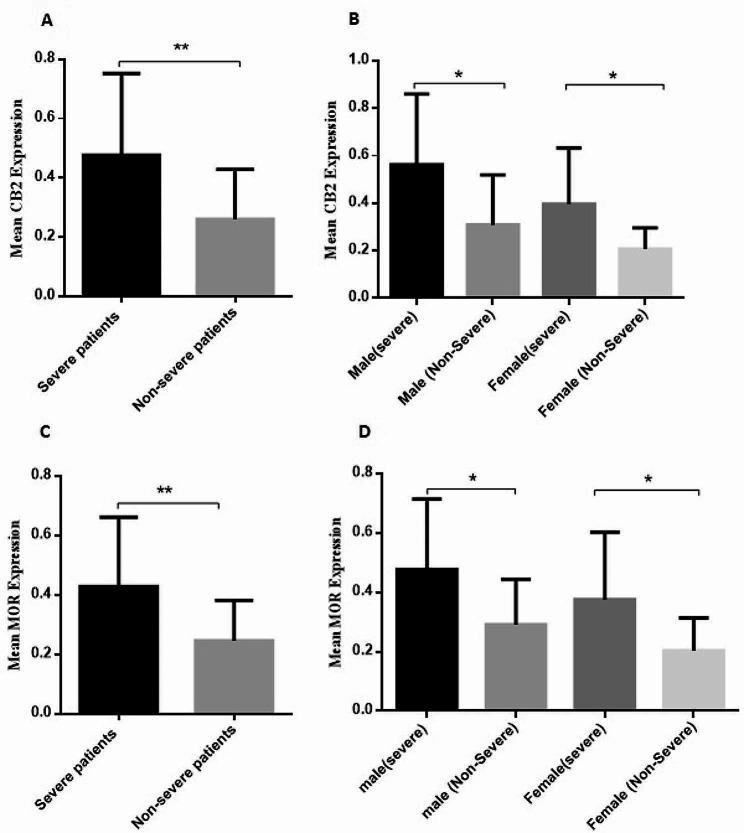
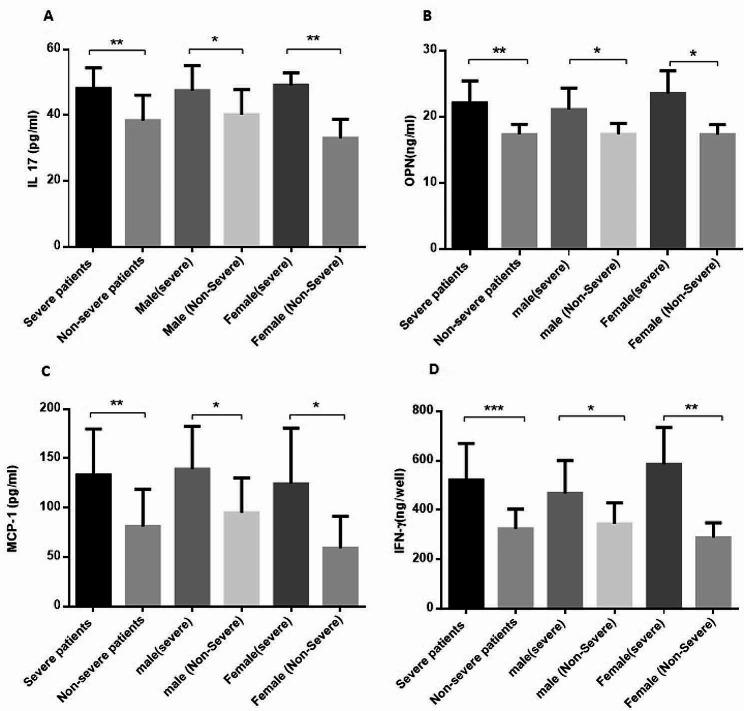
Our results demonstrated a significant increase in MOR gene expression in the epithelium of patients with severe infection. The expression of CB2 receptor was also elevated in both male and female patients with severe symptoms. Furthermore, we observed concurrent rises in MCP-1, IL-17, IFN-γ, and osteopontin levels in patients, which were linked to disease severity. CB2, MOR, MCP-1, IL-17, IFN-γ, and osteopontin showed strong predictive abilities in distinguishing between patients with varying degrees of SARS-CoV-2 severity. Moreover, we identified a significant correlation between CB2 expression and the levels of MOR, MCP-1, osteopontin, and IFN-γ.
CONCLUSIONS
These results underline the interconnected nature of molecular mediators in a sequential manner, suggesting that their overexpression may play a role in the development of SARS-CoV-2 infections.
背景
本研究旨在探索利用大麻素受体 2(CB2)、μ-阿片受体(MOR)、MCP-1、IL-17、IFN-γ 和骨桥蛋白的表达水平作为预测 SARS-CoV-2 感染严重程度的指标。总体目标是阐明与 SARS-CoV-2 相关的发病机制。
方法
使用定量实时 PCR,我们分析了从诊断为 SARS-CoV-2 感染的患者的鼻咽标本中 CB2 和 MOR 的基因表达水平,其中 46 名患者为严重症状,46 名患者为非严重症状。此外,我们使用 ELISA 测定法测量了循环 MCP-1、IL-17、IFN-γ 和骨桥蛋白的水平。我们检查了这些变量的预测能力,并探索了它们在所有患者组中的相关性。
结果
我们的结果表明,严重感染患者上皮细胞中 MOR 基因表达显著增加。CB2 受体的表达在男性和女性严重症状患者中也升高。此外,我们观察到患者中 MCP-1、IL-17、IFN-γ 和骨桥蛋白水平同时升高,与疾病严重程度相关。CB2、MOR、MCP-1、IL-17、IFN-γ 和骨桥蛋白在区分 SARS-CoV-2 严重程度不同的患者方面具有很强的预测能力。此外,我们发现 CB2 表达与 MOR、MCP-1、骨桥蛋白和 IFN-γ 水平之间存在显著相关性。
结论
这些结果强调了分子介质以顺序方式相互关联的性质,表明它们的过度表达可能在 SARS-CoV-2 感染的发展中起作用。

 Zotero 插件