Medical School of Chinese PLA, Beijing, 100853, China.
Department of Orthopedics, the First Medical Center, Chinese People's Liberation Army General Hospital, Fuxing Road, Haidian District, Beijing, 100853, China.
J Orthop Surg Res. 2024 Apr 12;19(1):236. doi: 10.1186/s13018-024-04713-z.
Osteonecrosis of the femoral head (ONFH) is a severe disease that primarily affects the middle-aged population, imposing a significant economic and social burden. Recent research has linked the progression of non-traumatic osteonecrosis of the femoral head (NONFH) to the composition of the gut microbiota. Steroids and alcohol are considered major contributing factors. However, the relationship between NONFH caused by two etiologies and the microbiota remains unclear. In this study, we examined the gut microbiota and fecal metabolic phenotypes of two groups of patients, and analyzed potential differences in the pathogenic mechanisms from both the microbial and metabolic perspectives.
Utilizing fecal samples from 68 NONFH patients (32 steroid-induced, 36 alcohol-induced), high-throughput 16 S rDNA sequencing and liquid chromatography with tandem mass spectrometry (LC-MS/MS) metabolomics analyses were conducted. Univariate and multivariate analyses were applied to the omics data, employing linear discriminant analysis effect size to identify potential biomarkers. Additionally, functional annotation of differential metabolites and associated pathways was performed using the Kyoto Encyclopedia of Genes and Genomes (KEGG) database. Subsequently, Spearman correlation analysis was employed to assess the potential correlations between differential gut microbiota and metabolites.
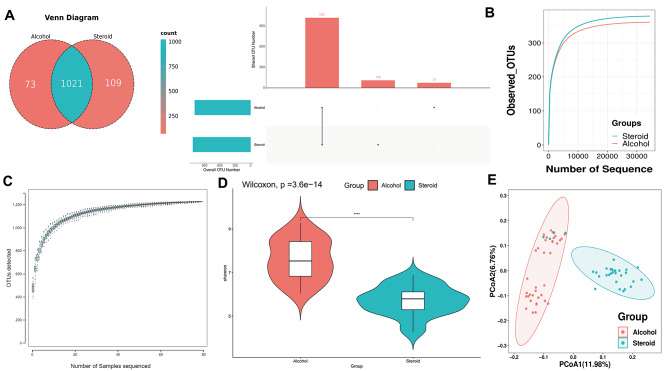
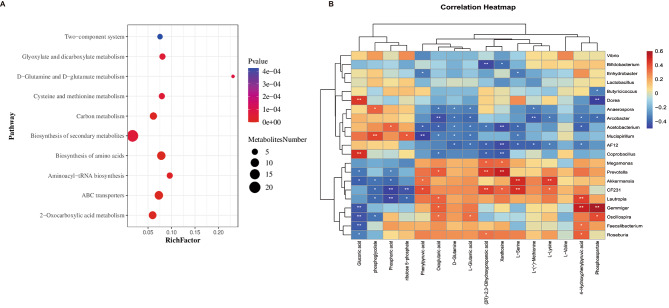
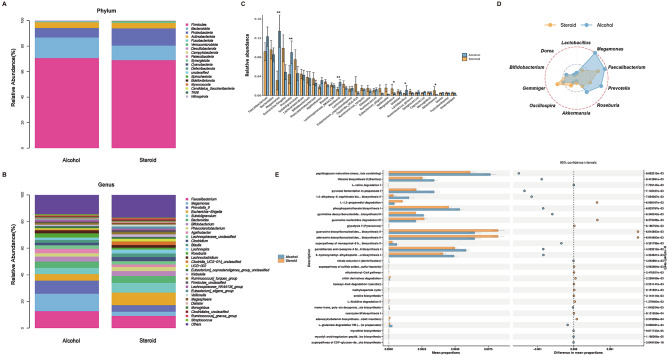
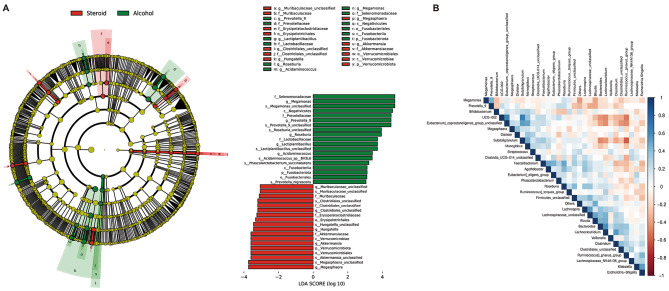
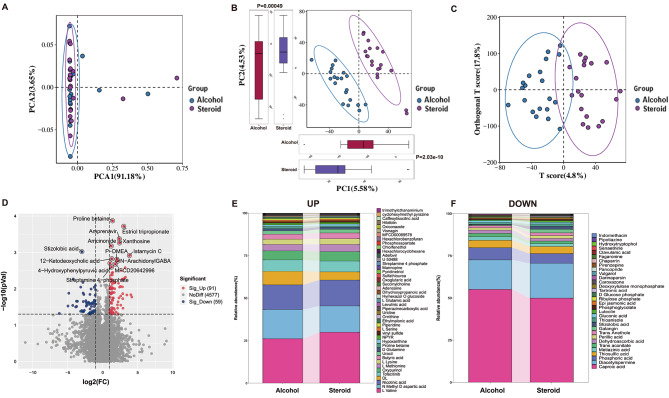
High-throughput 16 S rDNA sequencing revealed significant gut microbial differences. At the genus level, the alcohol group had higher Lactobacillus and Roseburia, while the steroid group had more Megasphaera and Akkermansia. LC-MS/MS metabolomic analysis indicates significant differences in fecal metabolites between steroid- and alcohol-induced ONFH patients. Alcohol-induced ONFH (AONFH) showed elevated levels of L-Lysine and Oxoglutaric acid, while steroid-induced ONFH(SONFH) had increased Gluconic acid and Phosphoric acid. KEGG annotation revealed 10 pathways with metabolite differences between AONFH and SONFH patients. Correlation analysis revealed the association between differential gut flora and differential metabolites.
Our results suggest that hormones and alcohol can induce changes in the gut microbiota, leading to alterations in fecal metabolites. These changes, driven by different pathways, contribute to the progression of the disease. The study opens new research directions for understanding the pathogenic mechanisms of hormone- or alcohol-induced NONFH, suggesting that differentiated preventive and therapeutic approaches may be needed for NONFH caused by different triggers.
股骨头坏死(ONFH)是一种主要影响中年人群的严重疾病,给社会和经济带来了巨大的负担。最近的研究表明,非创伤性股骨头坏死(NONFH)的进展与肠道微生物群的组成有关。类固醇和酒精被认为是主要的致病因素。然而,两种病因引起的 NONFH 与微生物群之间的关系尚不清楚。在这项研究中,我们检查了两组患者的肠道微生物群和粪便代谢表型,并从微生物和代谢角度分析了潜在的致病机制差异。
利用 68 例 NONFH 患者(32 例类固醇诱导,36 例酒精诱导)的粪便样本,进行高通量 16S rDNA 测序和液相色谱-串联质谱(LC-MS/MS)代谢组学分析。对组学数据进行单变量和多变量分析,采用线性判别分析效应大小来识别潜在的生物标志物。此外,利用京都基因与基因组百科全书(KEGG)数据库对差异代谢物及其相关通路进行功能注释。然后,采用 Spearman 相关分析评估差异肠道微生物群和代谢物之间的潜在相关性。
高通量 16S rDNA 测序显示肠道微生物存在显著差异。在属水平上,酒精组的乳酸杆菌和罗斯伯里氏菌较高,而类固醇组的巨球形菌和阿克曼氏菌较多。LC-MS/MS 代谢组学分析表明,类固醇和酒精诱导的 ONFH 患者的粪便代谢物存在显著差异。酒精性 ONFH(AONFH)患者的 L-赖氨酸和氧戊二酸水平升高,而类固醇性 ONFH(SONFH)患者的葡萄糖酸和磷酸水平升高。KEGG 注释显示,AONFH 和 SONFH 患者之间有 10 条代谢物差异通路。相关性分析显示,差异肠道菌群与差异代谢物之间存在关联。
我们的研究结果表明,激素和酒精可以诱导肠道微生物群的变化,导致粪便代谢物的改变。这些变化通过不同的途径发生,导致疾病的进展。该研究为理解激素或酒精引起的 NONFH 的致病机制开辟了新的研究方向,表明针对不同触发因素引起的 NONFH 需要采取不同的预防和治疗方法。