Ran Saidi, Wang Zhiqian, Fu Mingming, Hou Zhiyong
Department of Geriatric Orthopedics, The Third Hospital of Hebei Medical University, Shijiazhuang, Hebei, People's Republic of China.
Department of Orthopaedic Surgery, The Third Hospital of Hebei Medical University, Shijiazhuang, Hebei, People's Republic of China.
Clin Interv Aging. 2024 Apr 8;19:599-610. doi: 10.2147/CIA.S450590. eCollection 2024.
Older patients combined with coronary heart disease (CHD) develop acute heart failure (AHF) after hip fracture surgery is common, and this study aimed to investigate the risk factors of postoperative AHF in older hip fracture patients and to construct a nomogram prediction model.
We retrospectively collected older hip fracture patients with CHD who underwent hip fracture surgery at the Third Hospital of Hebei Medical University from January 2017 to December 2021. We divided them into a training set and a validation set. We collected the demographic data, laboratory indicators and imaging examination results. We identified risk factors for postoperative AHF and used R language software to establish a nomogram prediction model, plot ROC curves, calibration curves and DCA decision curves.
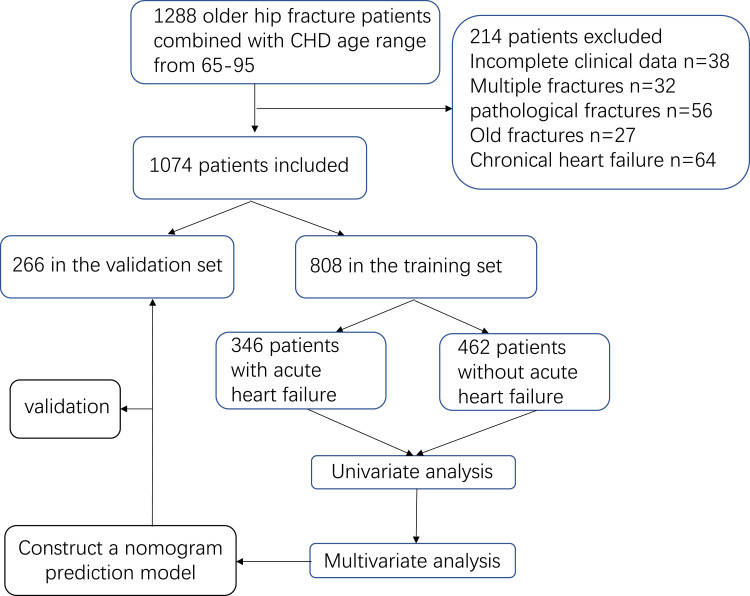
We retrospectively collected 1288 older hip fractures patients with CHD. After excluding 214 patients who did not meet the criteria, 1074 patients were included in our research and we divided them into the training set and the validation set. In the training set, a total of 346 (42.8%) patients developing postoperative AHF. Through univariate and multivariate logistic regression analysis, we identified the risk factors for postoperative AHF and constructed a nomogram prediction model. The AUC of the prediction model is 0.778. The correction curve shows that the model has good consistency. The decision curve analysis shows that the model has good clinical practicality.
There were 42.8% older patients combined with CHD develop postoperative AHF. Among them, fracture type, age, anemia at admission, combined with COPD, ASA ≥ 3, and preoperative waiting time >3 days are risk factors for postoperative AHF. We constructed a nomogram prediction model that can effectively predict the risk of postoperative AHF in older hip fracture patients combined with CHD.
老年冠心病(CHD)患者髋部骨折手术后发生急性心力衰竭(AHF)很常见,本研究旨在探讨老年髋部骨折患者术后AHF的危险因素,并构建列线图预测模型。
回顾性收集2017年1月至2021年12月在河北医科大学第三医院接受髋部骨折手术的老年冠心病合并髋部骨折患者。将其分为训练集和验证集。收集人口统计学数据、实验室指标和影像学检查结果。确定术后AHF的危险因素,并使用R语言软件建立列线图预测模型,绘制ROC曲线、校准曲线和DCA决策曲线。
回顾性收集1288例老年冠心病合并髋部骨折患者。排除214例不符合标准的患者后,1074例患者纳入研究并分为训练集和验证集。训练集中,共有346例(42.8%)患者发生术后AHF。通过单因素和多因素logistic回归分析,确定了术后AHF的危险因素并构建了列线图预测模型。预测模型的AUC为0.778。校准曲线显示该模型具有良好的一致性。决策曲线分析表明该模型具有良好的临床实用性。
42.8%的老年冠心病患者术后发生AHF。其中,骨折类型、年龄、入院时贫血、合并慢性阻塞性肺疾病(COPD)、美国麻醉医师协会(ASA)分级≥3级以及术前等待时间>3天是术后AHF的危险因素。构建了列线图预测模型,可有效预测老年冠心病合并髋部骨折患者术后AHF的风险。