Yamamoto Kumiko, Nasu Katsumi, Nakayoshi Yoko, Takase Miyuki
School of Nursing, Yasuda Women's University, 6-13-1, Yasuhigashi, Asaminami-ku, 731-0153, Hiroshima, Japan.
BMC Nurs. 2024 Apr 17;23(1):248. doi: 10.1186/s12912-024-01900-5.
The nursing shortage represents a persistent and urgent challenge within the healthcare industry. One of the most cost-effective and time-efficient solutions to address this issue is the recruitment of inactive nurses to rejoin the nursing workforce, while simultaneously ensuring the long-term sustainability of their careers following their return to work. The aim of this study is to explore the factors that facilitate the retention of nurses who have returned to work, from their perspective.
To achieve this aim, a qualitative descriptive design was employed. A total of 15 registered nurses who had not practiced nursing for a minimum of three years prior to their return to work, and had been working as nurses for at least three months following their return, were selected from seven healthcare institutions using convenience sampling. Face-to-face or online semi-structured interviews were conducted, and qualitative inductive analysis was employed to analyze the collected data.
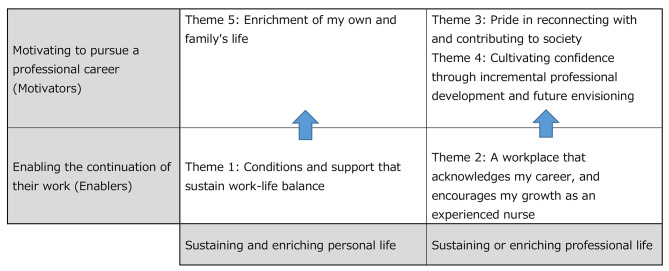
The analysis revealed five key themes, two of which were related to the enabling factors making it possible for the nurses to continue their work, while the remaining three pertained to the motivating factors driving the pursuit of professional careers. The two themes associated with enabling factors were identified as "Conditions and support that sustain work-life balance" and "A workplace that acknowledges my career, and encourages my growth as an experienced nurse". The three themes related to motivating factors were entitled "Pride in reconnecting with and contributing to society," "Cultivating confidence through incremental professional development and future envisioning," and "Enrichment of my own and my family's life".
Returning nurses constitute a valuable asset for healthcare institutions. To effectively retain these nurses, it is crucial to implement multi-dimensional approaches that enable and motivate them to sustain and enrich their professional and personal lives while continuing their work in the nursing field.
护理人员短缺是医疗行业长期面临的紧迫挑战。解决这一问题最具成本效益和时间效率的方法之一,是招募非在职护士重新加入护理队伍,同时确保她们重返工作岗位后职业生涯的长期可持续性。本研究旨在从回归工作岗位的护士的角度,探索促进她们留任的因素。
为实现这一目标,采用了定性描述性设计。通过便利抽样从7家医疗机构中选取了15名注册护士,她们在重返工作岗位前至少有三年未从事护理工作,且重返工作岗位后至少工作了三个月。进行了面对面或在线的半结构化访谈,并采用定性归纳分析方法对收集到的数据进行分析。
分析揭示了五个关键主题,其中两个与使护士能够继续工作的促成因素相关,其余三个与推动她们追求职业生涯的激励因素相关。与促成因素相关的两个主题被确定为“维持工作与生活平衡的条件和支持”以及“认可我的职业并鼓励我作为经验丰富的护士成长的工作场所”。与激励因素相关的三个主题分别是“重新融入社会并为社会做出贡献的自豪感”、“通过渐进式专业发展和未来展望培养信心”以及“丰富我自己和我家人的生活”。
回归工作岗位的护士是医疗机构的宝贵资产。为有效留住这些护士,至关重要的是实施多维度方法,使她们能够并激励她们在继续从事护理工作的同时,维持和丰富自己的职业和个人生活。