Department of Endocrinology, Metabolism and Internal Medicine, Poznan University of Medical Sciences, Poznan, Poland.
Front Endocrinol (Lausanne). 2024 Apr 2;15:1354098. doi: 10.3389/fendo.2024.1354098. eCollection 2024.
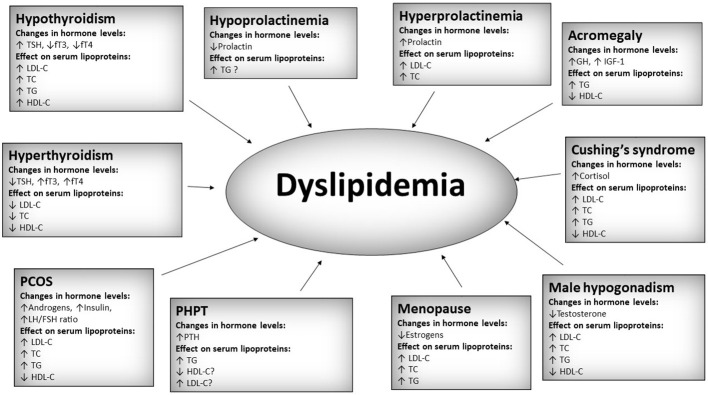
Dyslipidemia is one of the most common disorders worldwide, which, if left untreated, results in a multitude of complications. Thus proper diagnostics, which includes identifying of secondary causes of dyslipidemia is crucial. Endocrine disorders are an important cause of secondary dyslipidemia. This paper aims to review the publications on lipoprotein alterations in endocrine disorders from the past two years and provide an overview of the recent discoveries in this dynamically developing and large field. Significant changes in lipoprotein serum concentrations are present in most endocrinological diseases and can be modified with proper treatment. Some lipoproteins have also been proposed as markers in some endocrine diseases, e.g., thyroid carcinoma. From the scope of endocrine disorders, the largest number of studies explored the lipoprotein changes in polycystic ovary syndrome and in women during the menopausal and peri-menopausal period. Even though the association of thyroid disorders with dyslipidemia is already well studied, new research has delivered some exciting findings about lipoprotein alterations in euthyroid patients with either positive antithyroid peroxidase antibodies or reduced sensitivity to thyroid hormones. The problem of the adverse metabolic profile, including dyslipidemia in hypoprolactinemia has been recognized. Moreover, this review describes other significant discoveries encompassing lipoprotein alterations in disorders of the adrenals, thyroid, parathyroid glands, pituitary, and gonads. The up-to-date knowledge of the influence of endocrine disorders and hormonal changes on serum lipoproteins is prudent as it can significantly impact therapeutic decisions.
血脂异常是全球最常见的疾病之一,如果不加以治疗,会导致多种并发症。因此,适当的诊断,包括识别血脂异常的继发性原因,是至关重要的。内分泌紊乱是继发性血脂异常的一个重要原因。本文旨在回顾过去两年中关于内分泌紊乱中脂蛋白改变的出版物,并概述这一快速发展和庞大领域的最新发现。大多数内分泌疾病都会导致脂蛋白血清浓度的显著变化,并且可以通过适当的治疗来改善。一些脂蛋白也被提出作为某些内分泌疾病的标志物,例如甲状腺癌。从内分泌紊乱的范围来看,研究最多的是多囊卵巢综合征和绝经期及围绝经期妇女的脂蛋白变化。尽管甲状腺疾病与血脂异常的相关性已经得到了很好的研究,但新的研究发现,甲状腺过氧化物酶抗体阳性或对甲状腺激素敏感性降低的甲状腺功能正常患者的脂蛋白改变令人兴奋。人们已经认识到,催乳素低下症的不良代谢特征包括血脂异常。此外,本综述还描述了其他重要的发现,包括肾上腺、甲状腺、甲状旁腺、垂体和性腺疾病中的脂蛋白改变。了解内分泌紊乱和激素变化对血清脂蛋白的影响是明智的,因为它会对治疗决策产生重大影响。