
活体人类皮肤应变调制光谱反射率的动态模型。
Dynamic model for the strain-modulated spectral reflectance of the human skin in vivo.
作者信息
Huo Zongze, Wang Shibin, Wei Huixin, Cheng Xuanshi, Li Linan, Li Chuanwei, Wang Zhiyong
机构信息
Department of Mechanics, School of Mechanical Engineering, Tianjin University, Tianjin 300350, China.
出版信息
Biomed Opt Express. 2024 Mar 7;15(4):2238-2250. doi: 10.1364/BOE.507361. eCollection 2024 Apr 1.
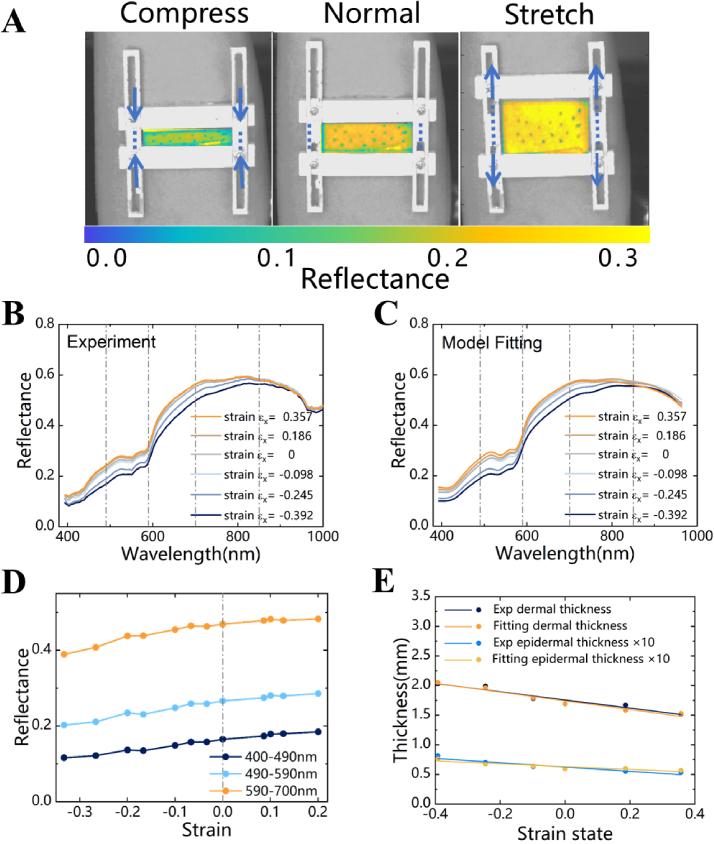
Hyperspectral imaging (HSI) offers a wealth of information regarding human skin. In this study, we established a dynamic skin spectral reflectance model (DSSR) relating the reflectance to skin surface strain, considering multi physiological and physical parameters of the skin. Experimentally, by HSI, we measured the reflectance variance of the forearm skin in vivo caused by the surface strain, and assessed these key parameters. For the human skin in vivo, within the strain range covered in this paper, stretching increases spectral reflectance, while compression decreases it. Our proposed model provides a possibility for non-contact strain measurement and health monitoring on the skin in vivo based on HSI.
高光谱成像(HSI)提供了大量有关人体皮肤的信息。在本研究中,我们建立了一个动态皮肤光谱反射率模型(DSSR),该模型将反射率与皮肤表面应变相关联,同时考虑了皮肤的多种生理和物理参数。通过实验,我们利用高光谱成像技术测量了体内前臂皮肤因表面应变引起的反射率变化,并评估了这些关键参数。对于体内的人体皮肤,在本文所涵盖的应变范围内,拉伸会增加光谱反射率,而压缩则会降低光谱反射率。我们提出的模型为基于高光谱成像技术的体内皮肤非接触应变测量和健康监测提供了可能性。


 Zotero 插件