Zhang Yin, Lindström Sara, Kraft Peter, Liu Yuxi
Department of Nutrition, Harvard T. H. Chan School of Public Health, Boston, MA, USA.
Department of Epidemiology, University of Washington, Seattle, WA, USA.
medRxiv. 2024 Apr 6:2024.04.04.24305361. doi: 10.1101/2024.04.04.24305361.
Early-onset cancer (diagnosed under 50 years of age) is associated with aggressive disease characteristics and its rising incidence is a global concern. The association between healthy lifestyle and early-onset cancer and whether it varies by common genetic variants is unknown.
To examine the associations between genetic risk, lifestyle, and risk of early-onset cancers.
We analyzed a prospective cohort of 66,308 white British participants who were under age 50 and free of cancer at baseline in the UK Biobank.
Sex-specific composite total cancer polygenic risk scores (PRSs), a breast cancer-specific PRS, and sex-specific health-associated lifestyle scores (HLSs, which summarize smoking status, body mass index [males only], physical activity, alcohol consumption, and diet).
Hazard ratios (HRs) and 95% confidence intervals (CIs) for early-onset total and breast cancer.
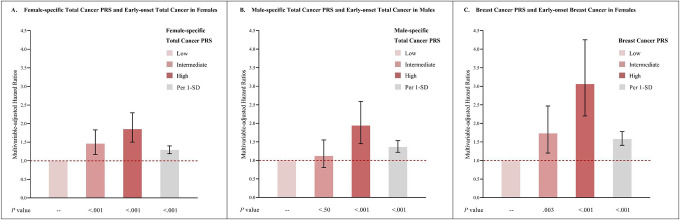
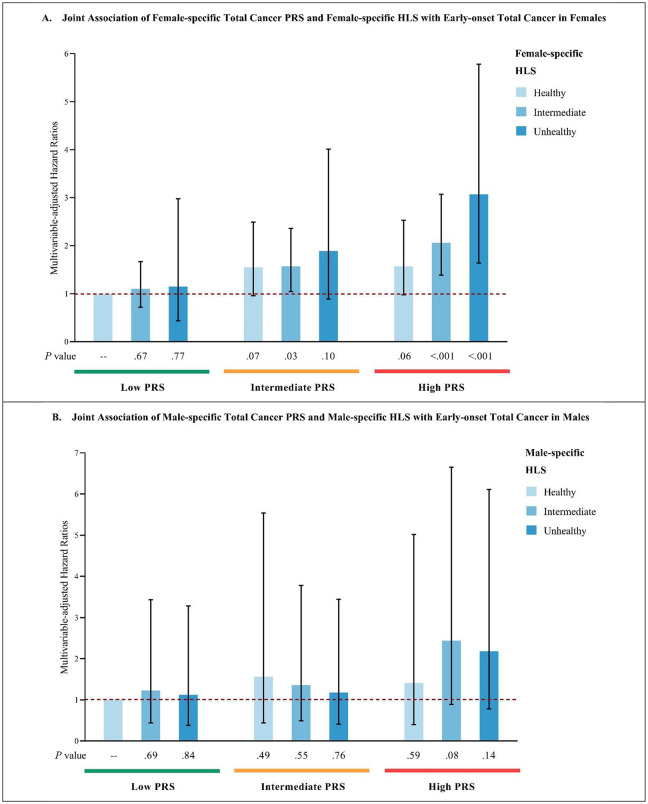
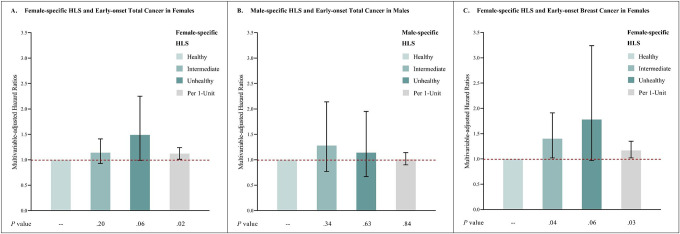
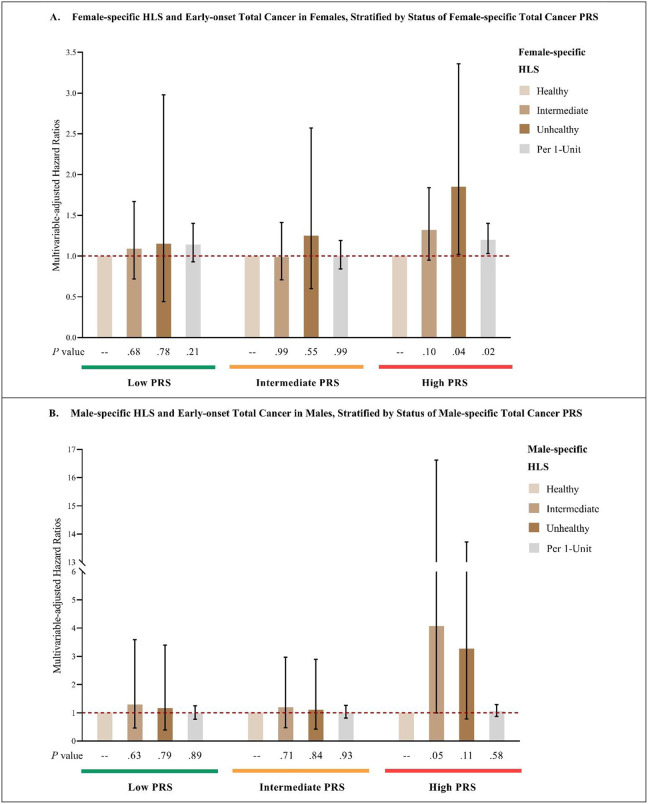
A total of 1,247 incident invasive early-onset cancer cases (female: 820, male: 427, breast: 386) were documented. In multivariable-adjusted analyses with 2-year latency, higher genetic risk (highest vs. lowest tertile of PRS) was associated with significantly increased risks of early-onset total cancer in females (HR, 95% CI: 1.85, 1.50-2.29) and males (1.94, 1.45-2.59) as well as early-onset breast cancer in females (3.06, 2.20-4.25). An unfavorable lifestyle (highest vs. lowest category of HLS) was associated with higher risk of total cancer and breast cancer in females across genetic risk categories; the association with total cancer was stronger in the highest genetic risk category than the lowest: HRs in females and men were 1.85 (1.02, 3.36), 3.27 (0.78, 13.72) in the highest genetic risk category and 1.15 (0.44, 2.98), 1.16 (0.39, 3.40) in the lowest.
Both genetic and lifestyle factors were independently associated with early-onset total and breast cancer risk. Compared to those with low genetic risk, individuals with a high genetic risk may benefit more from adopting a healthy lifestyle in preventing early-onset cancer.
早发性癌症(50岁之前确诊)与侵袭性疾病特征相关,其发病率上升是一个全球关注的问题。健康生活方式与早发性癌症之间的关联以及这种关联是否因常见基因变异而有所不同尚不清楚。
研究遗传风险、生活方式与早发性癌症风险之间的关联。
设计、设置和参与者:我们分析了英国生物银行中66308名年龄在50岁以下且基线时无癌症的白人英国参与者的前瞻性队列。
按性别分类的综合全癌多基因风险评分(PRSs)、乳腺癌特异性PRS以及按性别分类的健康相关生活方式评分(HLSs,汇总吸烟状况、体重指数[仅男性]、身体活动、饮酒和饮食)。
早发性全癌和乳腺癌的风险比(HRs)及95%置信区间(CIs)。
共记录了1247例侵袭性早发性癌症病例(女性:820例,男性:427例,乳腺癌:386例)。在有2年潜伏期的多变量调整分析中,较高的遗传风险(PRS最高三分位数与最低三分位数相比)与女性(HR,95%CI:1.85,1.50 - 2.29)和男性(1.94,1.45 - 2.59)早发性全癌风险显著增加以及女性早发性乳腺癌风险(3.06,2.20 - 4.25)相关。不良生活方式(HLS最高类别与最低类别相比)与女性全癌和乳腺癌风险较高相关,在各遗传风险类别中均如此;在最高遗传风险类别中与全癌的关联比最低遗传风险类别更强:女性和男性在最高遗传风险类别中的HR分别为1.85(1.02,3.36)、3.27(0.78,13.72),在最低遗传风险类别中分别为1.15(0.44,2.98)、1.16(0.39,3.40)。
遗传因素和生活方式因素均独立与早发性全癌和乳腺癌风险相关。与低遗传风险者相比,高遗传风险个体在预防早发性癌症方面可能从采用健康生活方式中获益更多。