Institute of Biology, University of Szczecin, Waska 13, 71-415, Szczecin, Poland.
Institute of Plant Physiology, Polish Academy of Sciences, Niezapominajek 21, 20-239, Krakow, Poland.
Planta. 2024 Apr 18;259(6):126. doi: 10.1007/s00425-024-04387-1.
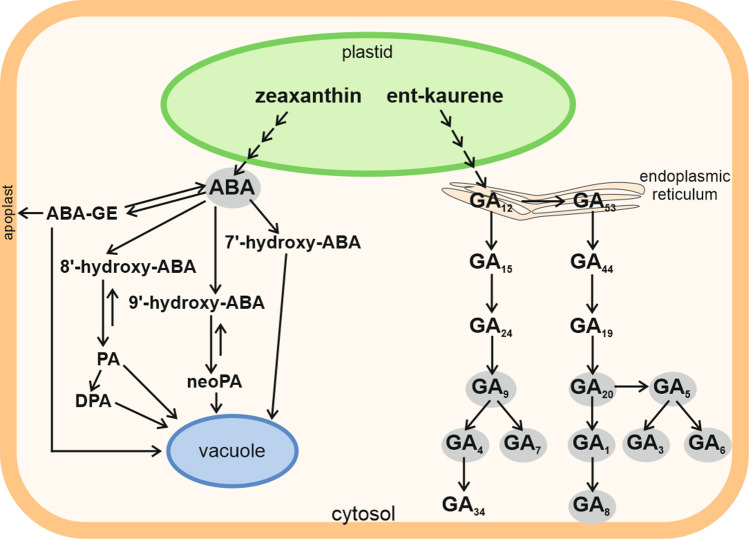
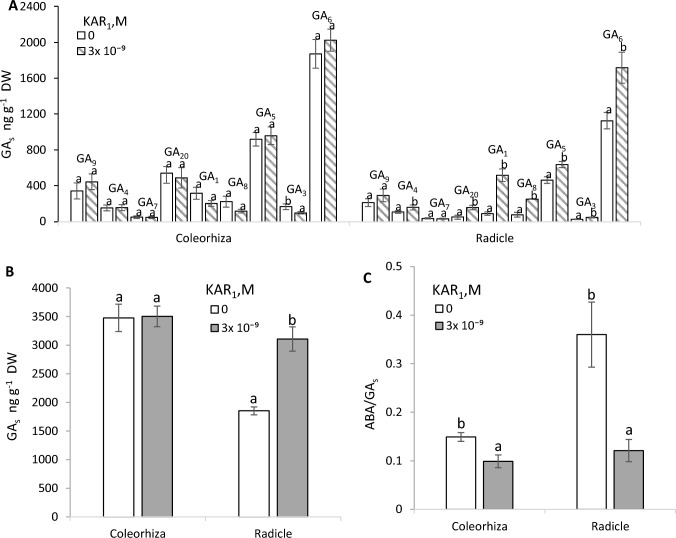
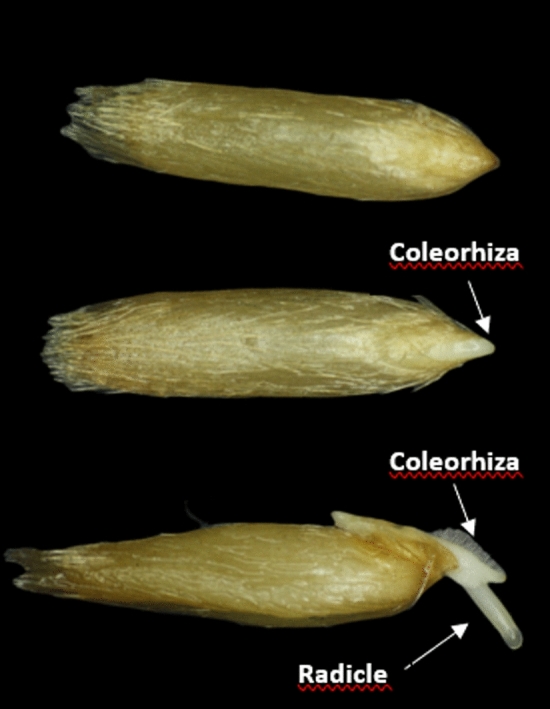
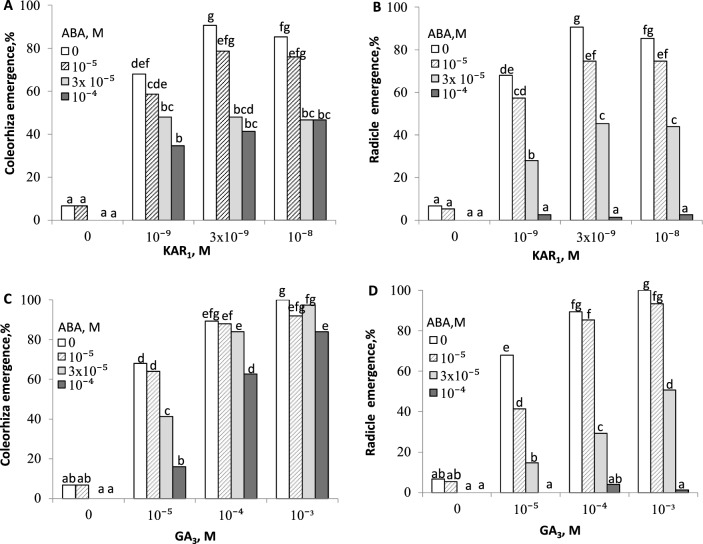
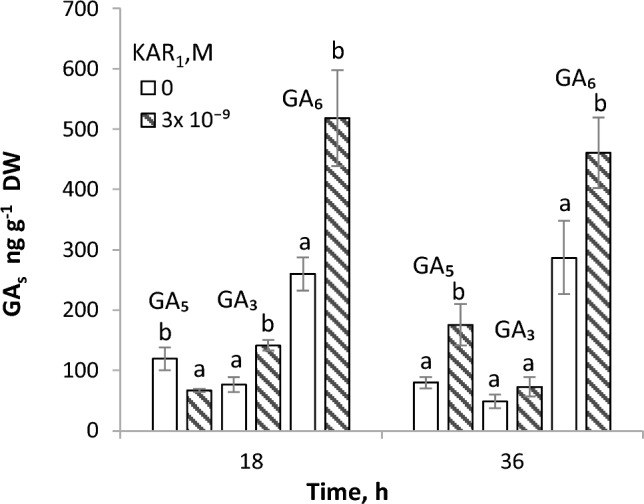
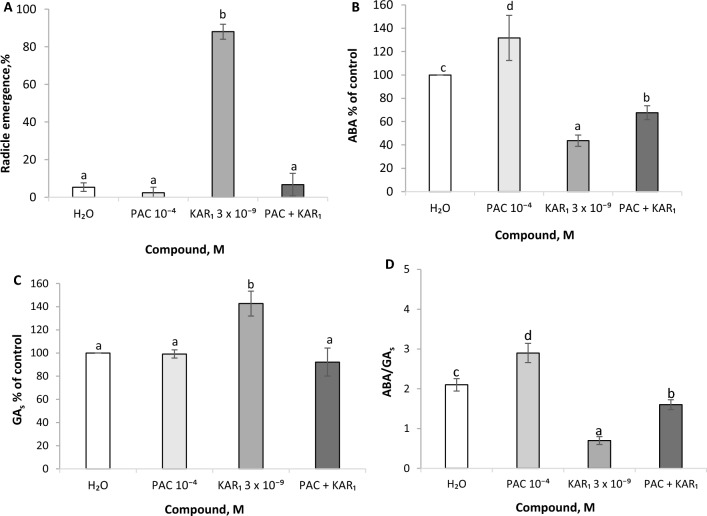
The dormancy release by KAR is associated with a reduction of coleorhiza and radicle sensitivity to ABA as well as with reduction the ABA/GA ratio in the coleorhiza, by a decrease content of ABA, and in the radicle, by a decrease the ABA and an increase of the GA contents. Both, karrikin 1 (KAR) and gibberellin A (GA), release dormancy in Avena fatua caryopses, resulting in the emergence of coleorhiza (CE) and radicle (RE). Moreover, KAR and GA stimulate CE and RE in the presence of abscisic acid (ABA), the stimulation being more effective in CE. The stimulatory effects of KAR and GA involve also the CE and RE rates. A similar effect was observed at KAR concentrations much lower than those of GA. KAR increased the levels of bioactive GA and GA in embryos and the levels of GA, GA, GA GA and GA in radicles. The stimulatory effect of KAR on germination, associated with increased levels of gibberellins (GA) and reduced levels of ABA in embryos, was counteracted by paclobutrazol (PAC), commonly regarded as a GA biosynthesis inhibitor. Consequently, KAR decreased the ABA/GA ratio, whereas PAC, used alone or in combination with KAR, increased it. The ABA/GA ratio was reduced by KAR in both coleorhiza and radicle, the effect being stronger in the latter. We present the first evidence that KAR-induced dormancy release requires a decreased ABA/GA ratio in coleorhiza and radicle. It is concluded that the dormancy-releasing effect of KAR in A. fatua caryopses includes (i) a reduction of the coleorhiza and radicle sensitivity to ABA, and (2) a reduction of the ABA/GA ratio (i) in the coleorhiza, by decreasing the ABA content, and (ii) in the radicle, by decreasing the ABA and increasing the content GA, particularly GA. The results may suggest different mechanisms of dormancy release by KAR in monocot and dicot seeds.
KAR 的休眠释放与 coleorhiza 和 radicle 对 ABA 的敏感性降低以及 coleorhiza 中 ABA/GA 比值降低有关,这是通过降低 ABA 含量实现的,而在 radicle 中则是通过降低 ABA 和增加 GA 含量来实现的。无论是 karrikin 1 (KAR) 还是赤霉素 A (GA),都能解除 Avena fatua 颖果的休眠,导致 coleorhiza (CE) 和 radicle (RE) 的萌发。此外,KAR 和 GA 在存在脱落酸 (ABA) 的情况下刺激 CE 和 RE,在 CE 中刺激作用更为明显。KAR 和 GA 的刺激作用还涉及 CE 和 RE 速率。在远低于 GA 浓度的 KAR 浓度下也观察到类似的效果。KAR 增加了胚胎中的生物活性 GA 和 GA 的水平,以及 radicle 中的 GA、GA、GA GA 和 GA 的水平。KAR 对萌发的刺激作用与胚胎中赤霉素 (GA) 水平的升高和 ABA 水平的降低有关,但被 paclobutrazol (PAC) 抵消,PAC 通常被认为是 GA 生物合成抑制剂。因此,KAR 降低了 ABA/GA 比值,而 PAC 单独使用或与 KAR 联合使用时则增加了 ABA/GA 比值。KAR 在 coleorhiza 和 radicle 中都降低了 ABA/GA 比值,后者的效果更强。我们首次证明,KAR 诱导的休眠释放需要 coleorhiza 和 radicle 中 ABA/GA 比值降低。因此,可以得出结论,KAR 在 A. fatua 颖果中的休眠释放效应包括:(i) 降低 coleorhiza 和 radicle 对 ABA 的敏感性,和 (2) 降低 ABA/GA 比值 (i) 在 coleorhiza 中,通过降低 ABA 含量,和 (ii) 在 radicle 中,通过降低 ABA 和增加 GA 含量,特别是 GA。这些结果可能表明 KAR 在单子叶和双子叶种子中解除休眠的机制不同。