Division of Cardiology, The First Affiliated Hospital of Nanjing Medical University, Nanjing, China.
Lillehei Heart Institute and Cardiovascular Division, University of Minnesota Medical School, Minneapolis, MN, USA.
J Electrocardiol. 2024 May-Jun;84:123-128. doi: 10.1016/j.jelectrocard.2024.03.016. Epub 2024 Apr 17.
Deep terminal negative of the P wave in V1 (DTNPV1) is a marker of left atrial remodeling. We aimed to evaluate the association of DTNPV1 with incident ischemic stroke.
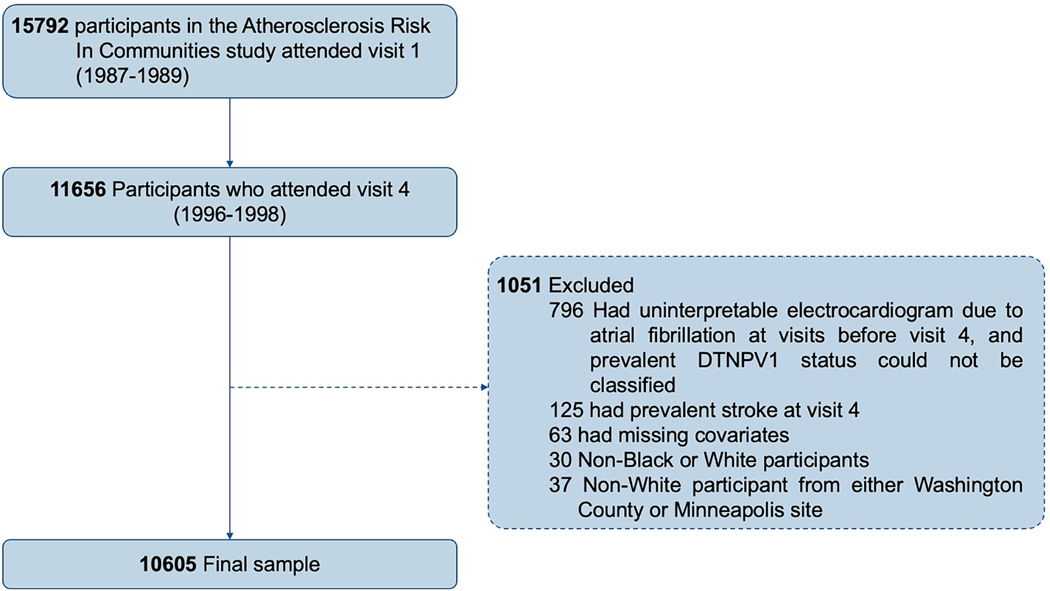
The Atherosclerosis Risk in Communities study is a prospective community-based cohort study. All participants at visit 4 (1996-1998) except those with prevalent stroke, missing covariates, and missing or uninterpretable ECG were included. DTNPV1 was defined as the absolute value of the depth of the terminal negative phase >100 μV in the presence of biphasic P wave in V1. Association between DTNPV1 as a time-dependent exposure variable and incident ischemic stroke was evaluated. The accuracy of the prediction model consisting of DTNPV1 and CHADS-VASc variables in predicting ischemic stroke was analyzed.
Among 10,605 participants (63 ± 6 years, 56% women, 20% Black), 803 cases of ischemic stroke occurred over a median follow-up of 20.19 years. After adjusting for demographics, DTNPV1 was associated with an increased risk of stroke (HR 1.96, [95% CI 1.39-2.77]). After further adjusting for stroke risk factors, use of aspirin and anticoagulants, and time-dependent atrial fibrillation, DTNPV1 was associated with a 1.50-fold (95% CI 1.06-2.13) increased risk of stroke. When added to the CHADS-VASc variables, DTNPV1 did not significantly improve stroke prediction as assessed by C-statistic. However, there was improvement in risk classification for participants who did not develop stroke.
DTNPV1 is significantly associated with higher risk of ischemic stroke. Since DTNPV1 is a simplified electrocardiographic parameter, it may help stroke prediction, a subject for further research.
V1 导联中 P 波终末负向深度(DTNPV1)深是左心房重构的一个标志物。我们旨在评估 DTNPV1 与缺血性卒中事件的相关性。
动脉粥样硬化风险社区研究是一项前瞻性社区为基础的队列研究。除了有先前的卒中、缺失协变量、以及缺失或无法解释的心电图的参与者之外,所有在第 4 次访视(1996-1998 年)的参与者都被纳入研究。DTNPV1 被定义为 V1 导联中存在双向 P 波时终末负相深度绝对值>100μV。评估 DTNPV1 作为时间依赖性暴露变量与缺血性卒中事件的相关性。分析由 DTNPV1 和 CHADS-VASc 变量组成的预测模型在预测缺血性卒中方面的准确性。
在 10605 名参与者(63±6 岁,56%为女性,20%为黑人)中,中位随访 20.19 年后发生了 803 例缺血性卒中。在校正了人口统计学因素后,DTNPV1 与卒中风险增加相关(HR 1.96,95% CI 1.39-2.77)。进一步校正卒中危险因素、阿司匹林和抗凝药物的使用以及时间依赖性心房颤动后,DTNPV1 与卒中风险增加 1.50 倍相关(95% CI 1.06-2.13)。当加入 CHADS-VASc 变量时,DTNPV1 并不能显著提高 C 统计量评估的卒中预测。然而,对于没有发生卒中的参与者,风险分类有所改善。
DTNPV1 与缺血性卒中的风险显著相关。由于 DTNPV1 是一个简化的心电图参数,它可能有助于进一步研究的卒中预测。