Vascular Cognitive Impairment, Neurodegeneration and Healthy Brain Aging Program, Department of Neurosurgery, University of Oklahoma Health Sciences Center, Oklahoma City, OK, USA.
Stephenson Cancer Center, University of Oklahoma, Oklahoma City, OK, USA.
Geroscience. 2024 Oct;46(5):5103-5132. doi: 10.1007/s11357-024-01139-7. Epub 2024 Apr 19.
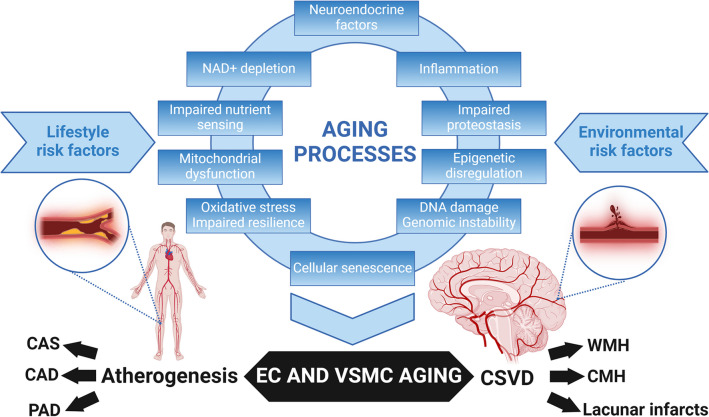
Cerebral microhemorrhages (CMHs, also known as cerebral microbleeds) are a critical but frequently underestimated aspect of cerebral small vessel disease (CSVD), bearing substantial clinical consequences. Detectable through sensitive neuroimaging techniques, CMHs reveal an extensive pathological landscape. They are prevalent in the aging population, with multiple CMHs often being observed in a given individual. CMHs are closely associated with accelerated cognitive decline and are increasingly recognized as key contributors to the pathogenesis of vascular cognitive impairment and dementia (VCID) and Alzheimer's disease (AD). This review paper delves into the hypothesis that atherosclerosis, a prevalent age-related large vessel disease, extends its pathological influence into the cerebral microcirculation, thereby contributing to the development and progression of CSVD, with a specific focus on CMHs. We explore the concept of vascular aging as a continuum, bridging macrovascular pathologies like atherosclerosis with microvascular abnormalities characteristic of CSVD. We posit that the same risk factors precipitating accelerated aging in large vessels (i.e., atherogenesis), primarily through oxidative stress and inflammatory pathways, similarly instigate accelerated microvascular aging. Accelerated microvascular aging leads to increased microvascular fragility, which in turn predisposes to the formation of CMHs. The presence of hypertension and amyloid pathology further intensifies this process. We comprehensively overview the current body of evidence supporting this interconnected vascular hypothesis. Our review includes an examination of epidemiological data, which provides insights into the prevalence and impact of CMHs in the context of atherosclerosis and CSVD. Furthermore, we explore the shared mechanisms between large vessel aging, atherogenesis, microvascular aging, and CSVD, particularly focusing on how these intertwined processes contribute to the genesis of CMHs. By highlighting the role of vascular aging in the pathophysiology of CMHs, this review seeks to enhance the understanding of CSVD and its links to systemic vascular disorders. Our aim is to provide insights that could inform future therapeutic approaches and research directions in the realm of neurovascular health.
脑微出血(CMH,也称为脑微出血)是脑小血管病(CSVD)的一个重要但经常被低估的方面,具有重要的临床意义。通过敏感的神经影像学技术可以检测到 CMH,揭示了广泛的病理学特征。它们在老年人群中很常见,在给定的个体中经常观察到多个 CMH。CMH 与认知能力下降加速密切相关,并且越来越被认为是血管性认知障碍和痴呆(VCID)和阿尔茨海默病(AD)发病机制的关键因素。本文综述了一个假说,即动脉粥样硬化,一种常见的与年龄相关的大血管疾病,将其病理学影响扩展到脑微循环,从而导致 CSVD 的发展和进展,特别是 CMH。我们探讨了血管老化作为一个连续体的概念,将大血管的血管病变(如动脉粥样硬化)与 CSVD 特征性的微血管异常联系起来。我们假设,导致大血管加速老化的相同危险因素(即动脉粥样硬化形成),主要通过氧化应激和炎症途径,同样会引发微血管加速老化。加速的微血管老化导致微血管脆弱性增加,从而易发生 CMH。高血压和淀粉样蛋白病理的存在进一步加剧了这一过程。我们全面综述了支持这一相互关联的血管假说的现有证据。我们的综述包括对流行病学数据的检查,这些数据提供了 CMH 在动脉粥样硬化和 CSVD 背景下的患病率和影响的见解。此外,我们探讨了大血管老化、动脉粥样硬化形成、微血管老化和 CSVD 之间的共同机制,特别关注这些相互交织的过程如何导致 CMH 的发生。通过强调血管老化在 CMH 病理生理学中的作用,本综述旨在增强对 CSVD 及其与全身血管疾病关系的理解。我们的目标是提供可以为神经血管健康领域的未来治疗方法和研究方向提供信息的见解。