Department of Leukemia, Division of Cancer Medicine, University of Texas MD Anderson Cancer Center, Houston, TX.
Clinical and Translational Leukemia Programs, Weill Cornell Medicine and New York Presbyterian Hospital, New York, NY.
Blood Adv. 2024 Aug 13;8(15):4209-4220. doi: 10.1182/bloodadvances.2023012302.
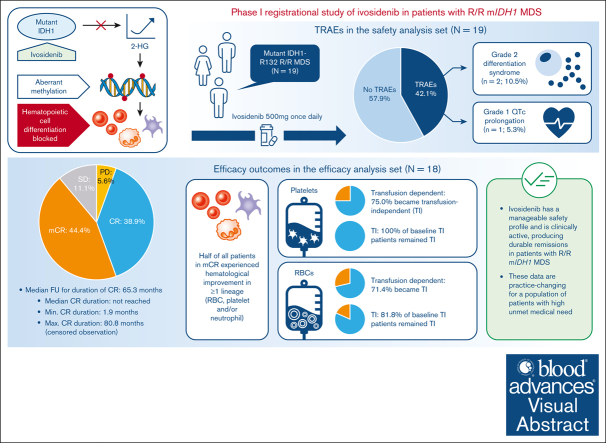
Ivosidenib is a first-in-class mutant isocitrate dehydrogenase 1 (mIDH1) inhibitor with efficacy and tolerability in patients with advanced mIDH1 hematologic malignancies, leading to approval in frontline and relapsed/refractory (R/R) mIDH1 acute myeloid leukemia. We report final data from a phase 1 single-arm substudy of once-daily ivosidenib in patients with R/R mIDH1 myelodysplastic syndrome (MDS) after failure of standard-of-care therapies. Primary objectives were to determine safety, tolerability, and clinical activity. The primary efficacy end point was the complete remission (CR) + partial remission (PR) rate. Nineteen patients were enrolled; 18 were included in the efficacy analysis. Treatment-related adverse events occurred in 8 (42.1%) patients, including a grade 1 QT interval prolongation in 1 (5.3%) patient and grade 2 differentiation syndrome in 2 (10.5%) patients. Rates of CR + PR and objective response (CR + PR + marrow CR) were 38.9% (95% confidence interval [CI], 17.3-64.3) and 83.3% (95% CI, 58.6-96.4), respectively. Kaplan-Meier estimates showed a 68.6% probability of patients in CR achieving a remission duration of ≥5 years, and a median overall survival of 35.7 months. Of note, 71.4% and 75.0% baseline red blood cell (RBC)- and platelet-transfusion-dependent patients, respectively, became transfusion independent (TI; no transfusion for ≥56 days); 81.8% and 100% of baseline RBC and platelet TI patients, respectively, remained TI. One (5.3%) patient proceeded to a hematopoietic stem cell transplant. In conclusion, ivosidenib is clinically active, with durable remissions and a manageable safety profile observed in these patients. This trial was registered at www.ClinicalTrials.gov as #NCT02074839.
依维莫司是一种首创的突变型异柠檬酸脱氢酶 1(mIDH1)抑制剂,在晚期 mIDH1 血液恶性肿瘤患者中具有疗效和耐受性,因此被批准用于一线和复发/难治性(R/R)mIDH1 急性髓系白血病。我们报告了一项单臂 1 期临床试验的最终数据,该试验在标准治疗失败后,评估了每日一次依维莫司在 R/R mIDH1 骨髓增生异常综合征(MDS)患者中的安全性、耐受性和临床活性。主要目标是确定安全性、耐受性和临床活性。主要疗效终点是完全缓解(CR)+部分缓解(PR)率。19 名患者入组;18 名患者纳入疗效分析。18 名患者中,有 18 名(100%)发生了治疗相关不良事件,包括 1 例(5.3%)患者出现 1 级 QT 间期延长和 2 例(10.5%)患者出现 2 级分化综合征。CR+PR 和客观缓解(CR+PR+骨髓 CR)率分别为 38.9%(95%置信区间[CI],17.3-64.3)和 83.3%(95%CI,58.6-96.4)。Kaplan-Meier 估计表明,38.9%的 CR 患者有 68.6%的概率获得至少 5 年的缓解持续时间,中位总生存期为 35.7 个月。值得注意的是,分别有 71.4%和 75.0%的基线红细胞(RBC)依赖输血和血小板依赖输血患者实现了输血独立性(TI;≥56 天无需输血);分别有 81.8%和 100%的基线 RBC 和血小板 TI 患者持续保持 TI。1 名(5.3%)患者进行了造血干细胞移植。总之,依维莫司在这些患者中具有临床活性,可实现持久缓解且安全性可管理。该试验在 www.ClinicalTrials.gov 上注册为#NCT02074839。