Costes Pauline, Soppelsa Julie, Houssin Céline, Boulinguez-Ambroise Grégoire, Pacou Camille, Gouat Patrick, Cornette Raphaël, Pouydebat Emmanuelle
Adaptive Mechanisms and Evolution (MECADEV) UMR 7179 CNRS/MNHN Paris France.
Institut de Systématique, Evolution, Biodiversité (ISYEB), UMR 7205, CNRS, Muséum National d'Histoire Naturelle, SU, EPHE, UA Paris France.
Ecol Evol. 2024 Apr 19;14(4):e11317. doi: 10.1002/ece3.11317. eCollection 2024 Apr.
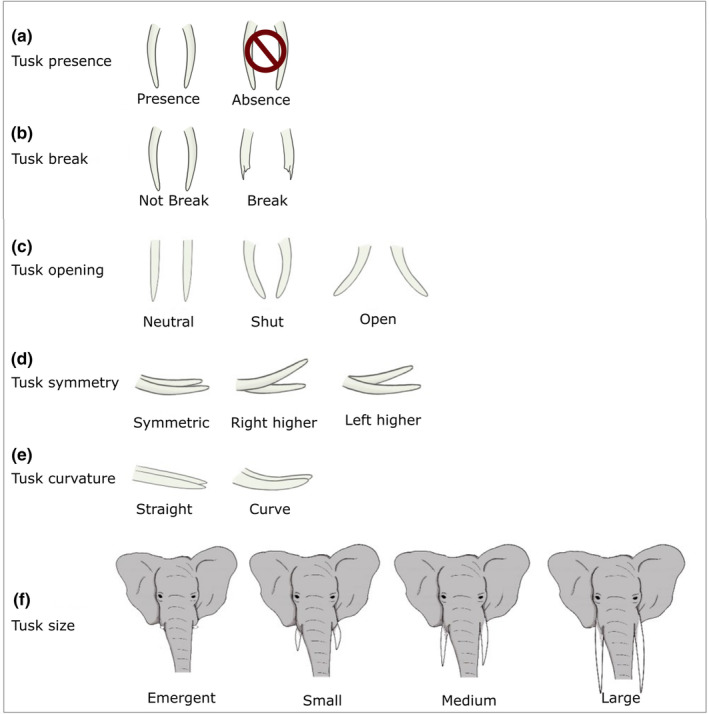
Among tetrapods, grasping is an essential function involved in many vital behaviours. The selective pressures that led to this function were widely investigated in species with prehensile hands and feet. Previous studies namely highlighted a strong effect of item properties but also of the species habitat on manual grasping behaviour. African savannah elephants () are known to display various prehensile abilities and use their trunk in a large diversity of habitats. Composed of muscles and without a rigid structure, the trunk is a muscular hydrostat with great freedom of movement. This multitasking organ is particularly recruited for grasping food items while foraging. Yet, the diet of African savannah elephants varies widely between groups living in different habitats. Moreover, they have tusks alongside the trunk which can assist in grasping behaviours, and their tusk morphologies are known to vary considerably between groups. Therefore, in this study, we investigate the food grasping techniques used by the trunk of two elephant groups that live in different habitats: an arid study site in Etosha National Park in Namibia, and an area with consistent water presence in Kruger National Park in South Africa. We characterised the tusks profiles and compared the grasping techniques and their frequencies of use for different foods. Our results show differences in food-grasping techniques between the two groups. These differences are related to the food item property and tusk profile discrepancies highlighted between the two groups. We suggest that habitat heterogeneity, particularly aridity gaps, may induce these differences. This may reveal an optimisation of grasping types depending on habitat, food size and accessibility, as well as tusk profiles.
在四足动物中,抓握是许多重要行为所涉及的一项基本功能。导致这种功能的选择压力在具有抓握手脚的物种中得到了广泛研究。先前的研究特别强调了物体属性以及物种栖息地对手动抓握行为的强烈影响。非洲草原象()已知具有多种抓握能力,并在各种各样的栖息地中使用它们的象鼻。象鼻由肌肉组成,没有刚性结构,是一种具有极大运动自由度的肌肉流体静力骨骼。这个多功能器官在觅食时特别用于抓取食物。然而,生活在不同栖息地的非洲草原象群体的饮食差异很大。此外,它们除了象鼻之外还有象牙,象牙可以辅助抓握行为,并且已知它们的象牙形态在不同群体之间有很大差异。因此,在本研究中,我们调查了生活在不同栖息地的两个大象群体的象鼻所使用的食物抓取技巧:纳米比亚埃托沙国家公园的一个干旱研究地点,以及南非克鲁格国家公园一个有稳定水源的区域。我们描绘了象牙的轮廓,并比较了不同食物的抓取技巧及其使用频率。我们的结果显示了两组之间食物抓取技巧的差异。这些差异与两组之间突出的食物属性和象牙轮廓差异有关。我们认为栖息地的异质性,特别是干旱程度的差异,可能导致了这些差异。这可能揭示了根据栖息地、食物大小和可及性以及象牙轮廓对抓握类型的优化。