Rojas-Pérez Lilia C, Narváez-Rincón Paulo C, Rocha M Angélica M, Coelho Elisabete, Coimbra Manuel A
Departamento de Ingeniería Química, Facultad de Ingeniería, Universidad Ean, 110221, Bogotá D.C., Colombia.
Departamento de Ingeniería Química y Ambiental, Facultad de Ingeniería, Universidad Nacional de Colombia, 111321, Bogotá D.C., Colombia.
Bioresour Bioprocess. 2022 Oct 4;9(1):105. doi: 10.1186/s40643-022-00594-4.
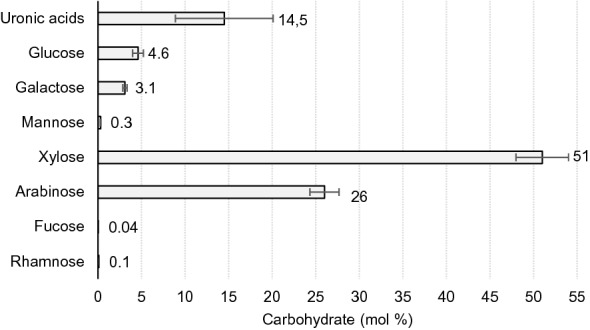
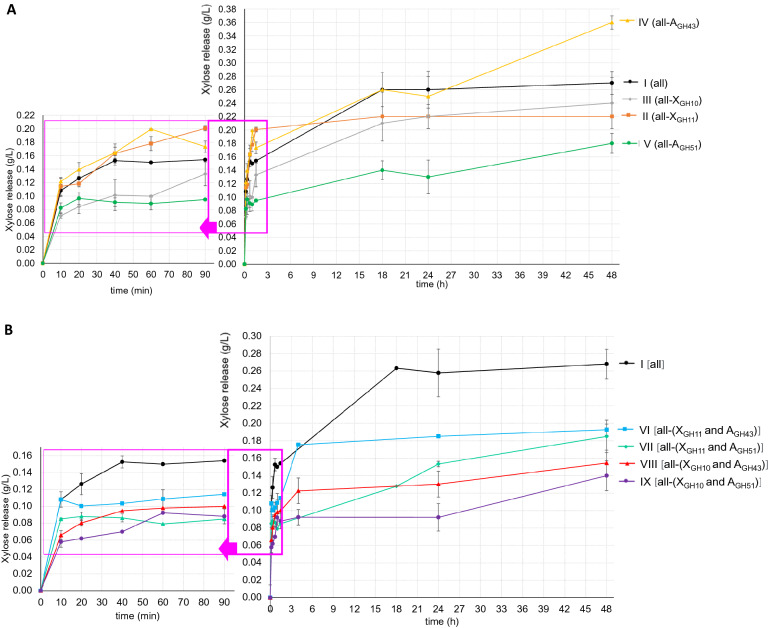
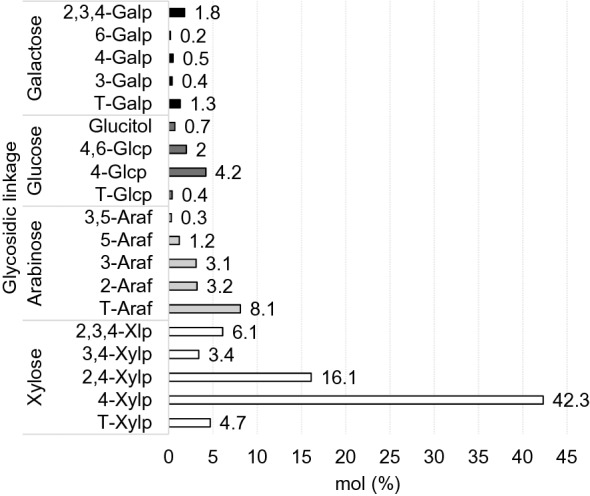
Xylose is an abundant bioresource for obtaining diverse chemicals and added-value products. The production of xylose from green alternatives like enzymatic hydrolysis is an important step in a biorefinery context. This research evaluated the synergism among four classes of hydrolytic purified enzymes-endo-1,4-β-xylanase, α-L-arabinofuranosidase, β-xylosidase, and α-D-glucuronidase-over hydrolysis of glucuronoarabinoxylan (GAX) obtained from brewers' spent grain (BSG) after alkaline extraction and ethanol precipitation. First, monosaccharides, uronic acids and glycosidic-linkages of alkaline extracted GAX fraction from BSG were characterized, after that different strategies based on the addition of one or two families of enzymes-endo-1,4-β-xylanase (GH10 and GH11) and α-L-arabinofuranosidase (GH43 and GH51)-cooperating with one β-xylosidase (GH43) and one α-D-glucuronidase (GH67) into enzymatic hydrolysis were assessed to obtain the best yield of xylose. The xylose release was monitored over time in the first 90 min and after a prolonged reaction up to 48 h of reaction. The highest yield of xylose was 63.6% (48 h, 40 ℃, pH 5.5), using a mixture of all enzymes devoid of α-L-arabinofuranosidase (GH43) family. These results highlight the importance of GH51 arabinofuranosidase debranching enzyme to allow a higher cleavage of the xylan backbone of GAX from BSG and their synergy with 2 endo-1,4-β-xylanase (GH10 and GH11), one β-xylosidase (GH43) and the inclusion of one α-D-glucuronidase (GH67) in the reaction system. Therefore, this study provides an environmentally friendly process to produce xylose from BSG through utilization of enzymes as catalysts.
木糖是一种丰富的生物资源,可用于获取多种化学品和高附加值产品。从酶促水解等绿色替代方法生产木糖是生物炼制过程中的重要一步。本研究评估了四类水解纯化酶(内切-1,4-β-木聚糖酶、α-L-阿拉伯呋喃糖苷酶、β-木糖苷酶和α-D-葡萄糖醛酸酶)对经碱性提取和乙醇沉淀后从啤酒糟(BSG)中获得的葡糖醛酸阿拉伯木聚糖(GAX)水解的协同作用。首先,对BSG碱性提取的GAX级分的单糖、糖醛酸和糖苷键进行了表征,之后评估了基于添加一类或两类酶(内切-1,4-β-木聚糖酶(GH10和GH11)和α-L-阿拉伯呋喃糖苷酶(GH43和GH51))与一种β-木糖苷酶(GH43)和一种α-D-葡萄糖醛酸酶(GH67)协同作用于酶促水解以获得最高木糖产率的不同策略。在反应的前90分钟以及延长至48小时的长时间反应过程中,对木糖释放随时间的变化进行了监测。使用不含α-L-阿拉伯呋喃糖苷酶(GH43)家族的所有酶的混合物时,木糖的最高产率为63.6%(48小时,40℃,pH 5.5)。这些结果突出了GH51阿拉伯呋喃糖苷酶去分支酶对实现BSG中GAX木聚糖主链更高程度裂解的重要性,以及它们与两种内切-1,4-β-木聚糖酶(GH10和GH11)、一种β-木糖苷酶(GH43)和反应体系中加入一种α-D-葡萄糖醛酸酶(GH67)的协同作用。因此,本研究提供了一种通过利用酶作为催化剂从BSG生产木糖的环境友好型工艺。