Ding Lei, Fu Bingqi, Zhang Hongda, Dai Cong, Zhang Aikai, Yu Fengyuan, Mi Lijie, Hua Wei, Tang Min
Department of Cardiology, State Key Laboratory of Cardiovascular Disease, National Center for Cardiovascular Diseases, Cardiovascular Institute, Fuwai Hospital, Chinese Academy of Medical Sciences, and Peking Union Medical College, Beijing, 100037, China.
Department of Health Policy and Management, School of Public Health, Peking University Health Science Center, No.167 Beilishi Rd, Xicheng District, Beijing, 100037, China.
BMC Geriatr. 2024 Apr 22;24(1):356. doi: 10.1186/s12877-024-04992-5.
The relationship between triglyceride glucose-body mass index (TyG-BMI) index and mortality in elderly patients with diabetes mellitus (DM) are still unclear. This study aimed to investigate the association between TyG-BMI with all-cause and cardiovascular mortality among elderly DM patients in the United States (US).
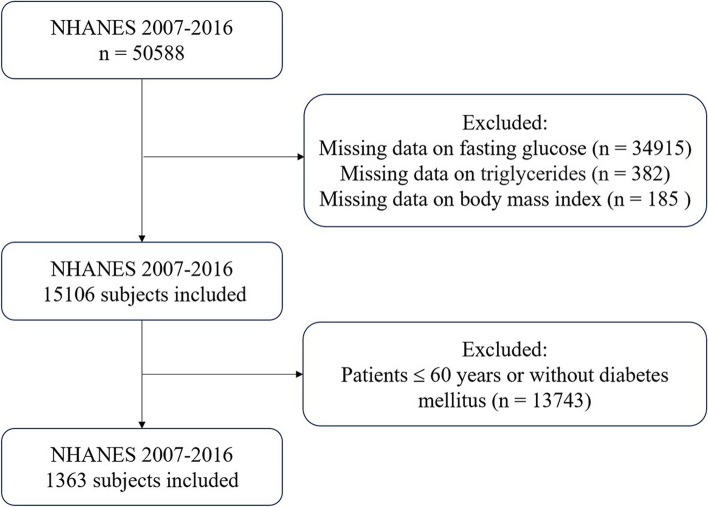
Patients aged over 60 years with DM from the National Health and Nutrition Examination Survey (2007-2016) were included in this study. The study endpoints were all-cause and cardiovascular mortality and the morality data were extracted from the National Death Index (NDI) which records up to December 31, 2019. Multivariate Cox proportional hazards regression model was used to explore the association between TyG-BMI index with mortality. Restricted cubic spline was used to model nonlinear relationships.
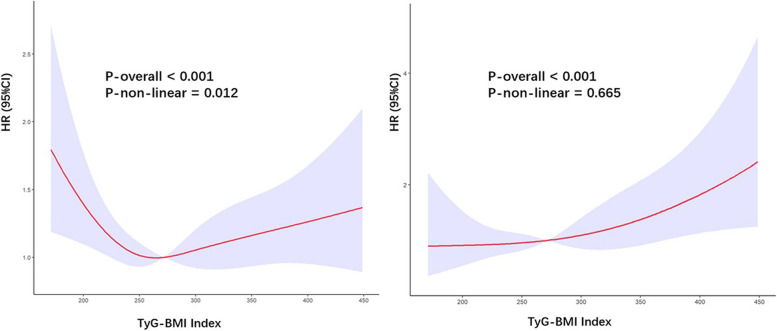
A total of 1363 elderly diabetic patients were included, and were categorized into four quartiles. The mean age was 70.0 ± 6.8 years, and 48.6% of them were female. Overall, there were 429 all-cause deaths and 123 cardiovascular deaths were recorded during a median follow-up of 77.3 months. Multivariate Cox regression analyses indicated that compared to the 1st quartile (used as the reference), the 3rd quartile demonstrated a significant association with all-cause mortality (model 2: HR = 0.64, 95% CI 0.46-0.89, P = 0.009; model 3: HR = 0.65, 95% CI 0.43-0.96, P = 0.030). Additionally, the 4th quartile was significantly associated with cardiovascular mortality (model 2: HR = 1.83, 95% CI 1.01-3.30, P = 0.047; model 3: HR = 2.45, 95% CI 1.07-5.57, P = 0.033). The restricted cubic spline revealed a U-shaped association between TyG-BMI index with all-cause mortality and a linear association with cardiovascular mortality, after adjustment for possible confounding factors.
A U-shaped association was observed between the TyG-BMI index with all-cause mortality and a linear association was observed between the TyG-BMI index with cardiovascular mortality in elderly patients with DM in the US population.
甘油三酯葡萄糖-体重指数(TyG-BMI)与老年糖尿病患者死亡率之间的关系仍不明确。本研究旨在调查美国老年糖尿病患者中TyG-BMI与全因死亡率和心血管死亡率之间的关联。
本研究纳入了来自国家健康与营养检查调查(2007 - 2016年)的60岁以上糖尿病患者。研究终点为全因死亡率和心血管死亡率,死亡数据从截至2019年12月31日的国家死亡指数(NDI)中提取。采用多变量Cox比例风险回归模型探讨TyG-BMI指数与死亡率之间的关联。使用受限立方样条来模拟非线性关系。
共纳入1363例老年糖尿病患者,并分为四个四分位数组。平均年龄为70.0±6.8岁,其中48.6%为女性。总体而言,在中位随访77.3个月期间,记录到429例全因死亡和123例心血管死亡。多变量Cox回归分析表明,与第一四分位数组(作为对照)相比,第三四分位数组与全因死亡率存在显著关联(模型2:HR = 0.64,95% CI 0.46 - 0.89,P = 0.009;模型3:HR = 0.65,95% CI 0.43 - 0.96,P = 0.030)。此外,第四四分位数组与心血管死亡率显著相关(模型2:HR = 1.83,95% CI 1.01 - 3.30,P = 0.047;模型3:HR = 2.45,95% CI 1.07 - 5.57,P = 0.033)。在调整可能的混杂因素后,受限立方样条显示TyG-BMI指数与全因死亡率之间呈U形关联,与心血管死亡率之间呈线性关联。
在美国老年糖尿病患者中,观察到TyG-BMI指数与全因死亡率之间呈U形关联,与心血管死亡率之间呈线性关联。