Ramadan Alaa, Aboeldahab Heba, Bashir Mohamed Nabih, Belal Mohamed Mohamed, Wageeh Ahmed, Atia Ahmed, Elbanna Mohamed, Alhejazi Tala Jouma, Abouzid Mohamed, Atef Hady, Khalid Esraa, Elaziz Osama Ahmed Abd, Eldeeb Mariam Ibrahim, Kamel Omar Doha Omar, Refaey Neveen, Setouhi Amr, Ak Mohammed
Faculty of Medicine, South Valley University, Qena, Egypt.
Biomedical Informatics and Medical Statistics Department, Medical Research Institute, Alexandria University, Alexandria, Egypt.
BMC Public Health. 2024 Apr 22;24(1):1107. doi: 10.1186/s12889-024-18553-3.
Cardiovascular disease (CVD) represents a significant health challenge in Egypt, yet there exists limited understanding regarding the knowledge, attitudes, and physical activity levels associated with CVD. These factors play a pivotal role in developing effective prevention and management strategies. Hence, this cross-sectional study aimed to evaluate Egyptian adults' knowledge, attitudes, and physical activity (KAP) levels.
Data were collected using a previously validated questionnaire encompassing demographic characteristics, CVD knowledge (including risk factors and symptoms), attitudes toward CVD, and self-reported physical activity levels. The survey was distributed among social media channels, and trained researchers administered the questionnaire via face-to-face interviews with adult patients with and without CVD admitted to Cairo University Hospital clinics.
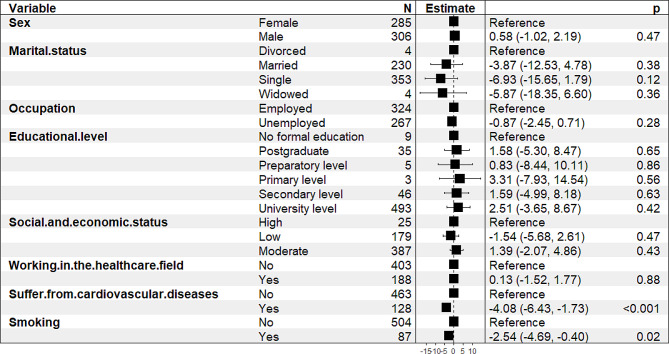
The study involved 591 participants, of whom 21.7% had CVD. Overall, participants exhibited poor knowledge regarding CVD, with a mean score of 21 ± 7 out of 40, equivalent to 52.5%. Attitudes toward CVD were moderate, with a mean score of 66.38 ± 8.7 out of 85, approximately 78%. Physical activity levels per week were also moderate, averaging 1188 MET-min with a range of 1121-18,761. Subgroup analysis revealed that individuals with CVD had lower average knowledge, attitude, and physical activity levels than those without CVD. Working in the healthcare field was a predictor of higher knowledge score (standard error (SE) 5.89, 95% confidence interval (CI) 4.61 to 7.17, P < 0.001), while those with CVD and smokers were predictors of lower attitude score (SE -4.08, 95% CI -6.43 to -1.73, P < 0.001) and (SE -2.54, 95% CI -4.69 to -0.40, P = 0.02), respectively.
The study findings highlight a significant disparity in knowledge, attitudes, and physical activity levels related to CVD in Egypt. Targeted interventions aimed at improving awareness, fostering positive attitudes, and promoting physical activity among individuals at risk for CVD are crucial for effective prevention and management.
心血管疾病(CVD)是埃及面临的一项重大健康挑战,但对于与心血管疾病相关的知识、态度和身体活动水平的了解有限。这些因素在制定有效的预防和管理策略中起着关键作用。因此,这项横断面研究旨在评估埃及成年人的知识、态度和身体活动(KAP)水平。
使用一份先前验证过的问卷收集数据,该问卷涵盖人口统计学特征、心血管疾病知识(包括危险因素和症状)、对心血管疾病的态度以及自我报告的身体活动水平。该调查通过社交媒体渠道分发,训练有素的研究人员通过对开罗大学医院诊所收治的患有和未患有心血管疾病的成年患者进行面对面访谈来管理问卷。
该研究涉及591名参与者,其中21.7%患有心血管疾病。总体而言,参与者对心血管疾病的了解较差,在40分的总分中平均得分为21±7分,相当于52.5%。对心血管疾病的态度中等,在85分的总分中平均得分为66.38±8.7分,约为78%。每周的身体活动水平也中等,平均为1188代谢当量分钟,范围为1121 - 18761。亚组分析显示,患有心血管疾病的个体的平均知识、态度和身体活动水平低于未患有心血管疾病的个体。在医疗保健领域工作是知识得分较高的一个预测因素(标准误差(SE)5.89,95%置信区间(CI)4.61至7.17,P < 0.001),而患有心血管疾病的人和吸烟者分别是态度得分较低的预测因素(SE -4.08,95%CI -6.43至-1.73,P < 0.001)和(SE -2.54,95%CI -4.69至-0.40,P = 0.02)。
研究结果突出了埃及在与心血管疾病相关的知识、态度和身体活动水平方面存在的显著差异。针对有心血管疾病风险的个体开展旨在提高认识、培养积极态度和促进身体活动的有针对性干预措施,对于有效的预防和管理至关重要。