Yildiz Nilgün, Cecen Serpil, Sancar Nuray, Karacan Ilhan, Knikou Maria, Türker Kemal S
Faculty of Dentistry & Physiology, Istanbul Gelisim University, Istanbul, Türkiye.
Department of Physiotherapy and Rehabilitation, Faculty of Health Sciences, Istanbul Gelisim University, Istanbul, Türkiye.
J Neurophysiol. 2024 Jun 1;131(6):1101-1111. doi: 10.1152/jn.00077.2024. Epub 2024 Apr 24.
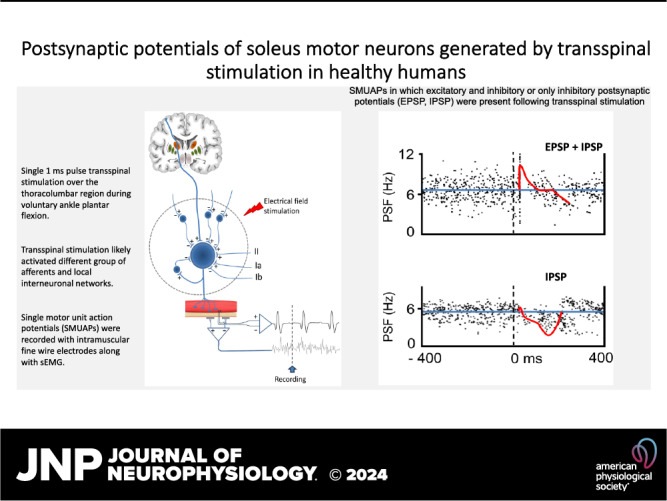
Transspinal (or transcutaneous spinal cord) stimulation is a noninvasive, cost-effective, easily applied method with great potential as a therapeutic modality for recovering somatic and nonsomatic functions in upper motor neuron disorders. However, how transspinal stimulation affects motor neuron depolarization is poorly understood, limiting the development of effective transspinal stimulation protocols for rehabilitation. In this study, we characterized the responses of soleus α motor neurons to single-pulse transspinal stimulation using single-motor unit (SMU) discharges as a proxy given the 1:1 discharge activation between the motor neuron and the motor unit. Peristimulus time histogram, peristimulus frequencygram, and surface electromyography (sEMG) were used to characterize the postsynaptic potentials of soleus motor neurons. Transspinal stimulation produced short-latency excitatory postsynaptic potentials (EPSPs) followed by two distinct phases of inhibitory postsynaptic potentials (IPSPs) in most soleus motor neurons and only IPSPs in others. Transspinal stimulation generated double discharges at short interspike intervals in a few motor units. The short-latency EPSPs were likely mediated by muscle spindle group Ia and II afferents, and the IPSPs via excitation of group Ib afferents and recurrent collaterals of motor neurons leading to activation of diverse spinal inhibitory interneuronal circuits. Further studies are warranted to understand better how transspinal stimulation affects depolarization of α motor neurons over multiple spinal segments. This knowledge will be seminal for developing effective transspinal stimulation protocols in upper motor neuron lesions. Transspinal stimulation produces distinct actions on soleus motor neurons: an early short-latency excitation followed by two inhibitions or only inhibition and doublets. These results show how transspinal stimulation affects depolarization of soleus α motor neurons in healthy humans.
经脊髓(或经皮脊髓)刺激是一种非侵入性、经济高效且易于应用的方法,作为恢复上运动神经元疾病中躯体和非躯体功能的治疗方式具有巨大潜力。然而,经脊髓刺激如何影响运动神经元去极化尚不清楚,这限制了用于康复的有效经脊髓刺激方案的开发。在本研究中,鉴于运动神经元与运动单位之间1:1的放电激活关系,我们以单运动单位(SMU)放电为指标,对比目鱼肌α运动神经元对单脉冲经脊髓刺激的反应进行了表征。使用刺激后时间直方图、刺激后频率图和表面肌电图(sEMG)来表征比目鱼肌运动神经元的突触后电位。经脊髓刺激在大多数比目鱼肌运动神经元中产生了短潜伏期兴奋性突触后电位(EPSP),随后是两个不同阶段的抑制性突触后电位(IPSP),而在其他一些神经元中仅产生IPSP。经脊髓刺激在少数运动单位中以短峰间期产生双放电。短潜伏期EPSP可能由肌梭Ia和II类传入纤维介导,而IPSP则通过Ib类传入纤维的兴奋和运动神经元的回返侧支,导致多种脊髓抑制性中间神经元回路的激活。有必要进行进一步研究,以更好地了解经脊髓刺激如何影响多个脊髓节段上α运动神经元的去极化。这些知识对于开发上运动神经元损伤的有效经脊髓刺激方案至关重要。经脊髓刺激对比目鱼肌运动神经元产生不同的作用:早期短潜伏期兴奋,随后是两次抑制或仅抑制以及双放电。这些结果显示了经脊髓刺激如何影响健康人类比目鱼肌α运动神经元的去极化。