Zipple Matthew N, Kuo Daniel Chang, Meng Xinmiao, Reichard Tess M, Guess Kwynn, Vogt Caleb C, Moeller Andrew H, Sheehan Michael J
bioRxiv. 2024 Apr 21:2024.04.19.590322. doi: 10.1101/2024.04.19.590322.
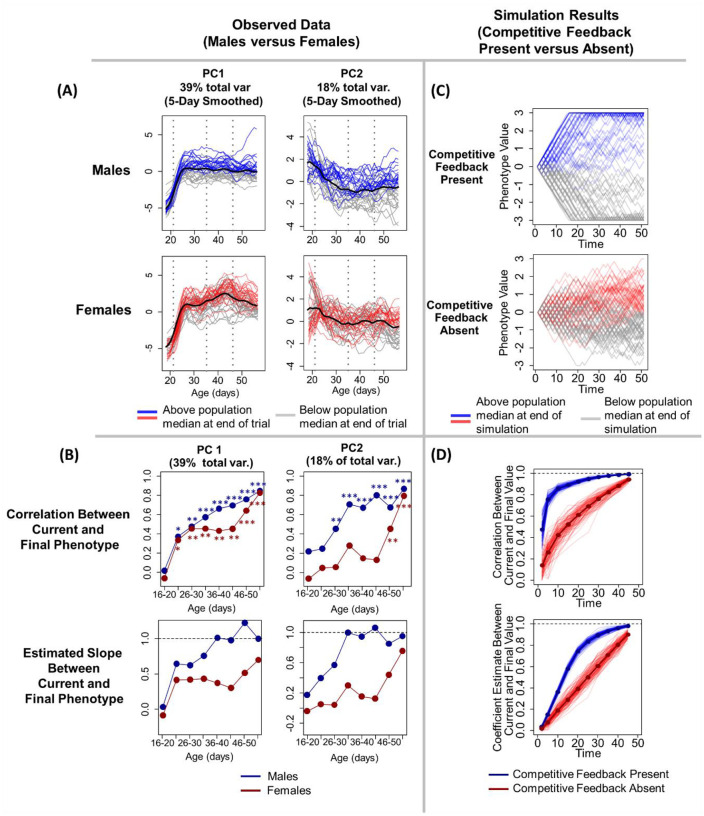
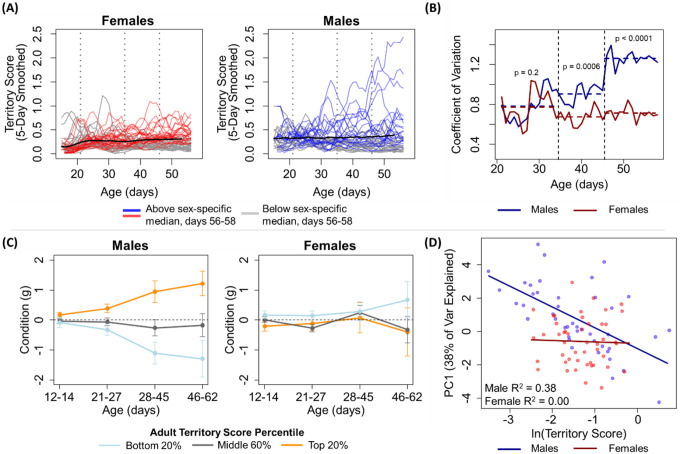
Contingency (or 'luck') in early life plays an important role in shaping individuals' development. When individuals live within larger societies, social experiences may cause the importance of early contingencies to be magnified or dampened. Here we test the hypothesis that competition magnifies the importance of early contingency in a sex-specific manner by comparing the developmental trajectories of genetically identical, free-living mice who either experienced high levels of territorial competition (males) or did not (females). We show that male territoriality results in a competitive feedback loop that magnifies the importance of early contingency and pushes individuals onto divergent, self-reinforcing life trajectories, while the same process appears absent in females. Our results indicate that the strength of sexual selection may be self-limiting, as within-sex competition increases the importance of early life contingency, thereby reducing the ability of selection to lead to evolution. They also demonstrate the potential for contingency to lead to dramatic differences in life outcomes, even in the absence of any underlying differences in ability ('merit').
早年生活中的偶然性(或“运气”)在塑造个体发展方面起着重要作用。当个体生活在较大的社会中时,社会经历可能会使早期偶然性的重要性被放大或抑制。在这里,我们通过比较基因相同、自由生活的小鼠的发育轨迹来检验这一假设,即竞争会以性别特异性的方式放大早期偶然性的重要性,这些小鼠要么经历了高水平的领地竞争(雄性),要么没有经历(雌性)。我们发现雄性的领地行为会导致一个竞争反馈循环,放大早期偶然性的重要性,并将个体推向不同的、自我强化的生活轨迹,而雌性似乎不存在同样的过程。我们的结果表明,性选择的强度可能是自我限制的,因为同性竞争增加了早年生活偶然性的重要性,从而降低了选择导致进化的能力。它们还表明,即使在能力(“功绩”)没有任何潜在差异的情况下,偶然性也有可能导致生活结果的巨大差异。