Recacha Esther, Kuropka Benno, Díaz-Díaz Sara, García-Montaner Andrea, González-Tortuero Enrique, Docobo-Pérez Fernando, Rodríguez-Rojas Alexandro, Rodríguez-Martínez Jose Manuel
Unidad Clínica de Enfermedades Infecciosas y Microbiología, Hospital Universitario Virgen Macarena, Seville, Spain.
Centro de Investigación Biomédica en Red en Enfermedades Infecciosas (CIBERINFEC), Instituto de Salud Carlos III, Madrid, Spain.
Front Microbiol. 2024 Apr 10;15:1379534. doi: 10.3389/fmicb.2024.1379534. eCollection 2024.
INTRODUCTION/OBJECTIVE: Suppression of the SOS response in combination with drugs damaging DNA has been proposed as a potential target to tackle antimicrobial resistance. The SOS response is the pathway used to repair bacterial DNA damage induced by antimicrobials such as quinolones. The extent of -regulated protein expression and other associated systems under pressure of agents that damage bacterial DNA in clinical isolates remains unclear. The aim of this study was to assess the impact of this strategy consisting on suppression of the SOS response in combination with quinolones on the proteome profile of clinical strains.
Five clinical isolates of carrying different chromosomally- and/or plasmid-mediated quinolone resistance mechanisms with different phenotypes were selected, with ATCC 25922 as control strain. In addition, from each clinical isolate and control, a second strain was created, in which the SOS response was suppressed by deletion of the gene. Bacterial inocula from all 12 strains were then exposed to 1xMIC ciprofloxacin treatment (relative to the wild-type phenotype for each isogenic pair) for 1 h. Cell pellets were collected, and proteins were digested into peptides using trypsin. Protein identification and label-free quantification were done by liquid chromatography-mass spectrometry (LC-MS) in order to identify proteins that were differentially expressed upon deletion of in each strain. Data analysis and statistical analysis were performed using the MaxQuant and Perseus software.
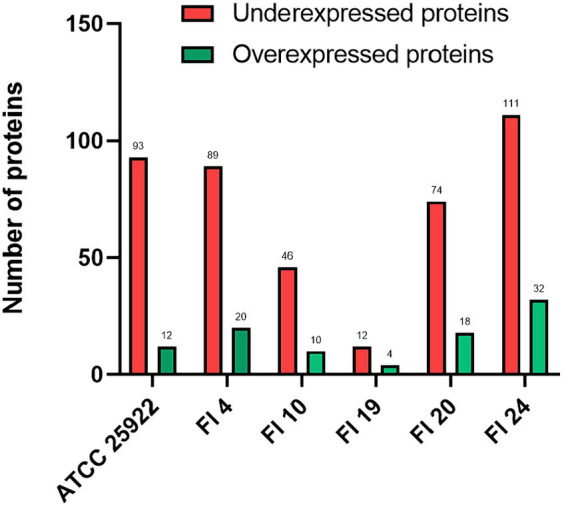
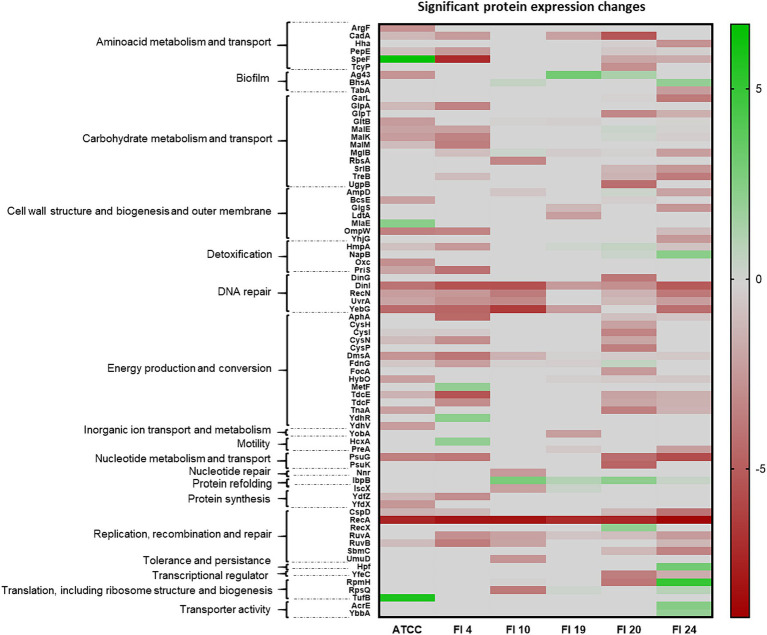
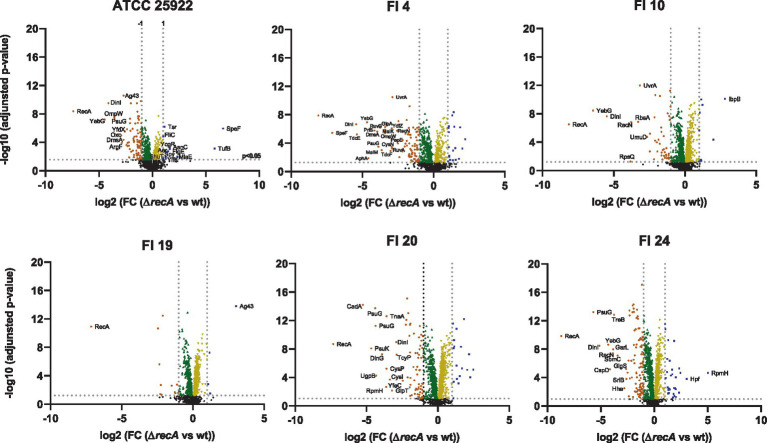
The proteins with the lowest expression levels were: RecA (as control), AphA, CysP, DinG, DinI, GarL, PriS, PsuG, PsuK, RpsQ, UgpB and YebG; those with the highest expression levels were: Hpf, IbpB, TufB and RpmH. Most of these expression alterations were strain-dependent and involved DNA repair processes and nucleotide, protein and carbohydrate metabolism, and transport. In isolates with suppressed SOS response, the number of underexpressed proteins was higher than overexpressed proteins.
High genomic and proteomic variability was observed among clinical isolates and was not associated with a specific resistant phenotype. This study provides an interesting approach to identify new potential targets to combat antimicrobial resistance.
引言/目的:将抑制SOS反应与破坏DNA的药物联合使用,已被提议作为应对抗菌药物耐药性的一个潜在靶点。SOS反应是用于修复由喹诺酮类等抗菌药物诱导的细菌DNA损伤的途径。在临床分离株中,受破坏细菌DNA的药物压力影响的调控蛋白表达及其他相关系统的程度仍不清楚。本研究的目的是评估这种将抑制SOS反应与喹诺酮类联合使用的策略对临床菌株蛋白质组图谱的影响。
选择了五株携带不同染色体和/或质粒介导的喹诺酮耐药机制且具有不同表型的临床分离株,以大肠埃希菌ATCC 25922作为对照菌株。此外,从每个临床分离株和对照中创建了第二个菌株,其中通过缺失lexA基因来抑制SOS反应。然后将所有12株菌株的细菌接种物暴露于1xMIC环丙沙星处理(相对于每个同基因对的野生型表型)1小时。收集细胞沉淀,并用胰蛋白酶将蛋白质消化成肽段。通过液相色谱-质谱联用(LC-MS)进行蛋白质鉴定和无标记定量,以鉴定在每个菌株中缺失lexA后差异表达的蛋白质。使用MaxQuant和Perseus软件进行数据分析和统计分析。
表达水平最低的蛋白质有:RecA(作为对照)、AphA、CysP、DinG、DinI、GarL、PriS、PsuG、PsuK、RpsQ、UgpB和YebG;表达水平最高的蛋白质有:Hpf、IbpB、TufB和RpmH。这些表达变化大多依赖于菌株,涉及DNA修复过程以及核苷酸、蛋白质和碳水化合物代谢及转运。在SOS反应受到抑制的分离株中,表达下调的蛋白质数量高于表达上调的蛋白质。
在临床分离株中观察到高度的基因组和蛋白质组变异性,且与特定的耐药表型无关。本研究为识别对抗抗菌药物耐药性的新潜在靶点提供了一种有趣的方法。