Institute of Genetic Epidemiology, Faculty of Medicine and Medical Center - University of Freiburg, Freiburg, Germany.
Department of Medicine IV, Nephrology and Primary Care, Faculty of Medicine and Medical Center - University of Freiburg, Freiburg, Germany.
Nephrol Dial Transplant. 2024 Nov 27;39(12):2016-2024. doi: 10.1093/ndt/gfae092.
Persons with chronic kidney disease (CKD) are at increased risk of adverse events, early mortality and multimorbidity. A detailed overview of adverse event types and rates from a large CKD cohort under regular nephrological care is missing. We generated an interactive tool to enable exploration of adverse events and their combinations in the prospective, observational German CKD (GCKD) study.
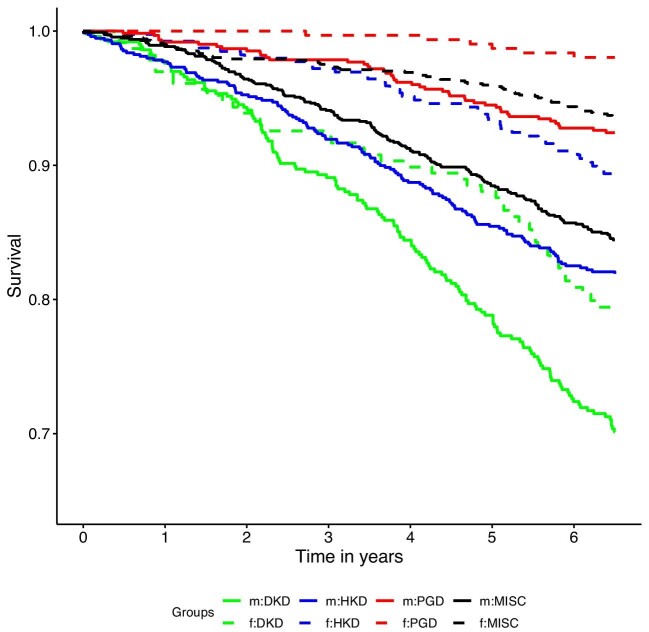
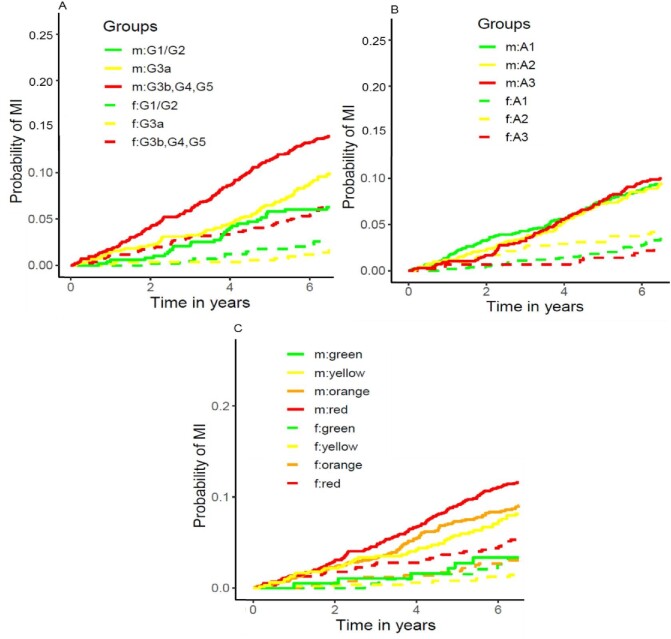
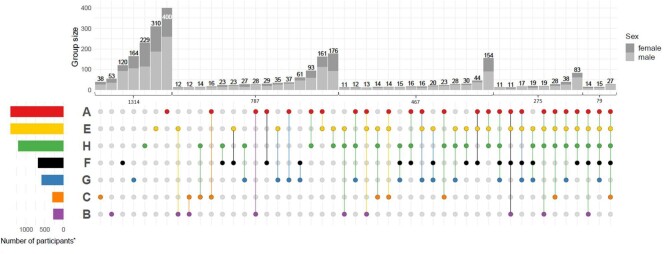
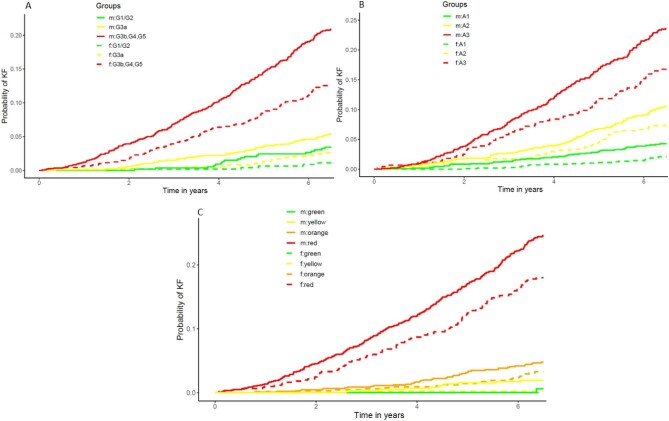
The GCKD study enrolled 5217 participants under regular nephrological care with an estimated glomerular filtration rate of 30-60 or >60 mL/min/1.73 m2 and an overt proteinuria. Cardiovascular, cerebrovascular and peripheral vascular, kidney, infection, and cancer events, as well as deaths were adjudicated following a standard operation procedure. We summarized these time-to-event data points for exploration in interactive graphs within an R shiny app. Multivariable adjusted Cox models for time to first event were fitted. Cumulative incidence functions, Kaplan-Meier curves and intersection plots were used to display main adverse events and their combinations by sex and CKD etiology.
Over a median of 6.5 years, 10 271 events occurred in 2947 participants (56.5%), of which 680 participants (13.0%) died. The new publicly available interactive platform enables readers to scrutinize adverse events and their combinations as well as mortality trends as a gateway to better understand multimorbidity in CKD: incident rates per 1000 patient-years varied by event type, CKD etiology and baseline characteristics. Incidence rates for the most frequent events and their recurrence were 113.6 (cardiovascular), 75.0 (kidney) and 66.0 (infection). Participants with presumed diabetic kidney disease and men were more prone to experiencing events.
This comprehensive explorative tool to visualize adverse events (https://www.gckd.org/studienhintergrund/previous-study-results/event-analysis/), their combination, mortality and multimorbidity among persons with CKD may serve as a valuable resourec for patient care, identification of high-risk groups, health services and public health policy planning.
患有慢性肾脏病(CKD)的患者发生不良事件、早期死亡和合并多种疾病的风险增加。在常规肾脏护理下,来自大型 CKD 队列的不良事件类型和发生率的详细概述尚不清楚。我们生成了一个交互式工具,以在前瞻性、观察性的德国 CKD(GCKD)研究中探索不良事件及其组合。
GCKD 研究纳入了 5217 名在常规肾脏护理下的参与者,他们的估计肾小球滤过率为 30-60 或 >60 ml/min/1.73 m2 ,且有明显蛋白尿。根据标准操作程序,对心血管、脑血管和周围血管、肾脏、感染和癌症事件以及死亡进行了裁决。我们总结了这些时间到事件数据点,以便在 R shiny 应用程序中的交互式图形中进行探索。使用多变量调整的 Cox 模型拟合了首次发生事件的时间。累积发生率函数、Kaplan-Meier 曲线和交点图用于按性别和 CKD 病因显示主要不良事件及其组合。
在中位数为 6.5 年的时间里,2947 名参与者中有 10271 名发生了事件(56.5%),其中 680 名参与者(13.0%)死亡。这个新的公开可用的交互式平台使读者能够仔细检查不良事件及其组合以及死亡率趋势,从而更好地了解 CKD 中的多种疾病:每 1000 名患者年的发生率因事件类型、CKD 病因和基线特征而异。最常见事件及其复发的发生率为 113.6(心血管)、75.0(肾脏)和 66.0(感染)。患有推定的糖尿病肾病的参与者和男性更容易发生事件。
这个用于可视化 CKD 患者的不良事件(https://www.gckd.org/studienhintergrund/previous-study-results/event-analysis/)、它们的组合、死亡率和多种疾病的综合探索性工具,可能成为患者护理、高风险群体识别、卫生服务和公共卫生政策规划的宝贵资源。