Altrecht Academic Anxiety Centre, Utrecht, the Netherlands.
Eur J Psychotraumatol. 2024;15(1):2341548. doi: 10.1080/20008066.2024.2341548. Epub 2024 Apr 26.
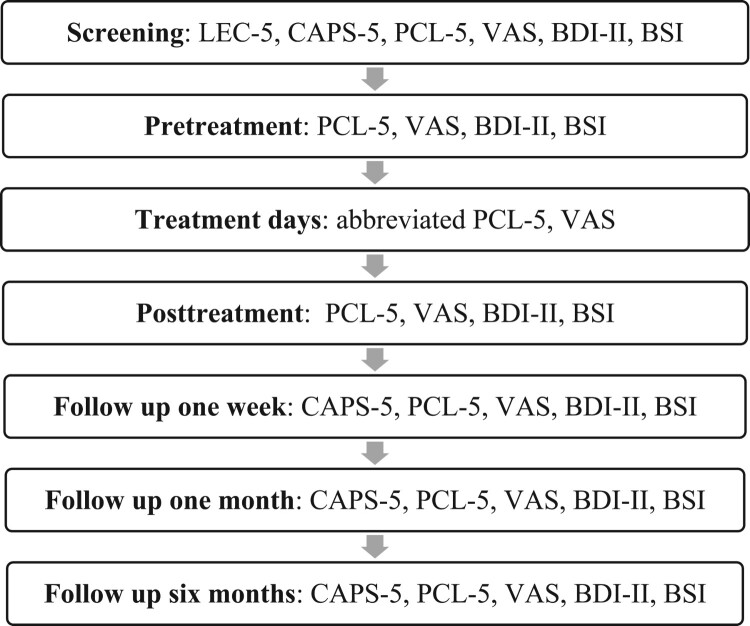
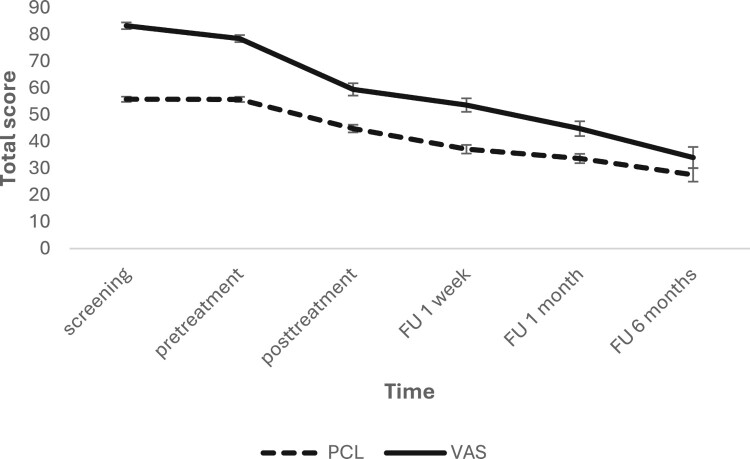
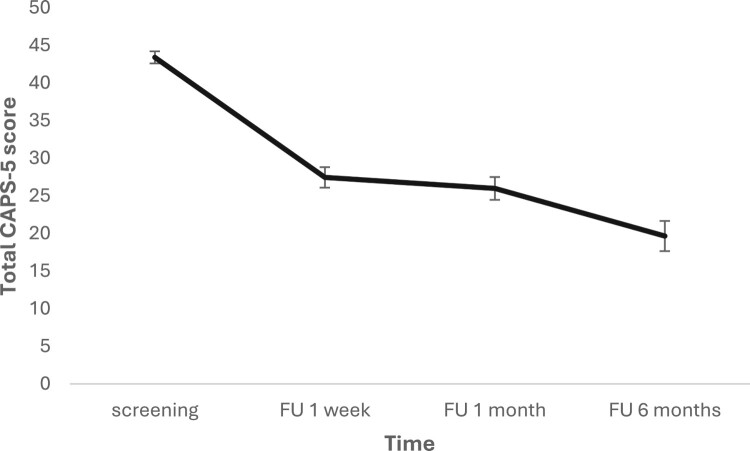
Research has shown that combining different evidence-based PTSD treatments for patients with PTSD in an intensive inpatient format seems to be a promising approach to enhance efficiency and reduce generally high dropout rates. To assess the effectiveness of an intensive six-day outpatient trauma-focused treatment for patients with PTSD. Data from 146 patients (89.7% female, mean age = 36.79, = 11.31) with PTSD due to multiple traumatization were included in the analyses. The treatment programme consisted of six days of treatment within two weeks, with two daily individual 90-minute trauma-focused sessions (prolonged exposure and eye movement desensitization and reprocessing), one hour of exercise, and one hour of psychoeducation. All participants experienced multiple traumas, and 85.6% reported one or more comorbid psychiatric disorders. PTSD symptoms and diagnoses were assessed with the Clinician-Administered PTSD Scale for DSM-5 (CAPS-5), and self-reported symptoms were assessed with the PTSD Checklist for DSM-5 (PCL-5). A significant decline in PTSD symptoms (CAPS-5 and PCL-5) from pretreatment to one-month follow-up (Cohen's = 1.13 and 1.59) was observed and retained at six-month follow-up (Cohen's = 1.47 and 1.63). After one month, 52.4% of the patients no longer met the diagnostic criteria for PTSD (CAPS-5). The Reliable Change Index (RCI) shows that 73.9% of patients showed improvement on the CAPS-5 and 77.61% on the PCL-5. Additionally, 21.77% (CAPS-5) and 20.0% (PCL-5) showed no change, while 4.84% (CAPS-5) and 2.96% (PCL-5) showed symptom worsening. The results show that an intensive outpatient trauma treatment programme, including two evidence-based trauma-focused treatments, exercise, and psychoeducation, is effective for patients suffering from PTSD as a result of multiple traumatization. Subsequent research should focus on more controlled studies comparing the treatment programme with other intensive trauma treatments and less frequent routine treatment.
研究表明,将不同的基于证据的 PTSD 治疗方法结合起来,以强化的住院模式为 PTSD 患者提供治疗,似乎是一种提高效率和降低普遍较高的脱落率的有前途的方法。本研究旨在评估一种强化的为期六天的门诊创伤聚焦治疗 PTSD 患者的有效性。共有 146 名(89.7%为女性,平均年龄 36.79 岁,SD=11.31)患有创伤后应激障碍的多创伤患者的数据被纳入分析。治疗方案包括两周内的六天治疗,每天两次每次 90 分钟的创伤聚焦治疗(延长暴露和眼动脱敏与再处理)、一小时的运动和一小时的心理教育。所有参与者都经历了多种创伤,85.6%的人报告有一个或多个合并的精神疾病。创伤后应激障碍症状和诊断采用 DSM-5 临床医生管理创伤后应激障碍量表(CAPS-5)评估,自我报告的症状采用 DSM-5 创伤后应激障碍检查表(PCL-5)评估。从治疗前到一个月随访时,创伤后应激障碍症状(CAPS-5 和 PCL-5)显著下降(Cohen's = 1.13 和 1.59),并在六个月随访时保持(Cohen's = 1.47 和 1.63)。一个月后,52.4%的患者不再符合 PTSD 的诊断标准(CAPS-5)。可靠变化指数(RCI)显示,73.9%的患者在 CAPS-5 上有改善,77.61%的患者在 PCL-5 上有改善。此外,21.77%(CAPS-5)和 20.0%(PCL-5)没有变化,4.84%(CAPS-5)和 2.96%(PCL-5)有症状恶化。结果表明,一种强化的门诊创伤治疗方案,包括两种基于证据的创伤聚焦治疗、运动和心理教育,对多创伤导致的 PTSD 患者有效。后续研究应侧重于更具控制性的研究,比较该治疗方案与其他强化创伤治疗和频率较低的常规治疗。