Division of Aquaculture, Upgrading and Biospropecting (DivAV), Department for the Sea and Marine Resources, Portuguese Institute for the Sea and Atmosphere (IPMA), Av. Dr. Alfredo Magalhães Ramalho 6, 1495-165 Lisbon, Portugal.
Interdisciplinary Center of Marine and Environmental Research (CIIMAR), University of Porto, Terminal de Cruzeiros de Leixões, Av. General Norton de Matos s/n, 4450-208 Matosinhos, Portugal.
Mar Drugs. 2024 Apr 9;22(4):166. doi: 10.3390/md22040166.
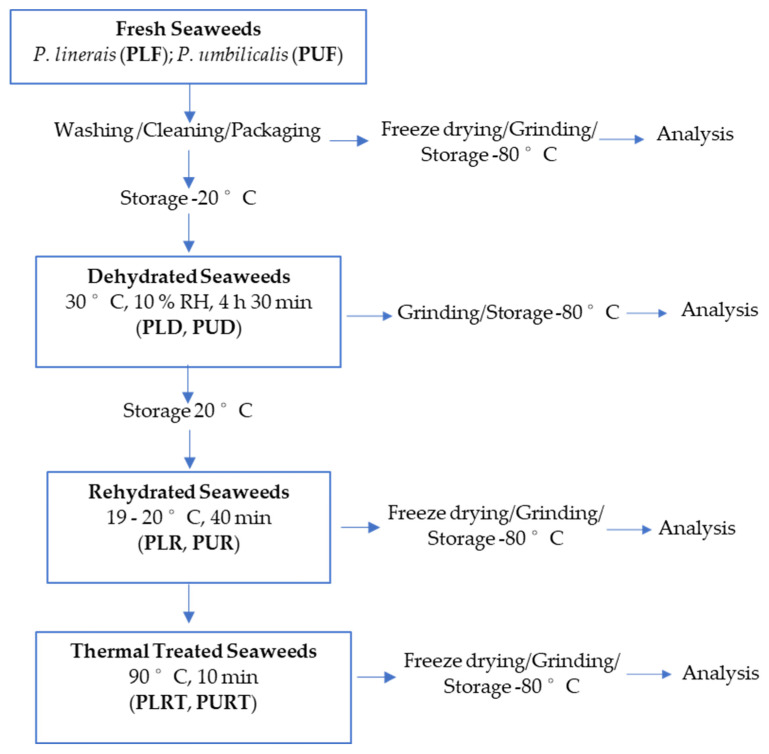
The nutritional and bioactive value of seaweeds is widely recognized, making them a valuable food source. To use seaweeds as food, drying and thermal treatments are required, but these treatments may have a negative impact on valuable bioactive compounds. In this study, the effects of dehydration, rehydration, and thermal treatment on the bioactive compounds (carotenoids, phycobiliproteins, total phenolic content (TPC), total flavonoids content (TFC)), antioxidant (ABTS and DPPH radical scavenging activities) and anti-Alzheimer's (Acetylcholinesterase (AchE) inhibitory activities, and color properties of and seaweeds were evaluated. The results revealed significant reductions in carotenoids, TPC, TFC, and antioxidant activities after the seaweeds' processing, with differences observed between species. Thermal treatment led to the most pronounced reductions in bioactive compound contents and antioxidant activity. AchE inhibitory activity remained relatively high in all samples, with showing higher activity than Changes in color (ΔE) were significant after seaweeds' dehydration, rehydration and thermal treatment, especially in Overall, optimizing processing methods is crucial for preserving the bioactive compounds and biological activities of seaweeds, thus maximizing their potential as sustainable and nutritious food sources or as nutraceutical ingredients.
海藻的营养价值和生物活性得到了广泛认可,使其成为一种有价值的食物来源。为了将海藻作为食物使用,需要进行干燥和热处理,但这些处理方法可能会对有价值的生物活性化合物产生负面影响。在这项研究中,评估了脱水、复水和热处理对 和 海藻的生物活性化合物(类胡萝卜素、藻胆蛋白、总酚含量(TPC)、总黄酮含量(TFC))、抗氧化(ABTS 和 DPPH 自由基清除活性)和抗阿尔茨海默病(乙酰胆碱酯酶(AchE)抑制活性)以及颜色特性的影响。结果表明,海藻加工后,类胡萝卜素、TPC、TFC 和抗氧化活性显著降低,不同物种之间存在差异。热处理导致生物活性化合物含量和抗氧化活性降低最为明显。所有样品的 AchE 抑制活性均保持较高水平,其中 显示出比 更高的活性。海藻脱水、复水和热处理后颜色变化(ΔE)显著,特别是在 中。总体而言,优化加工方法对于保留海藻的生物活性化合物和生物活性至关重要,从而最大限度地发挥其作为可持续和有营养的食物来源或作为营养保健品成分的潜力。