Division of Hematology, Mayo Clinic, Rochester, MN.
Department of Hematology and Hematologic Malignancies, Huntsman Cancer Institute/University of Utah, Salt Lake City, UT.
Blood Adv. 2024 Jul 9;8(13):3402-3415. doi: 10.1182/bloodadvances.2024012760.
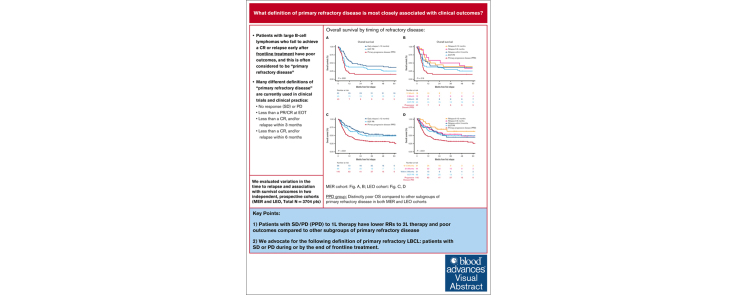
Patients with large B-cell lymphoma (LBCL) that fail to achieve a complete response (CR) or who relapse early after anthracycline-containing immunochemotherapy (IC) have a poor prognosis and are commonly considered to have "primary refractory disease." However, different definitions of primary refractory disease are used in the literature and clinical practice. In this study, we examined variation in the time to relapse used to define refractory status and association with survival outcomes in patients with primary refractory LBCL in a single-center prospective cohort with validation in an independent multicenter cohort. Patients with newly diagnosed LBCL were enrolled in the Molecular Epidemiological Resource cohort (MER; N = 949) or the Lymphoma Epidemiology of Outcomes cohort (LEO; N = 2755) from September 2002 to May 2021. Primary refractory LBCL was defined as no response (stable disease [SD]) or progressive disease (PD) during, or by the end of, frontline (1L) IC (primary PD; PPD); partial response at end of treatment (EOT PR); or relapse within 3 to 12 months after achieving CR at EOT to 1L IC (early relapse). In the MER cohort, patients with PPD had inferior overall survival (OS; 2-year OS rate: 15% MER, 31% LEO) when compared with other subgroups considered in defining primary refractory disease, EOT PR (2-year OS rate: 38% MER, 50% LEO) and early relapse (2-year OS rate: 44% MER, 58% LEO). Among patients receiving 1L IC with curative intent, we identified that patients with PPD are the key subgroup with poor outcomes. We propose a definition of primary refractory LBCL as SD or PD during, or by the end of, 1L treatment.
患有大 B 细胞淋巴瘤(LBCL)且未能达到完全缓解(CR)或在含蒽环类药物的免疫化疗(IC)后早期复发的患者预后较差,通常被认为患有“原发性难治性疾病”。然而,文献和临床实践中使用了不同的原发性难治性疾病定义。在这项研究中,我们检查了用于定义难治状态的复发时间的变化,并在单中心前瞻性队列中对原发性难治性 LBCL 患者的生存结果进行了验证,并在独立的多中心队列中进行了验证。从 2002 年 9 月至 2021 年 5 月,新诊断为 LBCL 的患者被纳入分子流行病学资源队列(MER;N=949)或淋巴瘤结局的流行病学队列(LEO;N=2755)。原发性难治性 LBCL 定义为在一线(1L)IC 期间或结束时无反应(稳定疾病[SD])或进展性疾病(PD)(原发性 PD;PPD);治疗结束时部分缓解(EOT PR);或在达到 1L IC 的 EOT 后 3 至 12 个月内复发。在 MER 队列中,与其他定义原发性难治性疾病的亚组相比,PPD 患者的总生存(OS)较差(MER 患者的 2 年 OS 率为 15%,LEO 患者为 31%),EOT PR(MER 患者的 2 年 OS 率为 38%,LEO 患者为 50%)和早期复发(MER 患者的 2 年 OS 率为 44%,LEO 患者为 58%)。在接受有治愈意向的 1L IC 的患者中,我们发现 PPD 患者是预后不良的关键亚组。我们提出了原发性难治性 LBCL 的定义,即在 1L 治疗期间或结束时出现 SD 或 PD。