Butler Tracy, Wang Xiuyuan, Chiang Gloria, Xi Ke, Niogi Sumit, Glodzik Lidia, Li Yi, Razlighi Qolamreza Ray, Zhou Liangdong, Hojjati Seyed Hani, Ozsahin Ilker, Mao Xiangling, Maloney Thomas, Tanzi Emily, Rahmouni Nesrine, Tissot Cécile, Lussier Firoza, Shah Sudhin, Shungu Dikoma, Gupta Ajay, De Leon Mony, Mozley P David, Pascoal Tharick A, Rosa-Neto Pedro
Department of Radiology, Weill Cornell Medicine, New York, NY, USA.
Translational Neuroimaging Laboratory, The McGill University Research Centre for Studies in Aging, Montréal, QC, Canada.
J Alzheimers Dis. 2024;99(1):307-319. doi: 10.3233/JAD-231312.
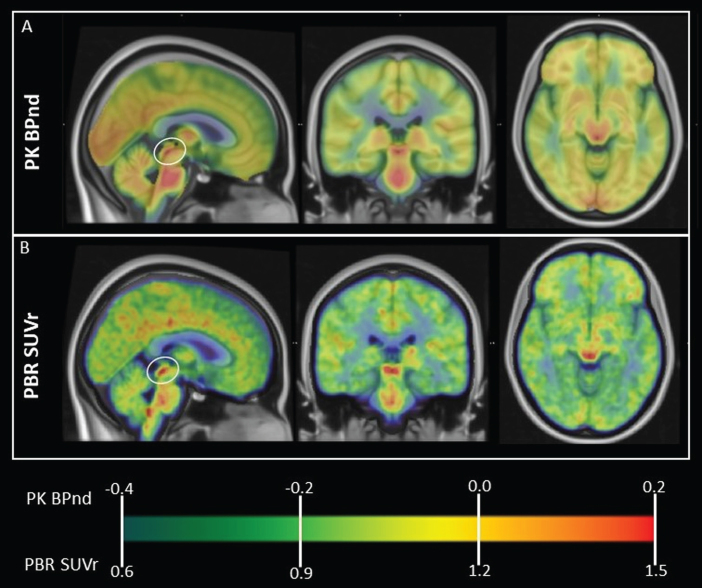
Alzheimer's disease (AD) pathology is considered to begin in the brainstem, and cerebral microglia are known to play a critical role in AD pathogenesis, yet little is known about brainstem microglia in AD. Translocator protein (TSPO) PET, sensitive to activated microglia, shows high signal in dorsal brainstem in humans, but the precise location and clinical correlates of this signal are unknown.
To define age and AD associations of brainstem TSPO PET signal in humans.
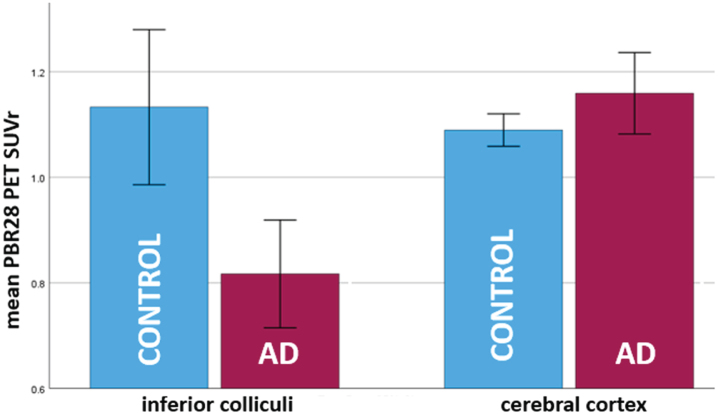
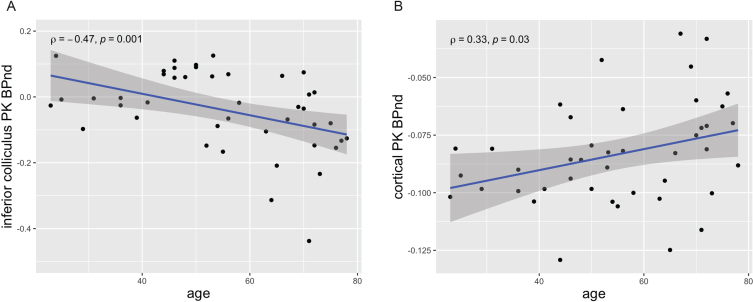
We applied new probabilistic maps of brainstem nuclei to quantify PET-measured TSPO expression over the whole brain including brainstem in 71 subjects (43 controls scanned using 11C-PK11195; 20 controls and 8 AD subjects scanned using 11C-PBR28). We focused on inferior colliculi (IC) because of visually-obvious high signal in this region, and potential relevance to auditory dysfunction in AD. We also assessed bilateral cortex.
TSPO expression was normally high in IC and other brainstem regions. IC TSPO was decreased with aging (p = 0.001) and in AD subjects versus controls (p = 0.004). In cortex, TSPO expression was increased with aging (p = 0.030) and AD (p = 0.033).
Decreased IC TSPO expression with aging and AD-an opposite pattern than in cortex-highlights underappreciated regional heterogeneity in microglia phenotype, and implicates IC in a biological explanation for strong links between hearing loss and AD. Unlike in cerebrum, where TSPO expression is considered pathological, activated microglia in IC and other brainstem nuclei may play a beneficial, homeostatic role. Additional study of brainstem microglia in aging and AD is needed.
阿尔茨海默病(AD)的病理过程被认为始于脑干,并且已知脑小胶质细胞在AD发病机制中起关键作用,但关于AD中脑干小胶质细胞的情况却知之甚少。对活化小胶质细胞敏感的转运蛋白(TSPO)PET在人类脑干背侧显示出高信号,但该信号的确切位置和临床相关性尚不清楚。
确定人类脑干TSPO PET信号与年龄及AD的关联。
我们应用脑干核团的新概率图谱,对71名受试者(43名使用11C-PK11195扫描的对照者;20名对照者和8名AD受试者使用11C-PBR28扫描)全脑(包括脑干)PET测量的TSPO表达进行量化。由于该区域视觉上明显的高信号以及与AD听觉功能障碍的潜在相关性,我们重点关注下丘(IC)。我们还评估了双侧皮质。
IC和其他脑干区域的TSPO表达通常较高。IC的TSPO随着年龄增长而降低(p = 0.001),与对照组相比,AD受试者中也降低(p = 0.004)。在皮质中,TSPO表达随着年龄增长(p = 0.030)和AD(p = 0.033)而增加。
随着年龄增长和AD,IC的TSPO表达降低——与皮质中的模式相反——突出了小胶质细胞表型中未被充分认识的区域异质性,并暗示IC在听力损失与AD之间的紧密联系的生物学解释中起作用。与大脑中TSPO表达被认为是病理性的情况不同,IC和其他脑干核团中活化的小胶质细胞可能发挥有益的稳态作用。需要对衰老和AD中的脑干小胶质细胞进行更多研究。