Rusciano Dario, Russo Cristina
Fidia Research Centre, c/o University of Catania, Via Santa Sofia 89, 95123 Catania, Italy.
Department of Biomedical and Biotechnological Sciences, University of Catania, Via Santa Sofia 89, 95123 Catania, Italy.
Pharmaceuticals (Basel). 2024 Mar 29;17(4):441. doi: 10.3390/ph17040441.
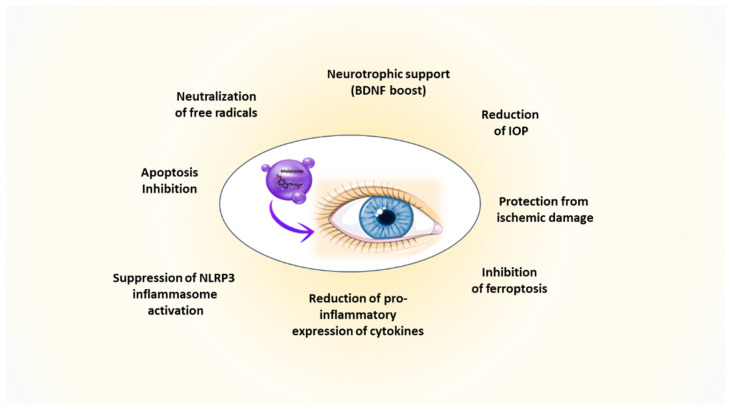
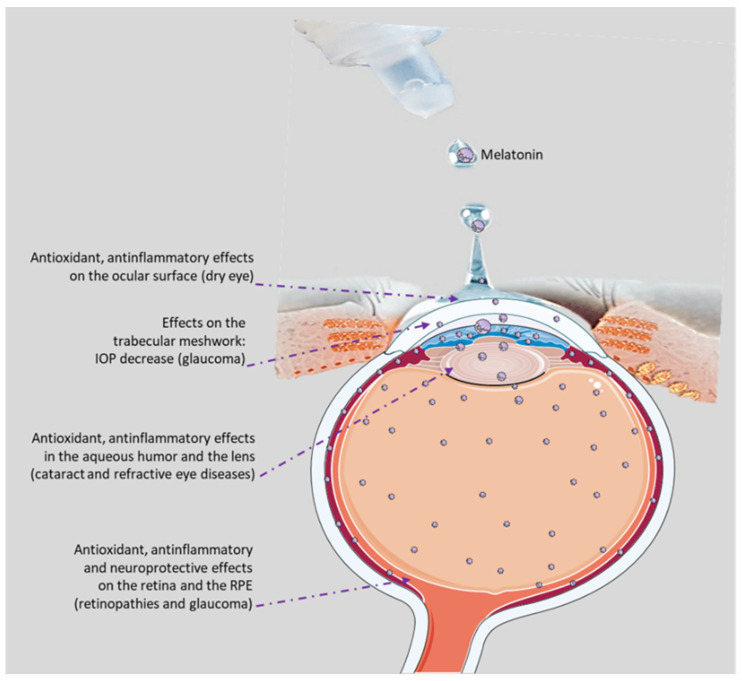
Melatonin is a ubiquitous molecule found in living organisms, ranging from bacteria to plants and mammals. It possesses various properties, partly due to its robust antioxidant nature and partly owed to its specific interaction with melatonin receptors present in almost all tissues. Melatonin regulates different physiological functions and contributes to the homeostasis of the entire organism. In the human eye, a small amount of melatonin is also present, produced by cells in the anterior segment and the posterior pole, including the retina. In the eye, melatonin may provide antioxidant protection along with regulating physiological functions of ocular tissues, including intraocular pressure (IOP). Therefore, it is conceivable that the exogenous topical administration of sufficiently high amounts of melatonin to the eye could be beneficial in several instances: for the treatment of eye pathologies like glaucoma, due to the IOP-lowering and neuroprotection effects of melatonin; for the prevention of other dysfunctions, such as dry eye and refractive defects (cataract and myopia) mainly due to its antioxidant properties; for diabetic retinopathy due to its metabolic influence and neuroprotective effects; for macular degeneration due to the antioxidant and neuroprotective properties; and for uveitis, mostly owing to anti-inflammatory and immunomodulatory properties. This paper reviews the scientific evidence supporting the use of melatonin in different ocular districts. Moreover, it provides data suggesting that the topical administration of melatonin as eye drops is a real possibility, utilizing nanotechnological formulations that could improve its solubility and permeation through the eye. This way, its distribution and concentration in different ocular tissues may support its pleiotropic therapeutic effects.
褪黑素是一种在生物体内普遍存在的分子,存在于从细菌到植物和哺乳动物等各类生物中。它具有多种特性,部分归因于其强大的抗氧化性质,部分则归功于它与几乎所有组织中存在的褪黑素受体的特异性相互作用。褪黑素调节不同的生理功能,并有助于整个生物体的稳态。在人眼中,也存在少量褪黑素,由眼前段和后极的细胞产生,包括视网膜。在眼睛中,褪黑素可能提供抗氧化保护,同时调节眼组织的生理功能,包括眼压(IOP)。因此,可以想象,向眼睛局部外用足够高剂量的褪黑素在几种情况下可能是有益的:用于治疗青光眼等眼部疾病,因为褪黑素具有降低眼压和神经保护作用;用于预防其他功能障碍,如干眼症和屈光缺陷(白内障和近视),主要是由于其抗氧化特性;用于治疗糖尿病视网膜病变,因其具有代谢影响和神经保护作用;用于治疗黄斑变性,因其具有抗氧化和神经保护特性;以及用于治疗葡萄膜炎,主要是由于其抗炎和免疫调节特性。本文综述了支持褪黑素在不同眼部区域应用的科学证据。此外,它提供的数据表明,利用纳米技术制剂将褪黑素制成眼药水进行局部给药是切实可行的,这可以提高其在眼中的溶解度和渗透率。通过这种方式,其在不同眼组织中的分布和浓度可能支持其多效性治疗效果。