Department of Brain Sciences, Daegu-Gyeongbuk Institute of Science and Technology (DGIST), Daegu 42988, Republic of Korea.
National Primate Research Center, Korea Research Institute of Bioscience and Biotechnology (KRIBB), Cheongju 28116, Republic of Korea.
eNeuro. 2024 May 23;11(5). doi: 10.1523/ENEURO.0151-24.2024. Print 2024 May.
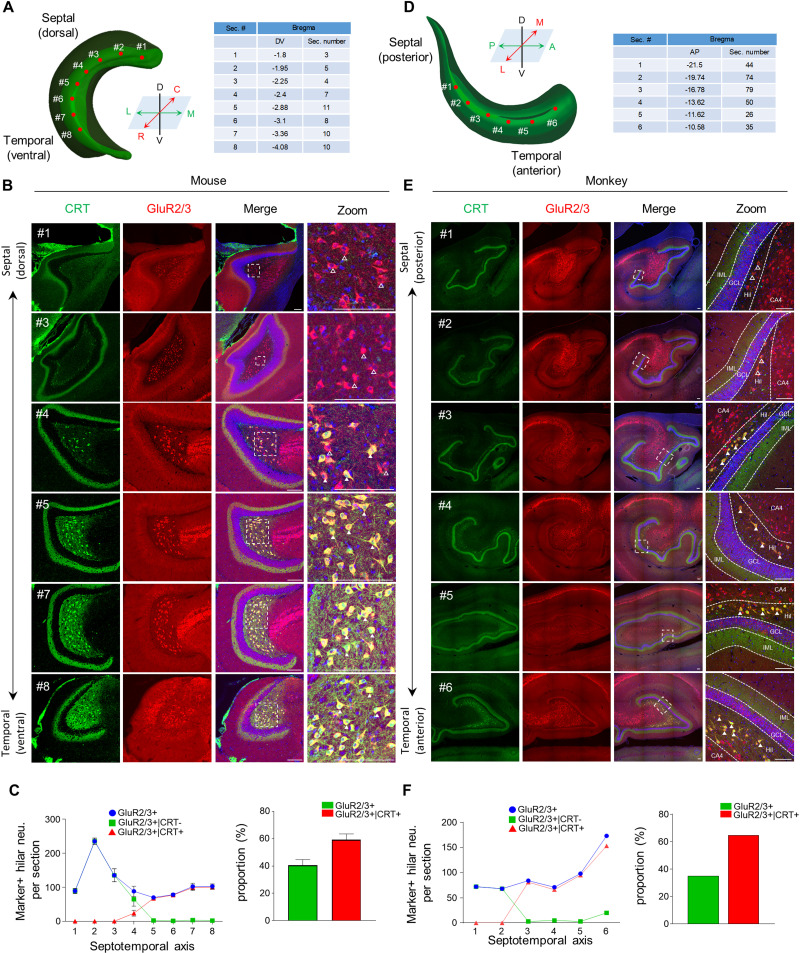
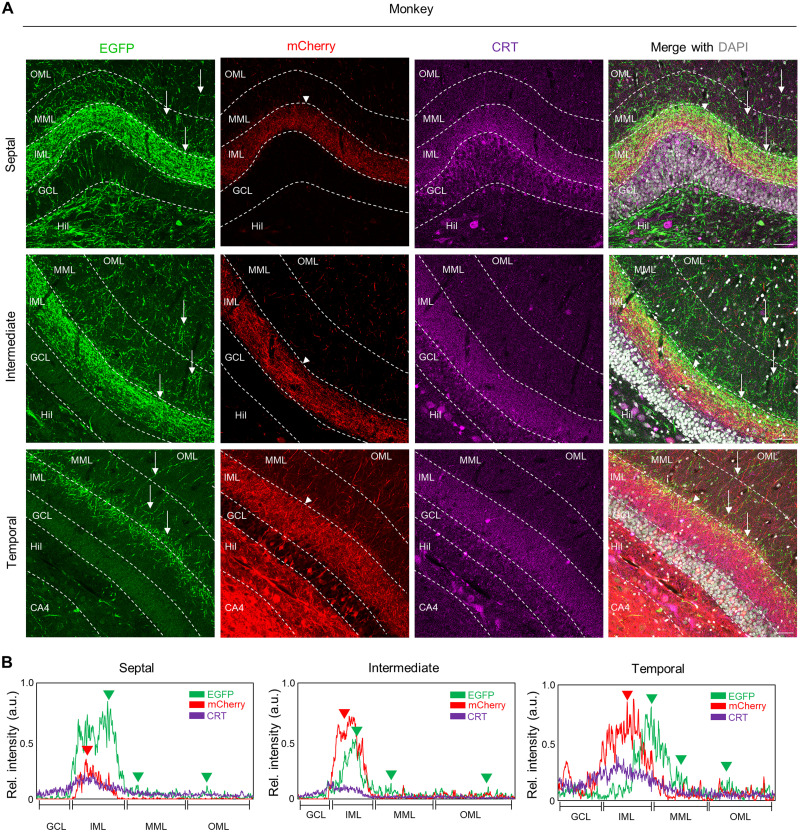
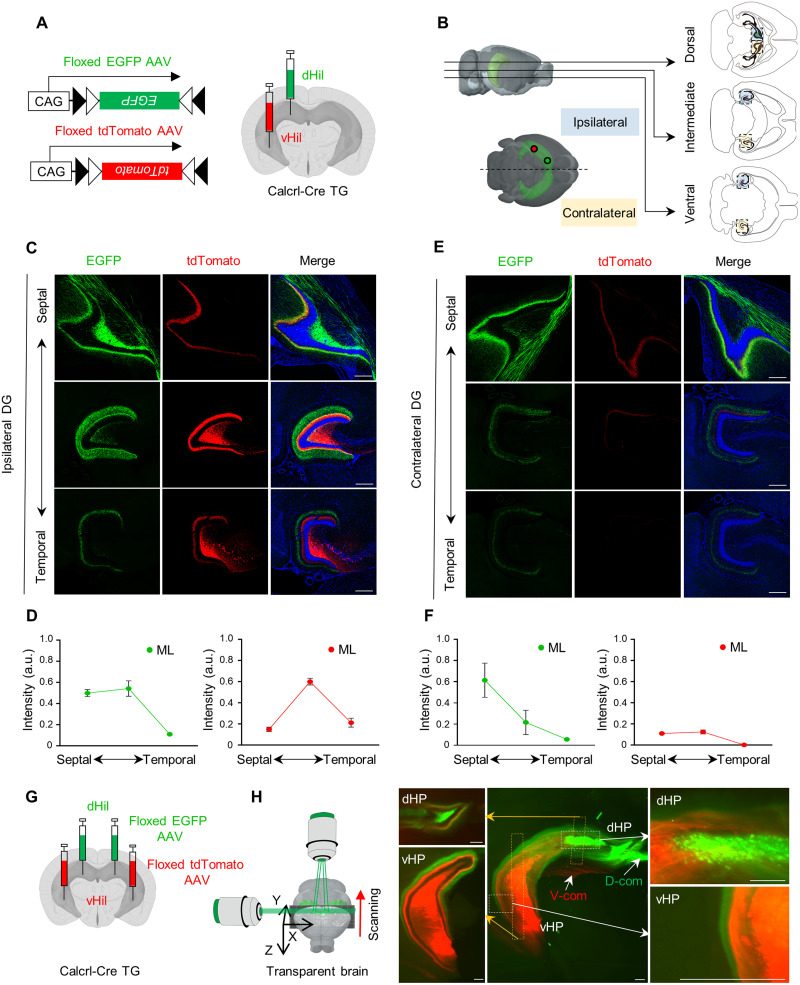
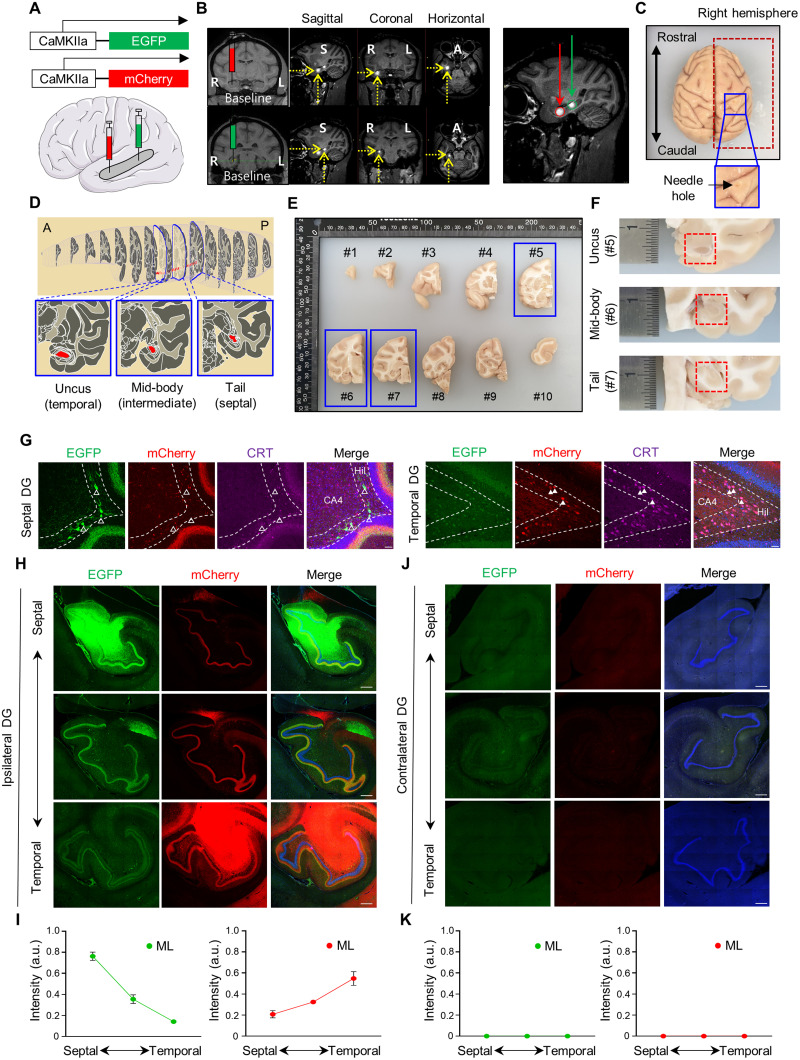
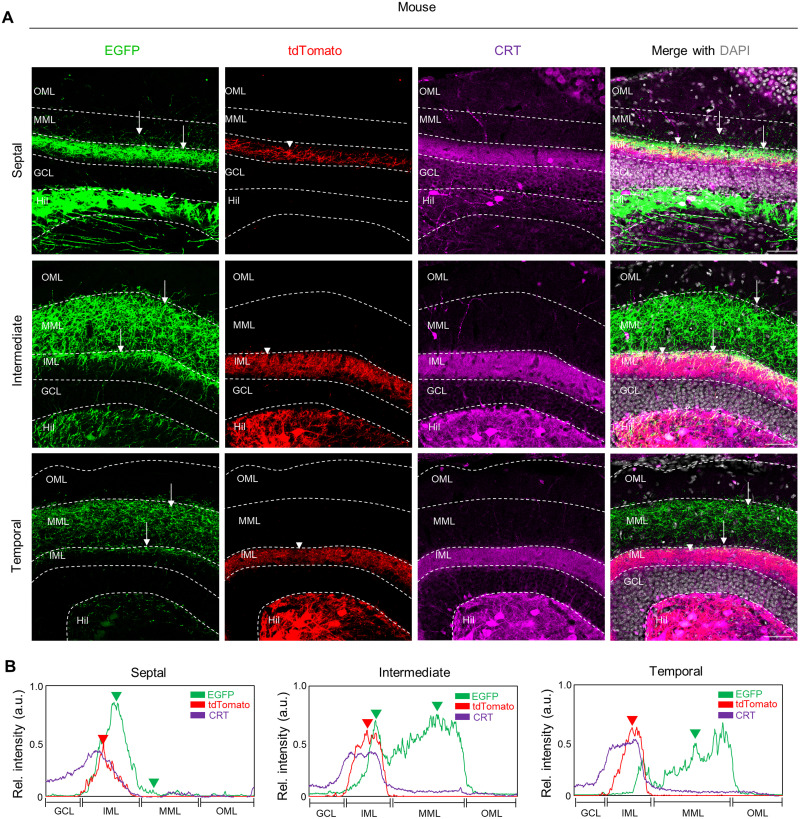
Glutamatergic mossy cells (MCs) mediate associational and commissural connectivity, exhibiting significant heterogeneity along the septotemporal axis of the mouse dentate gyrus (DG). However, it remains unclear whether the neuronal features of MCs are conserved across mammals. This study compares the neuroanatomy of MCs in the DG of mice and monkeys. The MC marker, calretinin, distinguishes two subpopulations: septal and temporal. Dual-colored fluorescence labeling is utilized to compare the axonal projection patterns of these subpopulations. In both mice and monkeys, septal and temporal MCs project axons across the longitudinal axis of the ipsilateral DG, indicating conserved associational projections. However, unlike in mice, no MC subpopulations in monkeys make commissural projections to the contralateral DG. In monkeys, temporal MCs send associational fibers exclusively to the inner molecular layer, while septal MCs give rise to wide axonal projections spanning multiple molecular layers, akin to equivalent MC subpopulations in mice. Despite conserved septotemporal heterogeneity, interspecies differences are observed in the topological organization of septal MCs, particularly in the relative axonal density in each molecular layer along the septotemporal axis of the DG. In summary, this comparative analysis sheds light on both conserved and divergent features of MCs in the DG of mice and monkeys. These findings have implications for understanding functional differentiation along the septotemporal axis of the DG and contribute to our knowledge of the anatomical evolution of the DG circuit in mammals.
谷氨酸能苔藓纤维细胞 (MCs) 介导联合和连合连接,在小鼠齿状回 (DG) 的隔-颞轴上表现出显著的异质性。然而,MCs 的神经元特征是否在哺乳动物中保守仍不清楚。本研究比较了小鼠和猴子 DG 中 MCs 的神经解剖结构。MC 标志物钙视网膜蛋白 (calretinin) 将两个亚群区分开来:隔区和颞区。使用双色荧光标记来比较这些亚群的轴突投射模式。在小鼠和猴子中,隔区和颞区 MCs 沿同侧 DG 的长轴投射轴突,表明存在保守的联合投射。然而,与小鼠不同的是,猴子中没有 MC 亚群向对侧 DG 进行连合投射。在猴子中,颞区 MCs 仅将联合纤维投射到内分子层,而隔区 MCs 则产生广泛的轴突投射,跨越多个分子层,类似于小鼠中的等效 MC 亚群。尽管存在隔-颞异质性的保守性,但在隔区 MCs 的拓扑组织中观察到种间差异,特别是在 DG 隔-颞轴上每个分子层中的相对轴突密度。总之,这项比较分析揭示了小鼠和猴子 DG 中 MCs 的保守和分歧特征。这些发现对于理解 DG 隔-颞轴上的功能分化具有重要意义,并为我们对哺乳动物 DG 回路的解剖进化的认识做出了贡献。