Department of Emergency, The Affiliated Hospital of Guizhou Medical University, Guizhou Medical University, Guiyang, 550004, China.
School of Basic Medical Sciences, Guizhou Medical University, Guiyang, 550025, China.
BMC Public Health. 2024 May 2;24(1):1211. doi: 10.1186/s12889-024-18686-5.
To investigate the correlation between socioeconomic status (SES) and the incidence of hypertension among adults aged 18 or above in southwest China.
A multistage proportional stratified cluster sampling method was employed to recruited 9280 adult residents from 12 counties in southwest China, with all participants in the cohort tracked from 2016 to 2020. The questionnaire survey gathered information on demographics, lifestyle habits, and household income. The physical exam recorded height, weight, and blood pressure. Biochemical tests measured cholesterol levels. The chi-square test was employed to assess the statistical differences among categorical variables, while the Cox proportional hazards regression model was applied to evaluate the association between socioeconomic status (SES) and the incidence of hypertension.
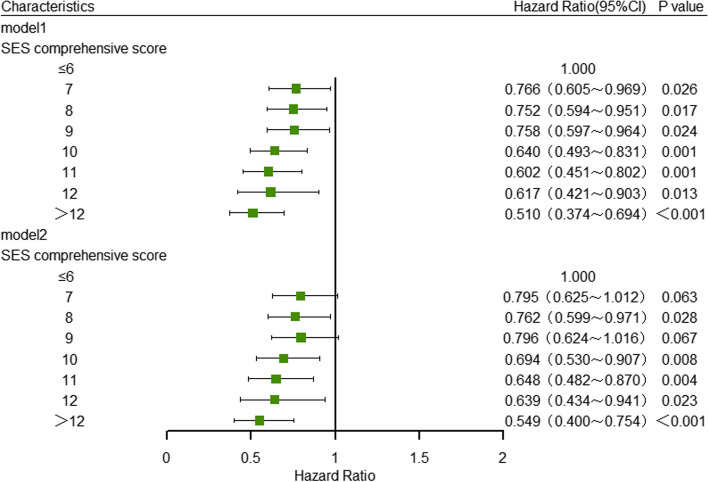
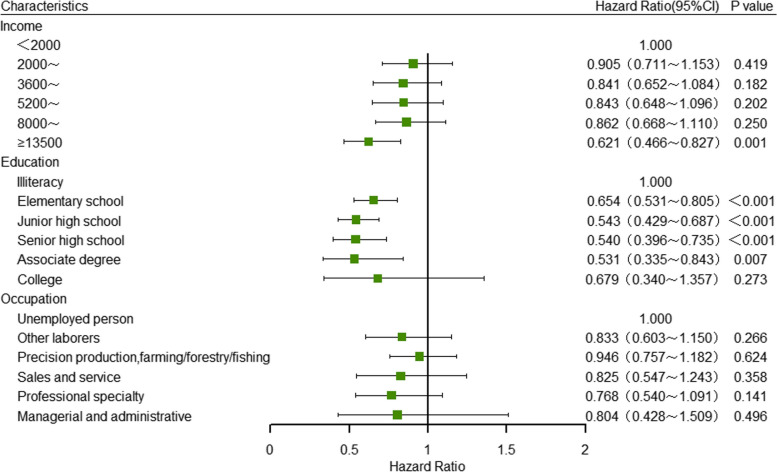
The finally effective sample size for the cohort study was 3546 participants, after excluding 5734 people who met the exclusion criteria. Adults in the highest household income group had a significantly lower risk of hypertension compared to those in the lowest income group (HR = 0.636, 95% CI: 0.478-0.845). Besides, when compared to individuals in the illiterate population, the risk of hypertension among adults with elementary school, junior high school, senior high school and associate degree educational level decreased respectively by 34.4% (HR = 0.656, 95%CI: 0.533-0.807), 44.9% (HR = 0.551, 95%CI: 0.436-0.697), 44.9% (HR = 0.551, 95%CI: 0.405-0.750), 46.1% (HR = 0.539, 95%CI: 0. 340-0.854). After conducting a thorough analysis of socioeconomic status, compared with individuals with a score of 6 or less, the risk of hypertension in participants with scores of 8, 10, 11, 12, and greater than 12 decreased respectively by 23.9% (HR = 0.761, 95%CI: 0.598-0.969), 29.7% (HR = 0.703, 95%CI: 0.538-0.919), 34.0% (HR = 0.660, 95%CI: 0.492-0.885), 34.3% (HR = 0.657, 95%CI: 0.447-0.967), 43.9% (HR = 0.561, 95%CI: 0.409-0.769).
The findings indicate a negative correlation between socioeconomic status and hypertension incidence among adults in southwest China, suggesting that individuals with higher socioeconomic status are less likely to develop hypertension.
调查中国西南地区 18 岁及以上成年人的社会经济地位(SES)与高血压发病率之间的相关性。
采用多阶段分层比例聚类抽样方法,从中国西南地区的 12 个县招募了 9280 名成年居民,对所有队列参与者进行了从 2016 年到 2020 年的追踪研究。问卷调查收集了人口统计学、生活方式习惯和家庭收入等信息。体格检查记录了身高、体重和血压。生化测试测量了胆固醇水平。采用卡方检验评估分类变量之间的统计学差异,同时采用 Cox 比例风险回归模型评估社会经济地位(SES)与高血压发病之间的关联。
经过排除 5734 名不符合纳入标准的人群后,本队列研究的最终有效样本量为 3546 人。与收入最低的人群相比,家庭收入最高组人群的高血压发病风险显著降低(HR=0.636,95%CI:0.478-0.845)。此外,与文盲人群相比,小学、初中、高中和大专学历人群的高血压发病风险分别降低了 34.4%(HR=0.656,95%CI:0.533-0.807)、44.9%(HR=0.551,95%CI:0.436-0.697)、44.9%(HR=0.551,95%CI:0.405-0.750)、46.1%(HR=0.539,95%CI:0.340-0.854)。在对社会经济地位进行全面分析后,与得分 6 分及以下的人群相比,得分 8 分、10 分、11 分和 12 分及以上的人群的高血压发病风险分别降低了 23.9%(HR=0.761,95%CI:0.598-0.969)、29.7%(HR=0.703,95%CI:0.538-0.919)、34.0%(HR=0.660,95%CI:0.492-0.885)、34.3%(HR=0.657,95%CI:0.447-0.967)和 43.9%(HR=0.561,95%CI:0.409-0.769)。
研究结果表明,中国西南地区成年人的社会经济地位与高血压发病率呈负相关,提示社会经济地位较高的人群发生高血压的风险较低。